Hexagonal Boron Nitride Market Outlook:
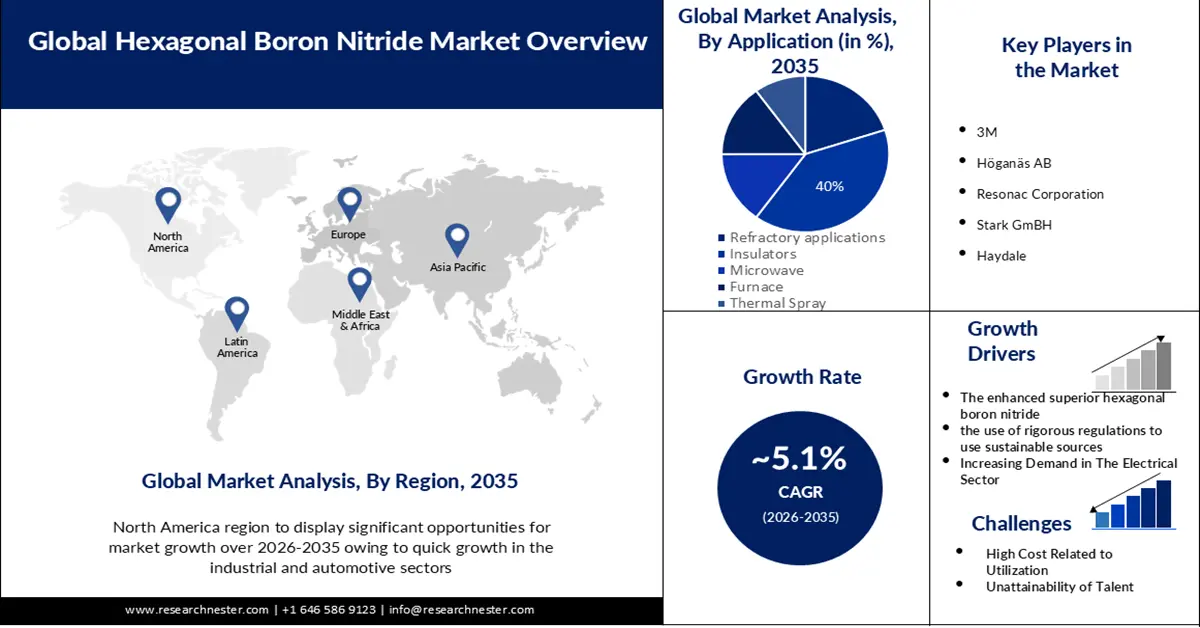
Hexagonal Boron Nitride Market size was valued at USD 957.54 million in 2025 and is expected to reach USD 1.57 billion by 2035, expanding at around 5.1% CAGR during the forecast period i.e., between 2026-2035. In the year 2026, the industry size of hexagonal boron nitride is evaluated at USD 1 billion.
The enhanced superior hexagonal boron nitride will propel the primary reason behind the growth of the hexagonal boron nitride market. hBN is a morphological opposite of graphite with a similar number of boron (B) and nitrogen (N) atoms instead placed in a two-dimensional layer kept together by weak van der Waals forces and changing B and N atoms interrelated by powerful chemical bonds. Currently, revealed deposition techniques for increasing large-area single-crystalline (SC) hBN films can advance these bottlenecks and have opened roads for the latest scopes.
Another reason that will propel the hexagonal boron nitride market by the end of 2036 is the use of rigorous regulations to use sustainable sources. For instance, the largest renewability enterprise, the EU’s Green Deal, uncovered in 2019, is an all-inclusive policy structure concentrated on making Europe the globe’s first climate-neutral continent by 2050. Among its targets are limiting greenhouse gas emissions, rising energy effectiveness, and generating circular economy practices. In addition to these rules, the EU also gives financial support for renewable projects through its Horizon Europe research and creation program. Horizon Europe has a resource of USD 95.5 billion for the range of 2021-2027, and a substantial part of this funding will be utilized to assist research and innovation in fields like climate change limitation, sustainable energy, and renewable agriculture. The United States conventionally has a more developed technique to rules, with federal, state, and local governments all acting in essential roles.