Hemorrhoid Drugs Market - Regional Analysis
North America Market Insights
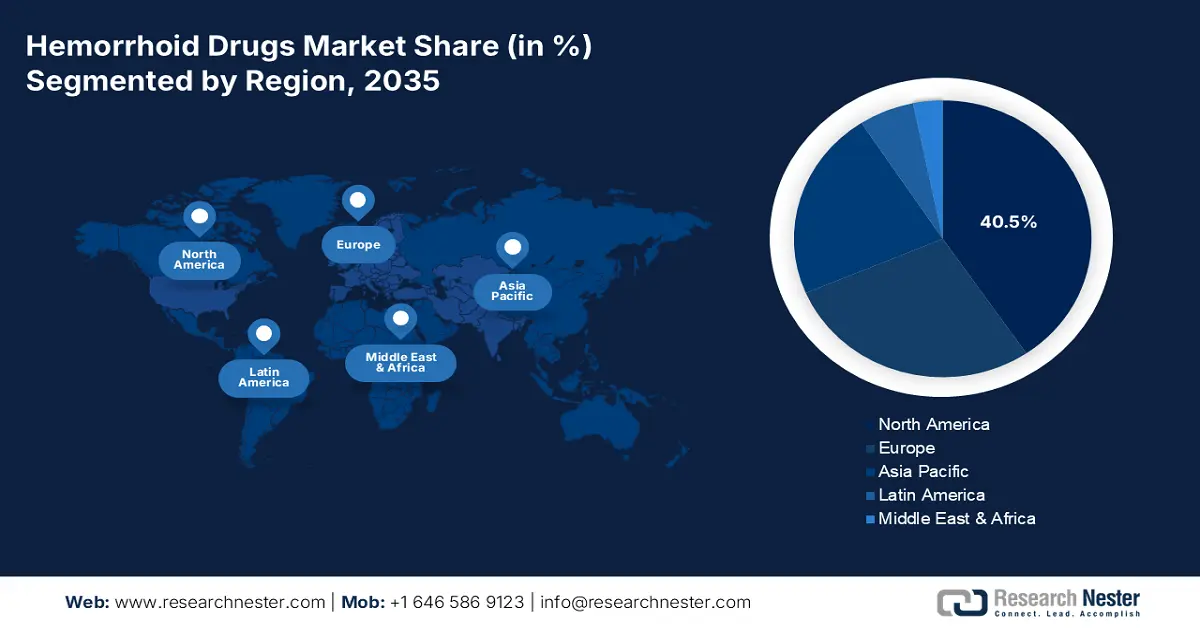
North America is anticipated to account for the highest share of 40.5% in the hemorrhoid drugs market by the end of 2035. The market’s upliftment in the overall region is primarily attributed to an increase in the disease prevalence, expansion in healthcare funding, and supportive government policies. For instance, according to an article published by the KFF Organization in May 2025, the international health fund in the U.S. was offered an ongoing resolution by maintaining the prior year's amount of USD 12.4 billion. Besides, the presence of Medicaid and Medicare has readily expanded its health insurance, covering hemorrhoid drug reimbursements, thus suitable for the market’s growth.
Historical Period of the U.S. Global Health Funding
|
Years |
Regular Appropriations (USD Billion) |
Emergency Supplement Funding (USD Billion) |
|
2016 |
10.5 |
- |
|
2017 |
10.7 |
- |
|
2018 |
10.9 |
- |
|
2019 |
10.9 |
- |
|
2020 |
12.5 |
1.2 |
|
2021 |
21.0 |
9.4 |
|
2022 |
12.2 |
- |
|
2023 |
12.9 |
- |
|
2024 |
12.4 |
- |
|
2025 |
12.4 |
- |
Source: KFF Organization
The hemorrhoid drugs market is set to rise in the U.S. with a rising prevalence of anorectal disorders, mostly seen in aging people and their lifestyle factors. As per a data report published by the CDC in October 2024, the per capita national health spending amounts to USD 11,582, with the overall expenditure being USD 3.8 trillion. In addition, the total health expenditure in terms of the gross domestic product (GDP) is 17.7%. Besides, the domestic health spending for care in retirement communities as well as nursing care facilities constitutes 4.5%, along with 3.0% for home healthcare, 20.3% for clinical and physician services, and 9.7% for retail prescription drugs, thereby bolstering the market’s growth in the country.
The hemorrhoid drugs market in Canada is also growing significantly, owing to the existence of the universal public healthcare system to govern cost-control and drug accessibility. In addition, an increase in the dependency on provincial drug formulations to administer treatment pathways, a focus on affordable generic and OTC prescriptions, and direct federal provision of funds are also responsible for the market’s development. Besides, according to an article published by the Government of Canada in November 2022, there has been an announcement of offering USD 5 million to provide intense support for patients residing with rare pain and to expand the Pain Canada Network, which is suitable for uplifting the market.
APAC Market Insights
Asia Pacific in the hemorrhoid drugs market is projected to emerge as the fastest-growing region during the predicted timeline. The market’s development in the region is driven by the huge population base, an increase in health and medical accessibility, and a rise in risk factors, such as urbanization and sedentary lifestyles. For instance, in developed economies, such as South Korea and Japan, the aging population is one of the primary drivers, while in India and China, the market is growing due to a surge in diagnosis rates and health awareness. Besides, governments across the entire region are making healthcare provisions, which benefits the market by optimizing accessibility to treatment options.
The hemorrhoid drugs market in China is gaining increased traction, owing to the massive population and improvements in healthcare facilities. In addition, the National Medical Products Administration (NMPA) has readily streamlined drug acceptances, along with an increase in the availability of both global and national treatment options. According to an article published by NLM in June 2022, the prevalence of constipation in the country ranges between 3% to 11%, with 13% to 32.6% prevalence among the elderly population. Therefore, with the objective of combating these incidents, there is a huge demand for the market in the overall country.
The hemorrhoid drugs market in India is also developing due to an upsurge in disease awareness, along with the presence of an underserved and large population. In addition, the development of governmental schemes, such as Ayushman Bharat, has optimized accessibility to healthcare, thereby driving the increasing demand for pharmaceuticals. Besides, as stated in the April 2025 NLM article, a clinical study was conducted on 3,689 patients in the country to evaluate gastrointestinal mobility disorder. This resulted in 55% patients with mild symptoms, 33% with mild, and 8% with critical symptoms, which is readily boosting the market’s demand in the country.
Europe Market Insights
Europe in the hemorrhoid drugs market is also projected to grow steadily by the end of the forecast duration. The market’s growth in the overall region is fueled by an increase in aging demographics, an upsurge in health and medical spending, and a rising incidence of hemorrhoidal disease. Additionally, a significant budget allocation by the region’s countries for their healthcare budgets to hemorrhoid treatments, which makes the market grow in demand. The region has prioritized access through funding and innovation to hemorrhoid therapies, with funding exceeding and supporting R&D related to the pharmaceutical sector. The key drivers are government-related healthcare programs, patient awareness, and reimbursement policies.
The hemorrhoid drug market in Germany is gaining increased exposure, owing to investments in pharmaceutical innovation, and reimbursement policies are supported by the Federal Ministry of Health to meet the market demand. The country is considered the largest market in Europe, as it has an extensive healthcare infrastructure and an aging population. The aging population in the nation contributes to the rise in disease prevalence and increases the need for effective treatments. Some innovative formulations enhance the appeal, for instance, minimally invasive drug delivery systems and natural extract-based formulations market the market.
The hemorrhoid drug market in France is also growing, owing to its wide-ranging and state-funded healthcare system that provides extended reimbursement for pharmaceuticals. This particular system has lowered the financial gap for patients, and encouraged treatment-seeking behavior, along with ensuring high volume sales. Besides, according to an article published by Leem Organization in June 2025, the R&I spending in the country remained unchanged, amounting to €5.9 billion as of 2024. In addition, the country also remains the region’s third-best nation for conducting clinical trials, thereby making it suitable for the hemorrhoid drugs market’s growth.