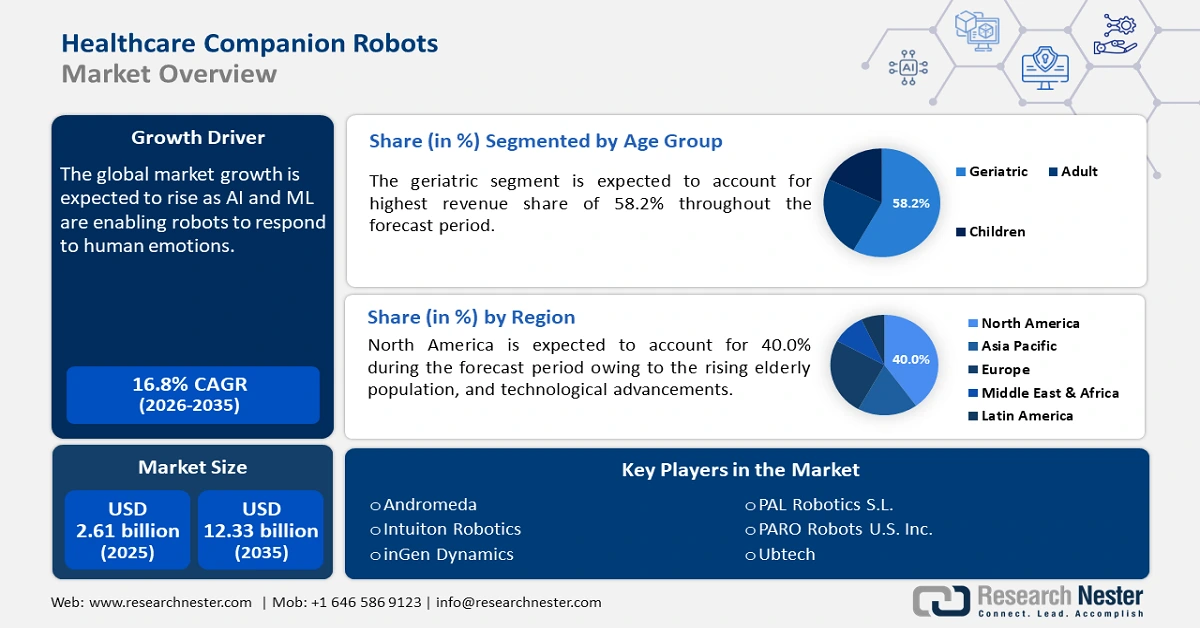
Healthcare Companion Robots Market Outlook:
Healthcare Companion Robots Market size was over USD 2.61 billion in 2025 and is poised to exceed USD 12.33 billion by 2035, witnessing over 16.8% CAGR during the forecast period i.e., between 2026-2035. In the year 2026, the industry size of healthcare companion robots is estimated at USD 3 billion.
Increasing demand for home healthcare, demand for automation in medical services, and advancements in AI are significantly driving the global market growth. Additionally, the rising geriatric population, urbanization, changing lifestyle, and lack of time are also boosting the healthcare companion robots market growth.
The worldwide healthcare system is seeking solutions to manage rising patient loads, provide personalized healthcare, and reduce costs. Regions such as North America, Europe, and parts of Asia, where aging populations are prominent, are showcasing rising acceptance of healthcare companion robots for assistance. In addition, robotics advancements have led to enhancements in mobility and additional capabilities, allowing robotic assistance in a wider range of physical tasks. This comprises navigation ability for complex home settings and performing satisfactory motor tasks including object handling and personal care help. For instance, Humanoid robot company 1X announced the launch of a Neo Beta bipedal humanoid robot designed for home use, in September 2024.