Hardware-in-the-Loop Market - Regional Analysis
North America Market Insights
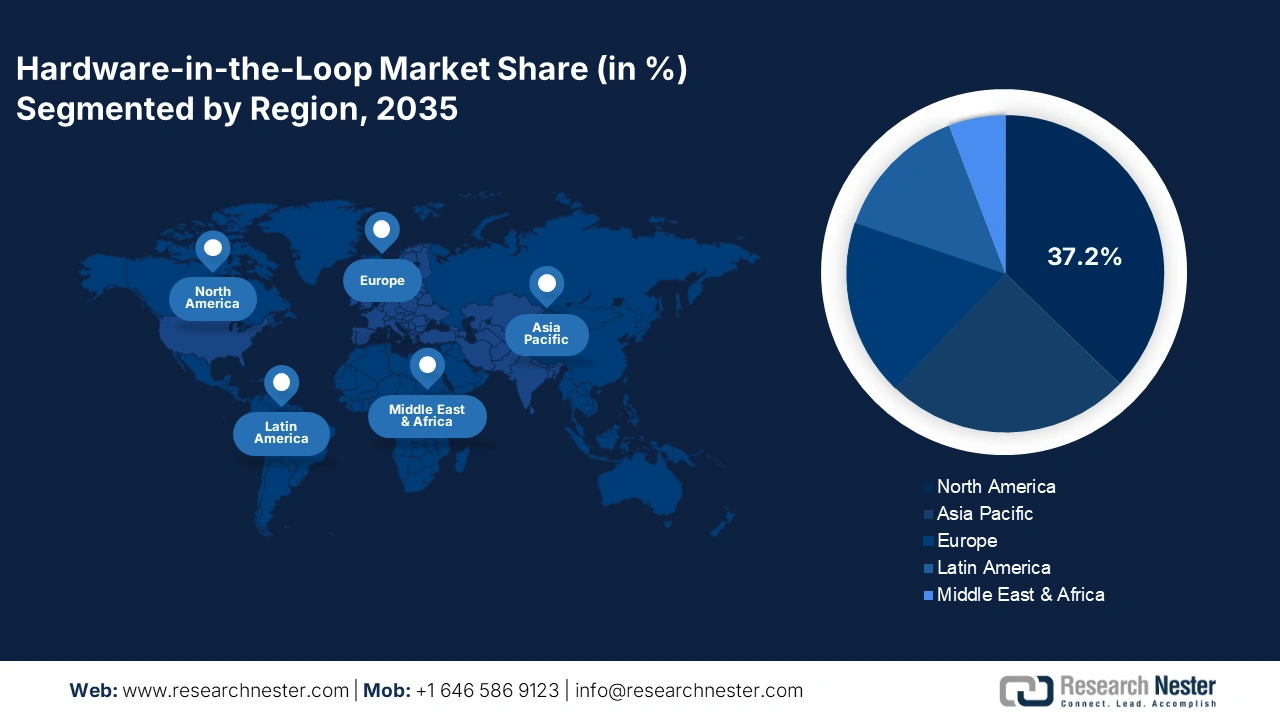
The North America hardware-in-the-loop market is estimated to hold 37.2% of the global revenue share through 2035. The growing adoption of real-time system simulation in the aerospace, automotive, and industrial automation sectors is contributing to the high sales of HIL solutions. The supportive government policies are also accelerating the employment of HIL solutions. These investment moves are expected to lay the groundwork for technologies, including HIL. The telecom and automotive industries are driving high sales of HIL platforms.
The market for hardware-in-the-loop in the U.S. is projected to capture a notable share by the end of 2035. The ongoing research and development activities in the defense, automotive, and semiconductor industries are set to fuel the employment of HIL platforms in the coming years. The rapid rise in digital infrastructure and industrial automation is creating a profitable environment for hardware-in-the-loop components manufacturers. The swift expansion of the telecommunication sector is also playing a vital role in the commercialization of the HIL solutions.
The sale of HiL solutions in Canada is expected to increase throughout the forecast period. The digitalization of industrial infrastructure and automotive innovation are fueling the HIL solution trade in the country. The market is witnessing growth as industries like clean energy, power transmission, and utility grid infrastructure increasingly require real-time validation for control and protection systems. Regulatory pressure, plus the shift toward electrification and renewable energy, is pushing utilities and OEMs in Canada to adopt HiL to avoid costly failures and accelerate deployment.
Additionally, technology innovation centres, simulation facilities, and government grants are supporting local HiL adoption, making it more accessible to SMEs and large enterprises alike. Hitachi Energy Canada received USD 21.59 million from the federal government for constructing a new HVDC simulation centre in Montreal and to modernize its transformer factory in Varennes. This facility will enable real-time simulation of HVDC systems to test control and protection systems before actual installation.
APAC Market Insights
The Asia Pacific hardware-in-the-loop market is anticipated to increase at a robust CAGR of 10.7% between 2026 and 2035. The strong presence of end users such as automotive, electronics, aerospace, and energy is propelling the adoption of hardware-in-the-loop platforms. The automation and digitalization trend is accelerating the demand for HIL solutions in the region. Japan and South Korea’s precision in technological advancements are set to drive the sales of innovative HIL solutions.
China, being a hub for semiconductor and other electronic component manufacturing, is likely to drive the sales of HIL solutions in the years ahead. The government's digital transformation strategies are expected to open new opportunities for hardware-in-the-loop component manufacturers in the country. Furthermore, the government's efforts to streamline hardware-software integration through standards and subsidies are estimated to boost the adoption curve.
The India market for hardware-in-the-loop is expected to expand notably through 2035. The rise in public-private investments for R&D, advancements in semiconductor manufacturing, and booming automotive trade are set to increase the revenue shares of HIL manufacturers. The auto makers are increasingly using HIL platforms for EV powertrain testing purposes. The Digital India and Semicon India initiatives are also contributing to the overall market growth. The modernization of the aerospace and defense sector is poised to offer profits to HIL producers in the years ahead.
Europe Market Insights
Europe is expected to register rapid growth during the forecast period owing to stringent automotive safety and emissions regulations, strong aerospace & defense sectors, and commitment to electrification & renewable energy. The regulatory regimes, such as Euro NCAP, EU CCAM roadmaps, and emissions directives, demand extensive testing, including edge cases, which pushes OEMs and Tier-1 suppliers to adopt HIL. Also, many European countries subsidize R&D, and there is a solid base of skilled engineering workforce and centres of excellence. The rise of electric vehicles mandates testing of battery, inverter, and thermal management systems under varied loads, which HIL enables more cheaply, reliably, and early. In February 2024, NORDEX SE in Europe introduced a new power Hardware-in-the-Loop (PHIL) test bench developed by R&D Test Systems, to do grid compliance testing of electric drivetrains, allowing simulation of diverse grid conditions and fault scenarios in the lab instead of field testing.
The UK HiL market is growing rapidly as the country pushes toward a low-carbon automotive future, greater electrification, and deployment of connected/autonomous vehicle systems, and the need to secure telecoms and infrastructure. Government funding, labs, test facilities, and policy initiatives are helping firms and universities build better HIL infrastructure. Also, efforts to increase domestic testing and lower dependence on overseas proving grounds motivate investment in local lab infrastructure. For instance, in May 2024, Fortescue acquired a UK automotive test lab in Banbury, previously owned by Arrival, to bolster its in-house prototype R&D and testing for electrification. The site includes test cells, battery development area, EMC chamber, etc., which are relevant for HIL-type testing of drive units, control units, etc.
Germany remains one of the leading HIL markets in Europe, driven by its large automotive OEMs, strong Tier-1 supplier base, and robust industrial and automotive R&D ecosystem. German firms are at the forefront of electrification, autonomous driving, ADAS sensor development, and aerospace systems, all of which require extensive hardware-software integration testing in real-time. In addition, the country’s push in industrial automation, robotics, and mechatronics further supports the growth of HIL systems.