Solar Charged Jacket Market - Regional Analysis
North America Market Insights
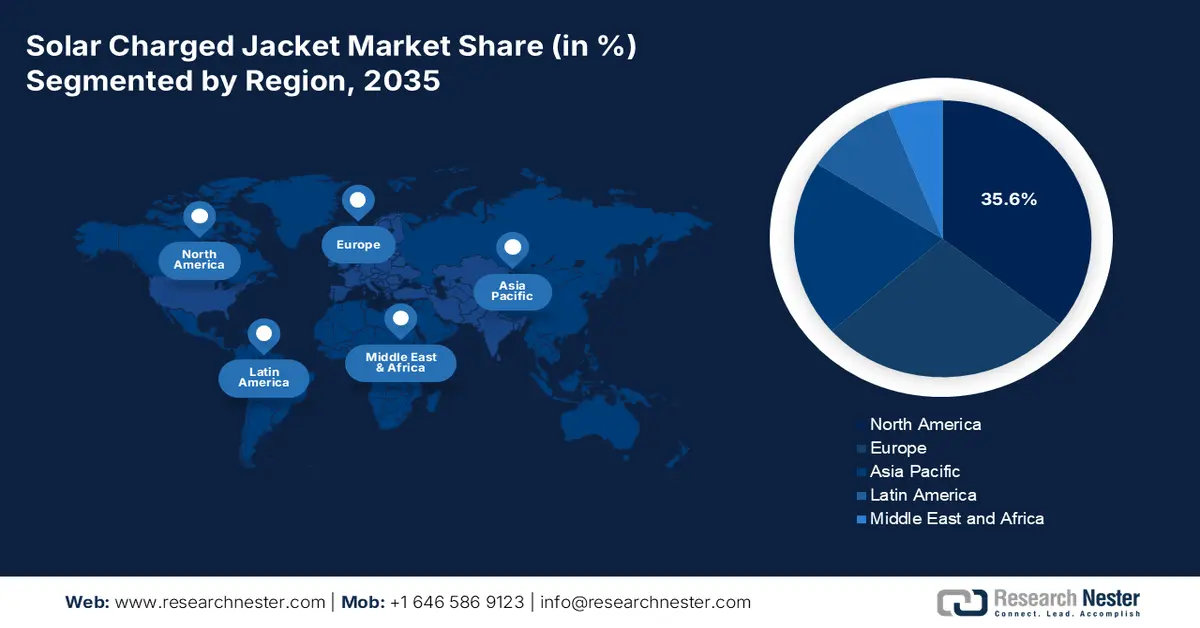
North America is dominating the solar charged jacket market and is expected to hold the share of 35.6% by 2035. The solar charged jacket market is driven by the advanced consumer adoption, significant R&D investment, and a strong alignment with the federal priorities in defense, emergency preparedness, and outdoor recreation. The U.S., as the dominant force, drives innovation via the Department of Defense funding for soldier modernization and the Department of Energy support for flexible photovoltaics. A robust outdoor recreation economy valued at over USD 1.1 trillion in output by the Outdoor Recreation Roundtable in November 2023 creates a substantial consumer base for the high-tech gear. In Canada, the federal strategies for Arctic sovereignty are remote community resilience, coupled with the provincial investments in emergency management for climate related disaster shape the demand.
The solar charged jacket market in the U.S. is propelled by the substantial federal spending targeting energy resilience and operational independence for the key personnel. The Department of Defense’s focus on reducing the logistical battery burden for dismounted soldiers, as evidenced by programs such as the Integrated Visual Augmentation System, creates direct procurement potential. Further, the agency grants from FEMA’s Homeland Security Grant Program that allocated USD 1.12 billion in 2023 for emergency preparedness, funds equipment for the first responders, where solar-charged gear enhances the mission endurance during the prolonged outages. Demand is bifurcating between professional-grade applications for defense and emergency services and premium products for the high-value outdoor consumer segment.
In Canada, the solar-charged jacket market is shaped by the geographic necessity and federal climate adaptation strategies. The key drivers include operations in the Arctic supported by the Polar Continental Shelf Program and enhancing the resilience of the remote and indigenous communities vulnerable to grid disruptions. The public safety in Canada’s Disaster Financial Assistance Arrangements and investments in wildfire management following a record-breaking season prioritize equipment that ensures the communication and safety for first responders in the extended field deployments. The mandate for greening government operations also encourages the procurement of renewable energy solutions for field staff. One major development is the emphasis on low-light and cold-weather performance improvement, as solar jackets must work efficiently in high-latitude areas with limited winter sunshine.
APAC Market Insights
Asia Pacific is the fastest-growing solar-charged jacket market and is expected to grow at a CAGR of 16.8% during the forecast period 2026 to 2035. The market is driven by the dominance in the solar photovoltaic manufacturing, rapid urbanization, and increasing disposable incomes. China is the undisputed production and technology hub, supplying key components such as the flexible thin film panels and batteries to global brands, while also cultivating an advanced domestic consumer market for high-tech apparel. The growth is fueled by the severe urban air pollution that fuels the demand for outdoor activities and eco-conscious products, and substantial government investments in renewable energy under the national plans, such as India’s production-linked initiative scheme. The regional trend is the division between the export-oriented manufacturing and the rising domestic consumption, with South Korea and Japan leading in the adoption of premium, design-integrated wearable technology.
China’s solar charged jacket market is anchored by its global dominance in the photovoltaic manufacturing and electronics supply chains. The country is both the world’s primary production hub for flexible solar panels and batteries and a rapidly growing domestic consumer market for the high tech wearables. The demand is driven by the severe urban air pollution, pushing consumers toward outdoor activities and a strong cultural affinity for innovative electronics. A key statistical driver is the massive scale of its solar industry. The Frontiers study in August 2023 indicates that nearly 40% of the labor capacity is expected to be reduced due to high occupational heat stress. This demands the new apparel and stimulates the adoption of the energy-assisted and heat-resilient workwear, such as solar-charged jackets.
Japan’s market prioritizes high-value innovation, premium quality, and technical integration for both outdoor performance and urban design in the solar charged jacket market. The solar charged jacket market is driven by a culture of precision engineering and high consumer trust in the domestic brands. The market demands products that offer reliability, durability, and seamless functionality. The growth is supported by the national energy security goals and an advanced outdoor recreation culture. The size of the apparel industry in Japan in 2022 was estimated to be 8.059,1 billion-yen, demanding quality products at a good price, based on the EU Business in Japan report in November 2023. Further, Japan’s government emphasis on distributed energy resilience and disaster preparedness reinforces the institutional interest in self-powered apparel supporting steady adoption of solar-charged jackets across the outdoor professionals, emergency readiness, and design-led urban segments.
Europe Market Insights
The solar charged jacket market in the Europe is driven by the robust environmental policies, high consumer sustainability awareness, and a robust outdoor culture. The EU’s Green Dealand Circular Economy Action Plan creates a favorable regulatory landscape for renewable energy integrated products. The demand is strongest in Northern and Western Europe, where premium technical apparel brands and a high participation rate in activities such as alpine hiking and cycling fuel innovation. The key trends include the integration of advanced flexible thin film photovoltaics for better aesthetics and durability, and the development of jackets suited for better aesthetics and durability of jackets suited for both urban commuting and extreme outdoor use. The solar charged jacket market is defined by the collaborations among the outdoor apparel giants and specialized solar technology startups.
The solar charged jacket market in Germany is the largest in Europe and most technically driven, underpinned by engineering excellence and a deep cultural commitment to the energy transition. The demand is fueled by the country’s powerful outdoor recreation sector, represented by the report in Deutscher Alpenverein in September 2023, indicating over 1.4 million members are recreating a substantial base for the high-performance gear. Consumers prioritize durability, efficiency, and integration from the established outdoor brands. A key government driver is the push for energy independence and innovation in green technology. Further, the federal support for the applied renewable energy research and sustainable manufacturing has channeled via public funding for energy-efficient technologies, which reinforces the supplier investment in advanced solar-integrated apparel, stimulating the commercialization and adoption within both the high-performance outdoor and professional segments.
The UK’s solar charged jacket market is defined by its fusion of advanced fashion tech and a strong outdoor heritage. London serves as a hub for the material science startups that prioritize aesthetic integration of the solar technology into the urban wear design. The solar charged jacket market benefits from the high consumer electronics adoption and a culture of innovation. The government policy actively blends the landscape via its net-zero commitments and support for green tech. The significant driver is the growth of the outdoor economy; the data from the State of Natural Capital in October 2024 depicts that the annual expenditure on recreation and tourism in the natural environment is expected to be £10.6 billion in 2022. This report indicates the vast potential user base for the gear that enhances these experiences with off-grid power.