GFRP Composites Market Outlook:
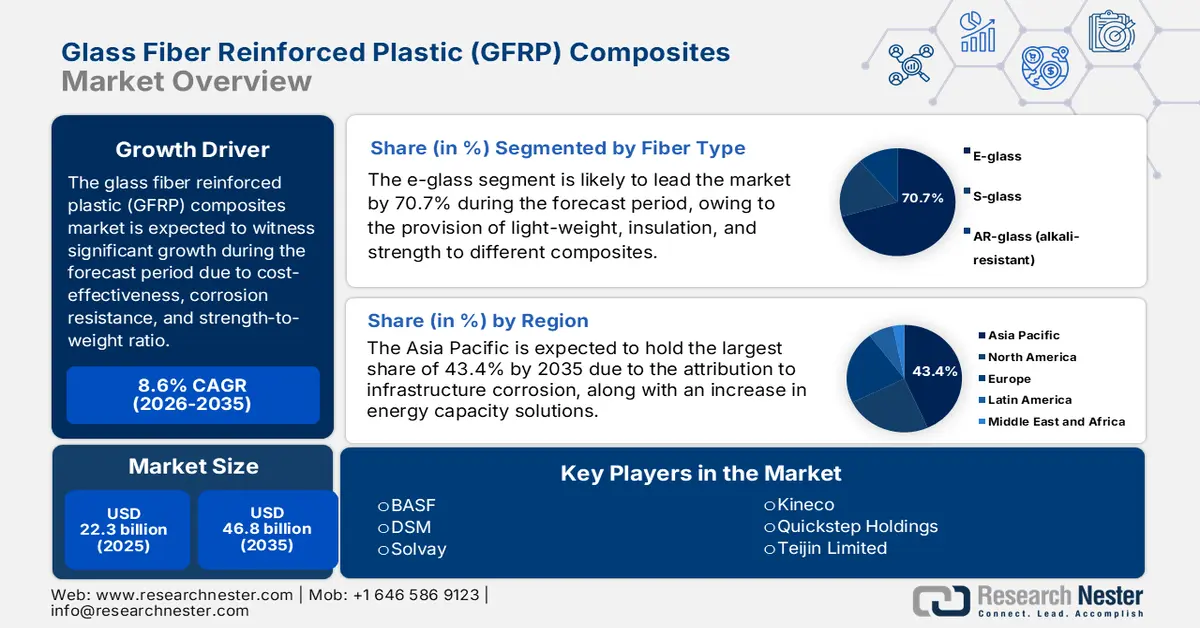
GFRP Composites Market size was over USD 22.3 billion in 2025 and is estimated to reach USD 46.8 billion by the end of 2035, expanding at a CAGR of 8.6% during the forecast timeline, i.e., 2026-2035. In 2026, the industry size of glass fiber reinforced plastic (GFRP) composites is assessed at USD 24.2 billion.
The international GFRP composites market is increasingly being adopted across different industries, owing to the aspects of cost efficiency, corrosion resistance, and increased strength-to-weight ratio. As per an article published by Defence Technology in June 2023, the A-10 Warthog offers suitable protection for the pilot and readily weighs 1,200 lbs. Besides, according to an article published by the U.S. Department of Energy in 2025, a 10% reduction in vehicle weight effectively leads to a 6% to 8% in fuel economy optimization. Therefore, replacing conventional steel and cast-iron components with lightweight materials, including polymer composites, carbon fiber, aluminum alloys, magnesium alloys, and high-strength steel, can diminish vehicles’ weight by almost 50%, and thus reduce vehicle fuel consumption.
Light-Weight Materials Ensuring Mass Reduction (2025)
|
Material Type |
Reduction (%) |
|
Magnesium |
30 to 70 |
|
Carbon Fiber Composites |
50 to 70 |
|
Aluminum and AI Matrix Composites |
30 to 60 |
|
Titanium |
40 to 55 |
|
Glass Fiber Composites |
25 to 35 |
|
Advanced High-Strength Steel |
15 to 25 |
|
High Strength Steel |
10 to 28 |
Source: U.S. Department of Energy
Furthermore, circular economy, sustainability, light-weighting in transportation, infrastructure resilience, and process innovation are current trends that are significantly fueling the glass fiber reinforced plastic (GFRD) composites market globally. As stated in a data report published by the Europe Commission in 2024, France’s President announced the 5-year €1.8 billion plan, with the intention of financing research in quantum computing, sensing, and communications, which is propelling the market’s exposure across different nations. Besides, as per an article published by the IEA Organization in 2025, aviation accounted for 2.5% of the international energy-driven carbon dioxide emissions as of 2023. However, to combat this, the U.S. granted almost USD 1.7 per gallon of SAF produced under the IRA, which is to be achieved between 2030 and 2050. Moreover, the aspect of carbon dioxide emissions in aviation for achieving a net-zero scenario is also uplifting the glass fiber reinforced plastic (GFRP) composites market’s demand internationally.
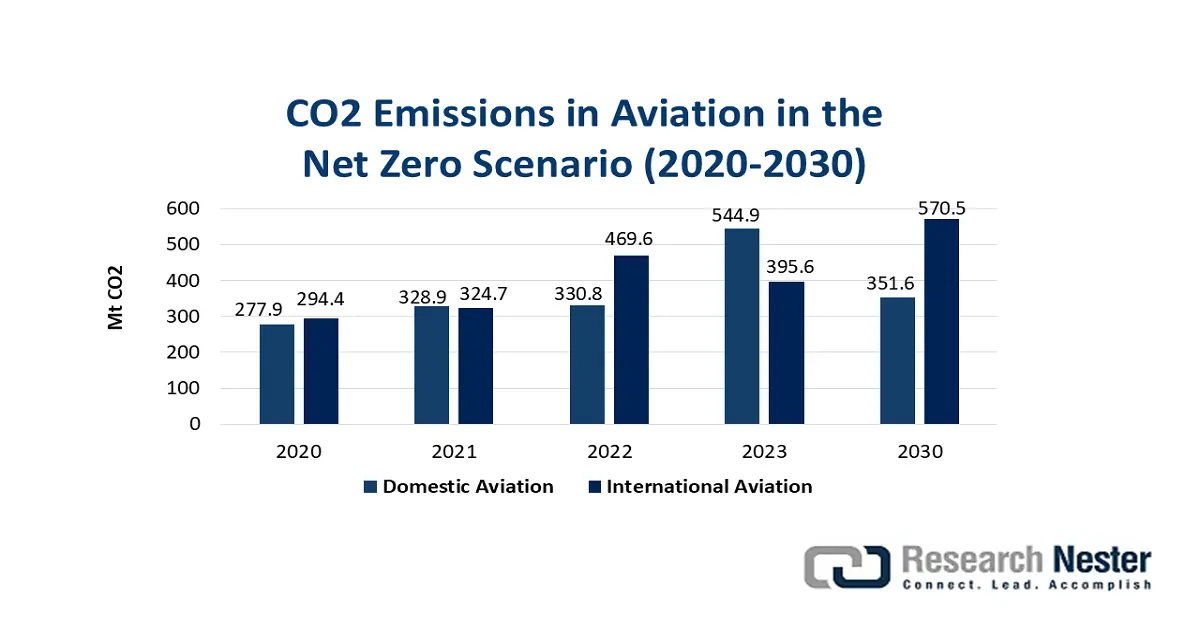
Source: IEA Organization