Gas Insulated Substation Market Outlook:
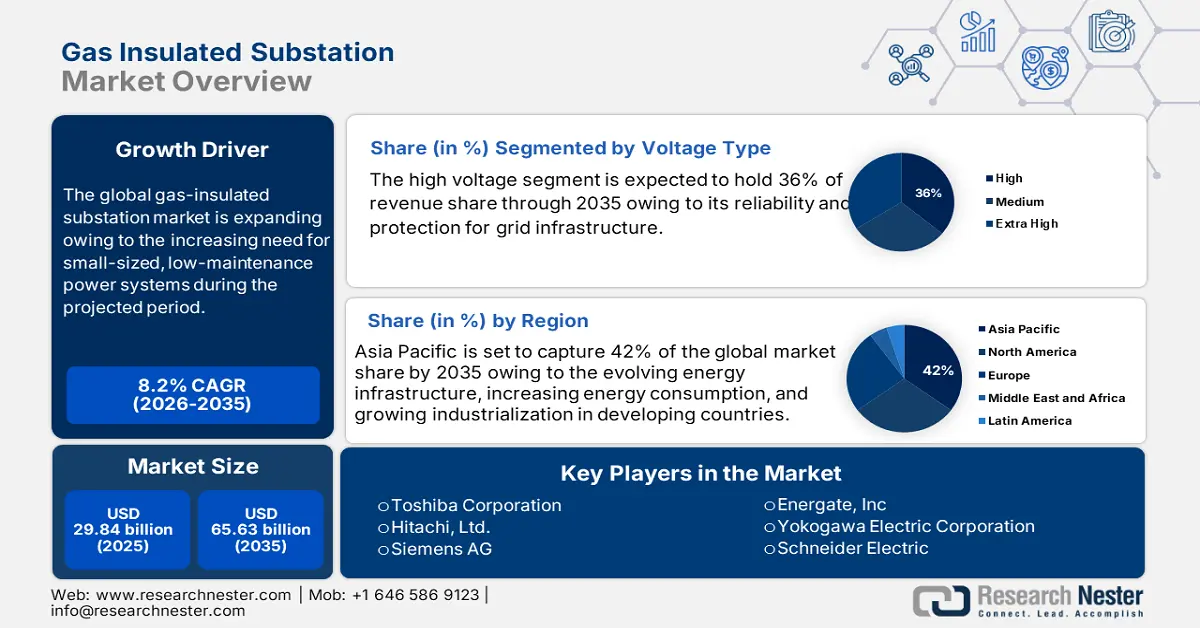
Gas Insulated Substation Market size was valued at USD 29.84 billion in 2025 and is set to exceed USD 65.63 billion by 2035, registering over 8.2% CAGR during the forecast period i.e., between 2026-2035. In the year 2026, the industry size of gas insulated substation is estimated at USD 32.04 billion.
Gas insulated substations are generally more reliable and efficient than air-insulated substations. Increasing per-hectare land values is also expected to provide lucrative growth opportunities for the market as the gas insulated substation consumes space as compared to its market counterparts. This substation consumes up to 90% less space than a typical power plant this factor is expected to drive the growth of gas insulated substation market in coming years.
Industry players are engaged in research, development, and deployment of market products to capture share for non-SF6 alternatives in HVDC and HVAC systems. As of 2023, the highest voltage non-SF6 gas-insulated switchgear was limited to 450 kV. With planned technologies, high voltage GIS capacity is expected to reach as high as 550 kV over the next few years. The anticipated level of technological advancements will allow phasing out several SF6 systems, but not entirely eliminating its usage as 765 kV systems have no planned alternatives. The U.S. is not exempt from technological innovations in energy and power, with the sector’s infrastructure investment surging from USD 25.1 billion in 2021 and USD 26.7 billion in 2022 to USD 29.1 billion in 2023, marking a 20% growth rate in two years.
The U.S. gas insulated switchgear market was USD 6.7 billion in 2023, representing 23% of all spending on domestic electrical infrastructure and 28% of the global gas insulated substation market. The high-voltage equipment segment accounts for most of this spending, with >75 kV voltage ratings valuing USD 4.8 billion. Of this, USD 2.1 billion was developing non-SF6 systems. According to the U.S. EPA September 2022 report, SF6-free equipment ownership cost is lower than 100% of the overall cost of SF6-based equipment. The O&M and end-of-life costs of vacuum and clean air technology are considered less than SF6-based equipment.
It is expected that lifecycle costs for SF6-free systems, including 145 kV GIS is USD 0 per metric ton of greenhouse gas reduced in metric tons CO2e with a capital cost of USD 33 per ton of GHG for SF6-free equipment. For a 145 kV GIS, an offshore subtraction or wind turbine capital cost is approximately USD 70,000 higher than clean air technology. This eliminates 85 kg of SF6, which is a cost of USD 33/ton CO2e and an equivalent of 2,100 tons of CO2e. An installation of 100 non-SF6 turbines would avoid 252,000 tons of CO2 emissions, driving investments in sustainable market alternatives.