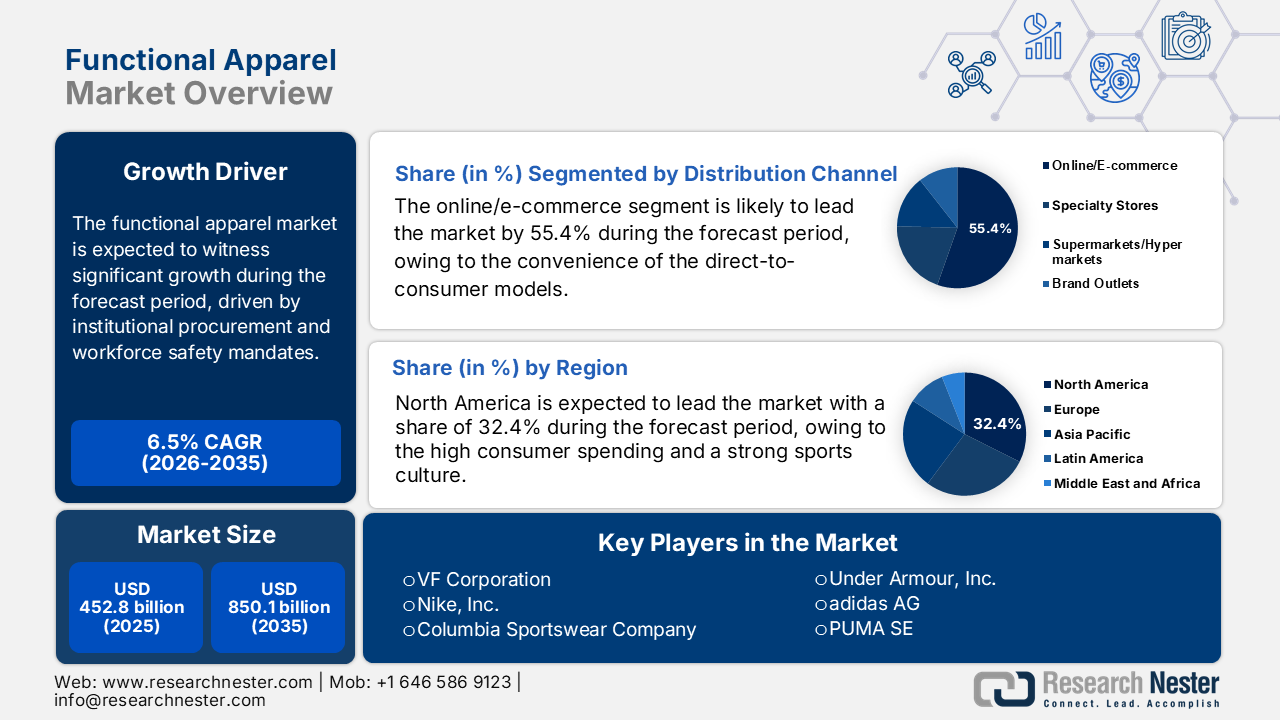
Functional Apparel Market Outlook:
Functional Apparel Market size was valued at USD 452.8 billion in 2025 and is projected to reach USD 850.1 billion by the end of 2035, rising at a CAGR of 6.5% during the forecast period, i.e., 2026-2035. In 2026, the industry size of functional apparel is evaluated at USD 482.2 billion.
The functional apparel market is strongly shaped by institutional procurement, workforce safety mandates, and public sector spending on health defense and infrastructure. In the U.S., the federal and state agencies are the major buyers of performance-driven garments used by the military personnel, healthcare workers, emergency responders, and industrial labor forces. The U.S. military demand illustrates this stability. The Defense Logistics Agency procurement indicates a sustained uniform purchasing under the long-term contracts. The report from the DLA April 2025 depicts that the supply chain acts as anchor customers, supplying more than 8,000 items ranging from combat and service uniforms to footwear, undergarments, body armor, and fire-retardant workwear for all service branches and emergency responders. This activity material in value terms during 2024 DLA Troop Support C&T obligation about 1.88 billion dollars across key NAICS categories. This data highlights the scale of the institutional demand for performance-oriented garments.
DLA Troop Support Clothing & Textiles (2024)
|
NAICS Code |
NAICS Description |
NAICS Dollars Obligated (USD) |
|
– |
Grand Total DLA Troop Support Clothing & Textiles FY24 |
1,878,048,895 |
|
315210 |
Cut and Sew Apparel Contractors |
624,305,296 |
|
315990 |
Apparel Accessories and Other Apparel Manufacturing |
273,362,258 |
|
315220 |
Men's and Boys' Cut and Sew Apparel Manufacturing |
165,238,079 |
|
314910 |
Textile Bag and Canvas Mills |
139,673,116 |
|
315250 |
Cut and Sew Apparel Manufacturing (Except Contractors) |
101,003,795 |
|
316210 |
Footwear Manufacturing |
100,647,870 |
|
339999 |
All Other Miscellaneous Manufacturing |
67,036,548 |
|
314999 |
All Other Miscellaneous Textile Product Mills |
49,346,946 |
|
339113 |
Surgical Appliance and Supplies Manufacturing |
43,130,204 |
|
711510 |
Independent Artists, Writers, and Performers |
43,111,646 |
Source: DLA April 2025
Further, the public sustainability policy and industrial standards are further reshaping the procurement criteria for the functional apparel suppliers. The U.S. Environmental Protection Agency highlights that the textile sector is among the most resource-intensive manufacturing industries, pushing the federal buyers to prioritize durability, reusability, and reduce the lifecycle waste in the apparel contracts. At a global level, the International Labor Organization report in July 2024 indicates that over 17.3% of workers are exposed to heat stress, reinforcing the long term institutional demand for performance-enhancing garments in both developed and emerging economies. Moreover, the WHO continues to emphasize the domestic manufacturing capacity for protective apparel as part of the national health security strategies.