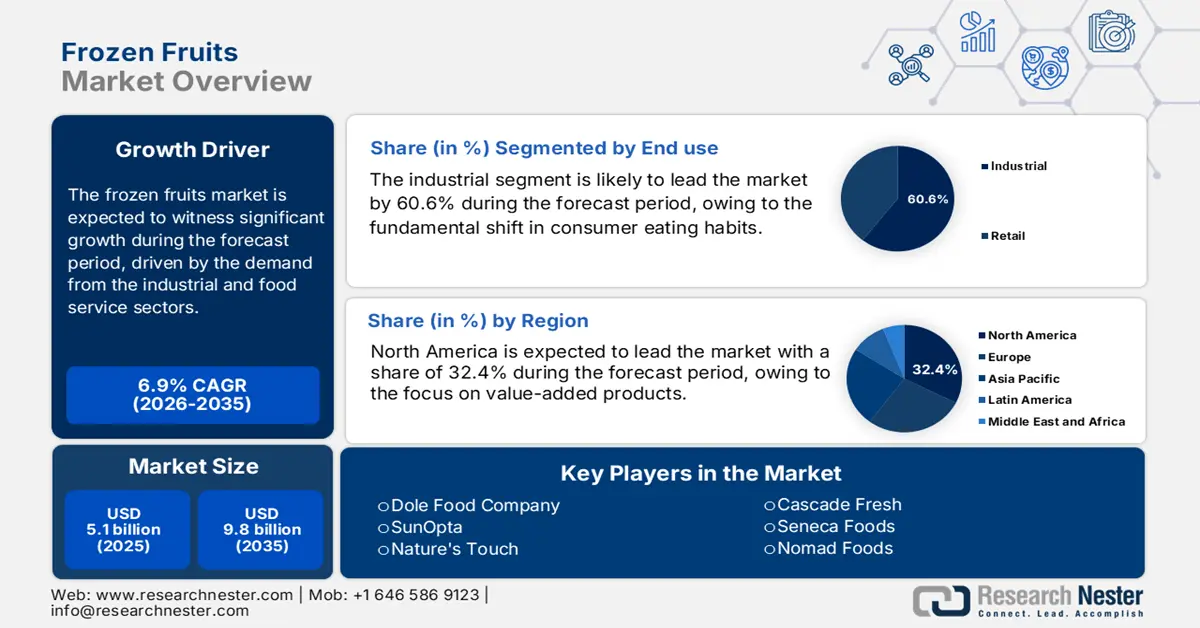
Frozen Fruits Market Outlook:
Frozen Fruits Market size was valued at USD 5.1 billion in 2025 and is projected to reach USD 9.8 billion by the end of 2035, rising at a CAGR of 6.9% during the forecast period, i.e., 2026-2035. In 2026, the industry size of frozen fruits is evaluated at USD 5.4 billion.
The global frozen fruits market is defined by the strong demand from the industrial and food service sectors and is driven by the need for a consistent, year-round ingredient supply. The fusion of frozen fruits as a key input in the secondary food manufacturing, including dairy, beverages, bakery, and confectionery, is the primary growth factor for the market expansion. The operational efficiency offered by the frozen fruits, including extended shelf life, minimizes the spoilage, and batch-to-batch consistency is vital for large-scale production. This industrial demand is boosted by the public sector initiatives. For example, the USDA National School Lunch Program has served lunches with a portion of frozen fruits included to meet the nutritional standards, creating a stable, high-volume procurement channel. Furthermore, the OEC data in 2023 states that the global trade value of frozen fruits and nuts reached USD 7.1 billion, reflecting the scale of the cross-border B2B transactions.
Governments are also underwriting the supply chain stability via cold chain and processing capacity. India’s Ministry of Food Processing Industries has approved hundreds of integrated cold chain projects under the PMKSY to reduce the post-harvest losses and enable the availability of the fruit throughout the year for freezing and export. Further, India’s Production Linked Incentive for the Food Processing with a multi-year outlay aims to expand the processing throughput and modernize lines supporting a consistent frozen fruit supply for domestic and global buyers. For procurement teams, this means near-term supply reliability and the opportunity to secure the multi-year contracts indexed to government-backed program calendars. Service levels and margin discipline can be enhanced by giving priority to suppliers with grant-funded cold chains, verifying origin compliance for public tenders, and connecting FAO supply data to seasonal formulations.