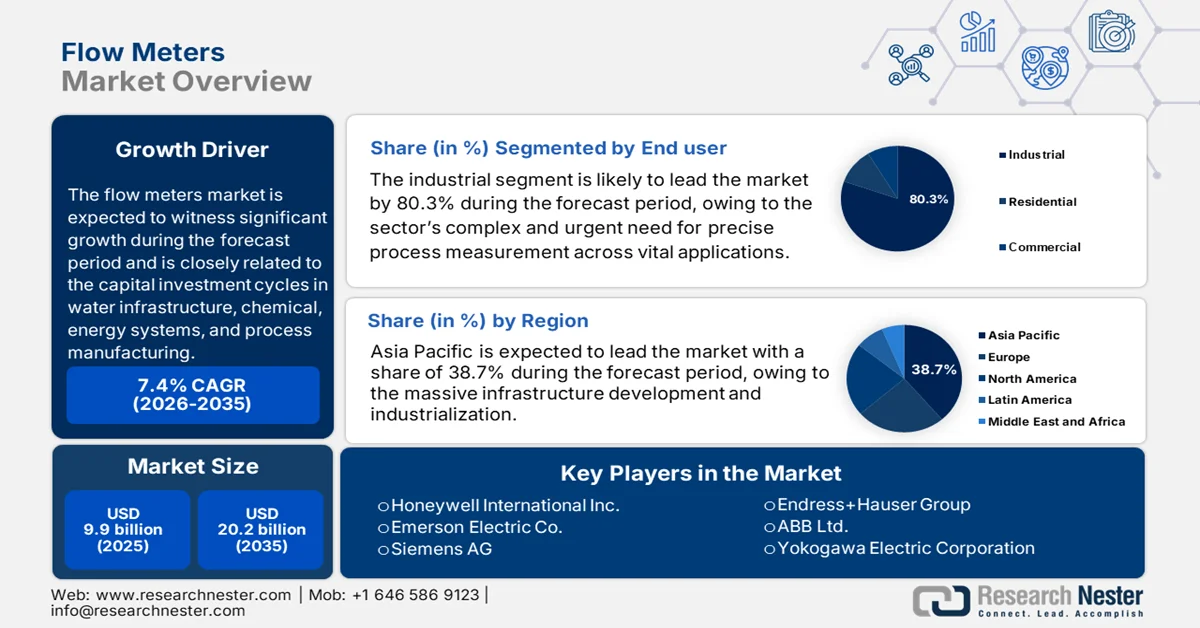
Flow Meters Market Outlook:
Flow Meters Market size was valued at USD 9.9 billion in 2025 and is projected to reach USD 20.2 billion by the end of 2035, rising at a CAGR of 7.4% during the forecast period, i.e., 2026-2035. In 2026, the industry size of flow meters is assessed at USD 10.6 billion.
The global demand for the market is closely related to the capital investment cycles in water infrastructure, chemical, energy systems, and process manufacturing, all of which are supported by public sector spending and regulatory oversight. According to the U.S. Environmental Protection Agency data in December 2025, the country requires over USD 625 billion in drinking water and wastewater infrastructure investments over 20 years, creating sustained procurement demand for flow measurement equipment across municipal utilities and industrial treatment facilities. Similarly, the IEA 2023 reports that the global energy investment exceeded USD 2.8 trillion in 2023, with oil and gas, power generation, hydrogen, and operational reporting. The government-backed industrial digitization initiatives, including the U.S. Department of Energy industrial efficiency programs, continue to encourage the adoption of advanced flow monitoring to reduce losses and improve process control in energy-intensive industries.
Besides, accurate flow data is required for emission reporting, environmental compliance, and fuel accounting across the power plants, pipelines, and refineries. In Europe, the Water Framework and industrial emissions directives drive the standardized monitoring across utilities and manufacturing sites. On the market demand side, the UNESCO February 2024 report highlights that over 70% of the global freshwater withdrawals are used by agriculture and industry, prompting governments to fund water efficiency and monitoring projects mainly in Africa, the Middle East, and the Asia Pacific. Further, the public investments in the LNG terminal, cross-border pipelines, and renewable fuels support the long-term procurement of flow meters in custody transfer process optimization and safety-critical applications. Moreover, these government-led infrastructure program regulatory frameworks and energy transition investments provide a predictable policy-backed demand environment for the market across the emerging and developed nations.