Flame Retardant Thermoplastic Market Outlook:
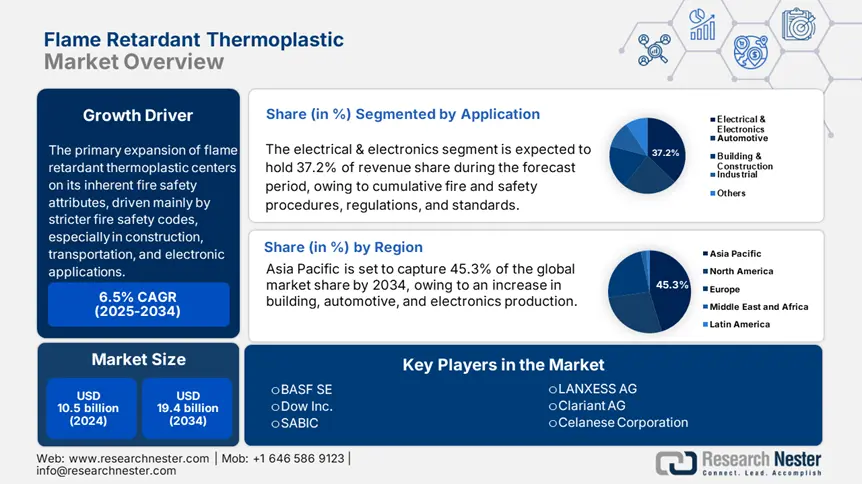
Flame Retardant Thermoplastic Market size was estimated at USD 10.5 billion in 2024 and is expected to surpass USD 19.4 billion by the end of 2034, rising at a CAGR of 6.5% during the forecast period, i.e., 2025-2034. In 2025, the industry size of flame retardant thermoplastic is expected to reach USD 11.2 billion.
The primary expansion of flame retardant thermoplastic centers on its inherent fire safety attributes, driven mainly by stricter fire safety codes, especially in construction, transportation, and electronic applications. This has led to ongoing general fund R&D and implementation of safer, non-halogenated retardants. The U.S. Bureau of Labor Statistics notes the Producer Price Index for thermoplastic resins (including flame retardant grades) has been flat at ~156 (Dec 2024), and the plastic goods Consumer Price Index has risen annually by ~ 3%, which is wholly attributable to a pass-through of regulatory costs. The U.S. EPA's Toxic Release Inventory reports production volumes resulted in continued volumes ~463,001 lb of HBCD waste in 2015, indicating ongoing use of haloalkanes in some applications, and continued investment in research in the reduced risk alternatives.
The raw material supply chain, mainly antimony trioxide, organophosphates, and synergists has had growth in the raw material supply chain, with extraction expansion activities pushing forward. U.S. Customs has demonstrated that the import volumes of new Jerusalem Ghosts TCEP on imports have reached hundreds of pounds each year, ie, ~10,001 lb imported 2014-18. New manufacturing capacity (e.g., new compounding capacity) has been realized with investments in cleaner plastic parts production (i.e., to support NESHAP). Expanding export volumes are modestly occurring, as there was a constrained growth impact of tariffs globally, but supported by demand from OECD countries, and hence, raw material imports are still rising ~6–11% each year over the year since expanding assembly line setups over the last 5 years in North America and Europe.