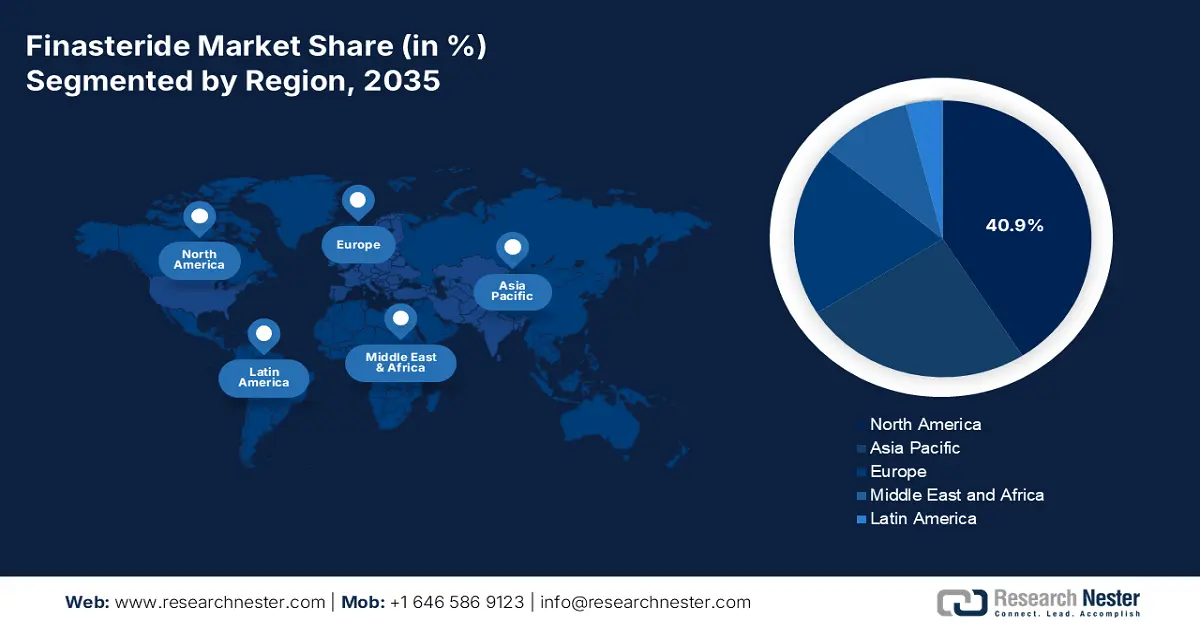
Finasteride Market - Regional Analysis
North America Market Insights
The finasteride market in North America dominates the market and is expected to hold the market share of 40.9% by 2035. The market is fueled by expanding patient pools for BPH and androgenetic alopecia, broader reimbursement schemes, and high generic uptake. Rising prescription volume, telemedicine proliferation, and DTC e-pharmacy business models are the major drivers. Further, the U.S. Medicare and Medicaid expanded the coverage for finasteride, while Canada's public health system surged procurement for long-term home care use. Moreover, the competitive pricing and availability of the market are driven by the FDA-approved generics and Health Canada licensing.
The market in the U.S. reflects impressive demand across BPH patients. The market is supported by high-volume prescribing patterns, availability of FDA-approved generics, and widespread expansion of in direct-to-consumer (DTC) telehealth care. The American Hair Loss Association states that by the age of 35, 2/3rd of U.S. men will experience some extent of noticeable hair loss. Researchers are using finasteride on a wide level as an inhibitor that reduces dihydrotestosterone (DHT) levels, a hormone linked to hair follicle miniaturization in AGA.
Asia Pacific Market Insights
The APAC is the fastest-growing region in the finasteride market and is expected to capture significant growth by 2034. The market is driven by an expanding patient population, growing healthcare access, and aggressive generic drug uptake. The increased incidence of androgenetic alopecia and benign prostatic hyperplasia (BPH) in elderly male populations aided regional governments in increasing public healthcare spending on dermatology treatments. Further, the clinical trials of new delivery methods and fixed-dose combinations are in progress across the region, which reflects continued R&D emphasis. The APAC market is also driven by accelerated urbanization and heightened health screening, contributing to early detection and long-term therapy compliance.
The market in India is set to register significant growth on the back of the rising presence of online platforms in the region. Also, there are rising efforts from the government to address the hair loss problem. The market in the country also gets benefits from a robust pharmaceutical industry that produces generic versions of finasteride. This makes the treatment more accessible and affordable for a larger segment of the population. The dominant market position is complemented by the cost-effective manufacturing platform and pro-export policies of India, which make it a prime supplier both of developed as well as emerging pharmaceutical markets.
Europe Market Insights
Europe's finasteride market is growing at a very high pace and is projected to capture a significant market share. Drivers of the market include aging male populations, higher diagnoses of benign prostatic hyperplasia (BPH) and androgenetic alopecia, and expanded insurance for generic treatments. Europe governments are incorporating finasteride into national lists of essential drugs, promoting the utilization of low-priced generics. The market is facilitated by robust regulatory systems and central price negotiation via Europe joint procurement arrangements. Finasteride's availability both within the public and private sectors of healthcare, specifically in the UK, Germany, France, Italy, and Spain, has driven increased volumes of prescriptions. Telemedicine take-up and electronic prescription models, particularly in Germany and France, have increased access further.
In Germany, there is a burgeoning awareness among the population about hair loss treatments. This awareness is resulting in higher acceptance and adoption of such treatments. Reimbursement policies guarantee drug expenditure for approved indications, and new digital health laws have surged the online provision of BPH drugs. The country boasts a well-developed healthcare infrastructure, ensuring feasible treatments. Also, the growth is propelled by the rising disposable income of the people in the country.