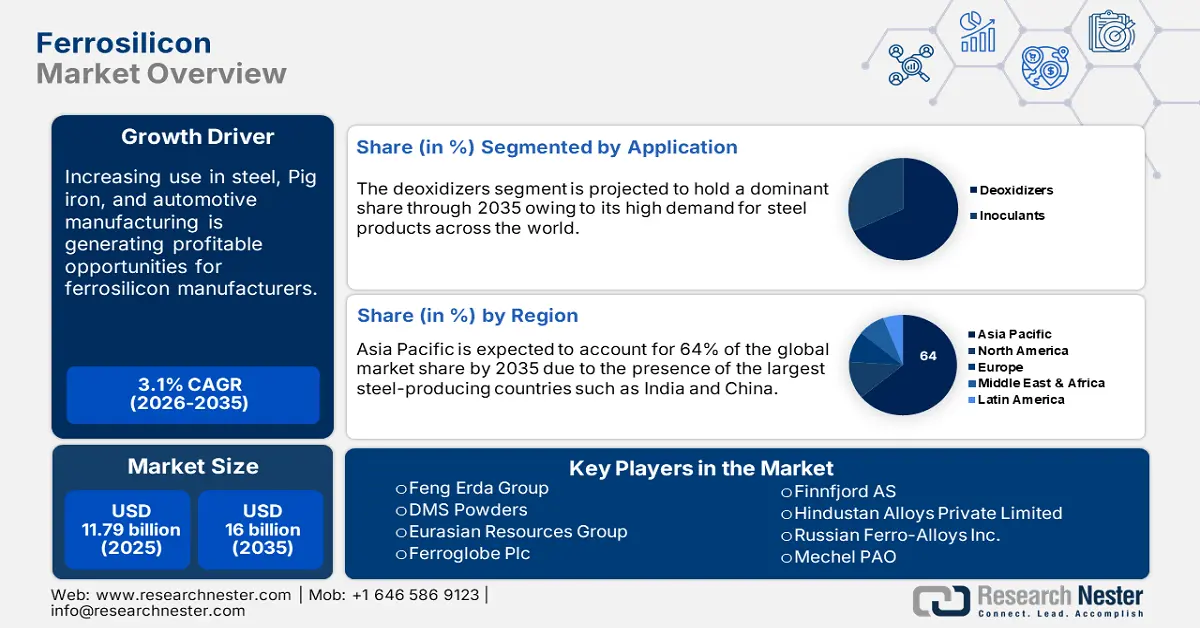
Ferrosilicon Market Outlook:
Ferrosilicon Market size was over USD 11.79 billion in 2025 and is anticipated to cross USD 16 billion by 2035, witnessing more than 3.1% CAGR during the forecast period i.e., between 2026-2035. In the year 2026, the industry size of ferrosilicon is assessed at USD 12.12 billion.
The ferrosilicon market is marked by expanding end users and the consecutive rise in production. The U.S. silicon production was 22,100 metric tons (t) in September 2024 compared with 21,900 t in August 2024 and the net shipments accounted for 15,400 t in September 2024. The ending stocks were 20,600 t by September 2024, a steady surge from the previous month. The total ferrosilicon imports in September 2024 were 6,040 t and overall silicon metal imports were 13,500 t, a 47% spike from August 2024, a double from September 2023. The key export destinations of 99.9% silicon metal as per USGS include Vietnam (1,600 tons), Japan (378 tons), and Taiwan (283 tons) and 55-80% grade exports were to India (1,500 tons), Canada (1,090 tons), and Vietnam (562 tons).
The U.S. production, stocks, and shipments of silicon alloys and metals (through 2024)
|
Year to date |
Gross production |
Net shipments |
Producers' stocks, end of period |
|
2023 |
|
|
|
|
September |
W* |
W |
22,600 |
|
October |
28,700 |
W |
22,900 |
|
November |
26,300 |
20,500 |
22,000 |
|
December |
W |
20,100 |
20,400 |
|
Jan-Dec |
W |
245,000 |
20,400 |
|
Jan-Sep |
W |
W |
22,600 |
|
2024 |
|
|
|
|
January |
W |
24,200 |
17,500 |
|
February |
W |
W |
17,700 |
|
March |
W |
W |
18,800 |
|
April |
W |
W |
19,900 |
|
May |
W |
21,600 |
20,700 |
|
June |
W |
18,400 |
20,800 |
|
July |
W |
18,900 |
21,800 |
|
August |
21,900 |
W |
20,100 |
|
September |
22,100 |
15,400 |
20,600 |
|
Jan-Sep |
W |
179,000 |
20,600 |
Source: USGS; W*-Withheld to avoid disclosing
Barium titanate, gallium, and germanium are the leading raw materials used in ferrosilicon and its alloys. Being a critical material, titanium was priced at USD 11 per kilogram in 2022. In smaller consumer electronics, its ferrosilicon concentration is 0.1332 w/w% and it is relatively dispersed. In acoustic devices, it is found as barium titanate and is used as a barrier coating in ICs. Presently, titanium recovery is not economically appealing. Specialized devices such as MRI magnets have 37 w/w% titanium concentration, with a lifetime of over ten years, thereby generating less waste. 2024 file report by USGS suggests that China dominates the gallium and germanium global supply chain, positioning itself as crucial for global players.
The U.S. Geological Survey estimates quantify the potential aftermath of mineral commodity supply chain disruptions from net import restrictions on gallium and germanium on the U.S. GDP. The results indicated that total restriction on gallium and germanium imports from China could result in a slump in the U.S. GDP of USD 3.1 billion or 0.013% of the total GDP. 46.5%, nearly half of the setback would be semiconductor and connected device manufacturing, which has a high dependency on gallium. As per OEC, the worldwide trade of germanium (comprising germanium oxides and zirconium dioxide) accounted for USD 484 million, exhibiting a 7% export growth rate. China alone was valued at USD 180 million, capturing a 37.1% export share and the U.S. import value was USD 61.5 million, with an import share of 12.7%.
In terms of ferrosilicon trade, the value totaled USD 6.15 billion in 2022 and was the world’s 630th most imported/exported item out of 4648. The export CAGR was a whopping 37.6%, making China an evident leader with USD 1.34 billion worth of exports. Between 2021 and 2022 the Ferro-silicon, >55% silicon global outbound trade rose to USD 6.15 billion from USD 4.47 billion. After China, Russia (USD 830 million), Norway (USD 555 million), Malaysia (USD 425 million), and Brazil (USD 419 million) were key exporters. Whereas, Japan (USD 926 million), the U.S. (USD 829 million), Germany (USD 456 million), South Korea (USD 410 million), and the Netherlands (USD 398 million) were the top importers of ferrosilicon.