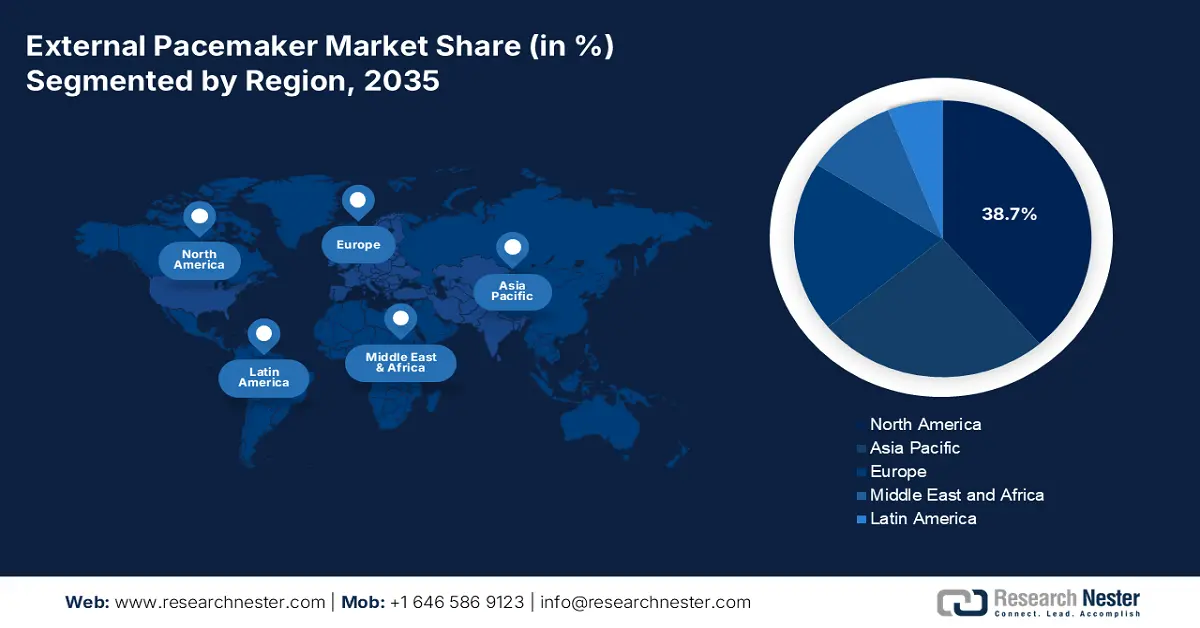
External Pacemaker Market Regional Analysis:
North America Market Insights
The North America external pacemaker market is projected to register the highest share of 38.7% during the forecast period. The region benefits from the developmental tendency of countries such as the U.S. and Canada, which hold global market players. The U.S. dominates North America’s market with a lucrative share, owing to the expanded Medicaid reimbursements that increased by 12.6% in 2024, benefiting more than 500,000 patients. Besides, in 2024 FDA reported that AI-based monitoring adoption grew by 25.4%, highlighting the reduced hospital readmissions. Hence, these factors widen the use of pacemakers, allowing a positive market development.
Canada external pacemaker market is witnessing significant growth opportunities driven by both public and private healthcare reforms. In this regard, Health Canada in 2024 declared Ontario invested a substantial value of USD 320.4 million in cardiovascular care, reflecting heightened government support. Moreover, according to CIHI, there is a 15.3% increase in implant growth from 2020. The market in the country is further propelled by an 18.5% expanded access in rural areas for cardiac health. This is the evidence for a wider scope, thereby creating a prolific opportunity for domestic players in Canada.
Asia Pacific Market Insights
The Asia Pacific external pacemaker market is projected to witness the fastest growth with a considerable share of 22.5% during the forecast period. The expanding aging population and the innovations in medical technologies are readily responsible for market upliftment in the region. Besides, countries such as Japan and South Korea are at the forefront, necessitating the demand for external pacemakers. Furthermore, the enhanced device efficacy and patient comfort are fostering a favorable business environment in this sector. Upgraded medical facilities and access to advanced treatments further contribute to market growth in the Asia Pacific.
The market in India is gaining immense traction owing to factors such as exacerbated government expenditure and a huge patient population. As reported, the government spending on cardiovascular diseases increased by 18.4% over the last decade, that is USD 1.9 billion per year, reflecting the government’s support to improve cardiac care in the country. Besides, in India, the patient population who received cardiovascular diseases reached 2.5 million, highlighting the growing demand for pacemaker devices. Hence, this patient-centric approach in the country is allowing noteworthy investments in India.