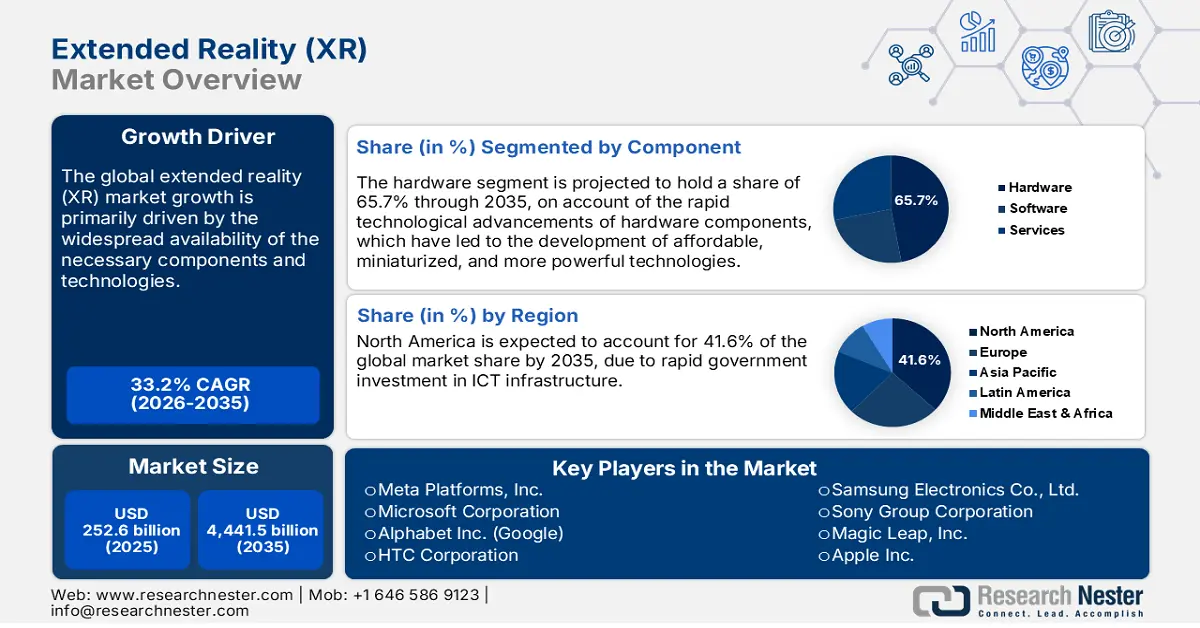
Extended Reality Market Outlook:
Extended Reality (XR) Market size was USD 252.6 billion in 2025 and is estimated to reach USD 4,441.5 billion by the end of 2035, expanding at a CAGR of 33.2% during the forecast period, i.e., 2026-2035. In 2026, the industry size of extended reality is evaluated at USD 336.5 billion.
The global trade of extended reality is heavily reliant on the supply chain of optical components, sensors, semiconductors, and display technologies, all of which are primarily sourced from East and Southeast Asia. The widespread availability of the necessary components and technologies contributes to increasing the convenience of developing and producing extended reality (XR)-based products and services. As revealed by SPIE in July 2022, the core optics and photonics industry globally accounted for a revenue of over USD 300 billion in 2023. Similarly, sales in the global semiconductor industry totaled USD 526.8 billion in the same year, as per the Semiconductor Industry Association (SIA) report. Despite the dominance of the Asia Pacific, in 2023, the U.S. maintained a consistent surplus of semiconductor trade and exported the technology to a value of USD 52.7 billion. In addition, tariffs for semiconductors are low in a wide range of countries globally. Accessibility of raw materials creates a profitable environment for companies involved in the development and production of XR-based products and services.
The functionality and growth of the XR-based products are expected to surge with the expansion of electronics production encompassing the manufacturing of XR devices, such as smart glasses, interaction controllers, headsets, haptic devices, holographic displays, and others. For example, in February 2024, the leading consumer electronics manufacturer, Apple, announced the market availability of Apple Vision Pro, which is a mixed reality headset. The development of this type of advanced XR-based product indicates significant investor interest in the market, expected to continue to fuel production.