Exoskeleton Market Outlook:
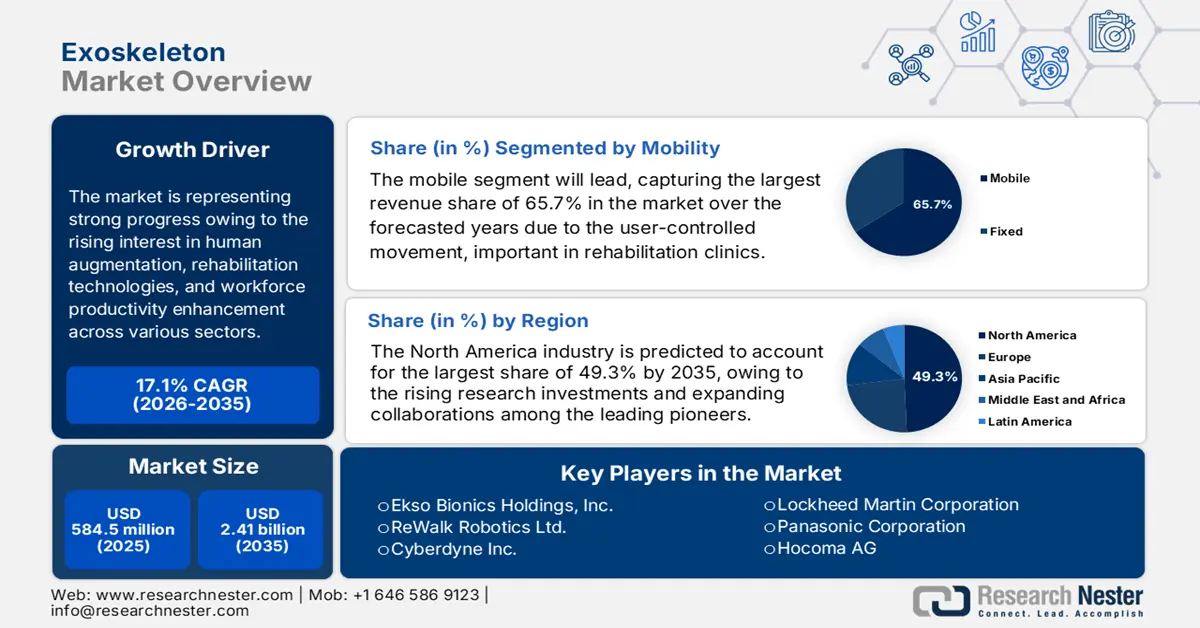
Exoskeleton Market size was valued at USD 584.5 million in 2025 and is projected to reach USD 2.41 billion by the end of 2035, rising at a CAGR of 17.1% during the forecast period, i.e., 2026-2035. In 2026, the industry size of exoskeleton is estimated at USD 684.4 million.
The exoskeleton market is representing strong progress, positively influenced by a rising interest in human augmentation, rehabilitation technologies, and workforce productivity enhancement across sectors such as healthcare, industrial, military, and consumer applications. In this regard, Wandercraft in June 2025 announced the closure of its Series D round by securing a total of USD 75 million to accelerate global deployment of its AI-powered robotics portfolio. The firm also mentioned that this funding will support the commercialization of the Eve personal exoskeleton, expansion of clinical adoption for Atalante X, and industrial rollout of the Calvin-40 humanoid robot. In addition, a strategic partnership with Renault Group, including minority ownership, strengthens large-scale manufacturing capabilities and cost-efficient production. Also, this is efficiently backed by public and private investors, reinforcing Wandercraft’s momentum in this field.
Furthermore, the increasing awareness of workplace safety and the need for mobility assistance is prompting widespread adoption in the exoskeleton market, in turn attracting stronger investments from both public and private entities. As evidence, Auxivo AG in July 2023 announced that it closed a financing round, which was led by Ankaa Ventures and participation from existing investors, to support innovation and international expansion in terms of occupational exoskeletons. Besides, the company also stated that this funding will be utilized for accelerating research and development and scaling market presence across major industries such as logistics, manufacturing, construction, and healthcare. In addition, Ankaa Ventures highlighted Auxivo’s potential to drive innovation and improve workplace health on a global scale, reinforcing the strategic value of the partnership, hence promoting sustainable and healthy physical labor.