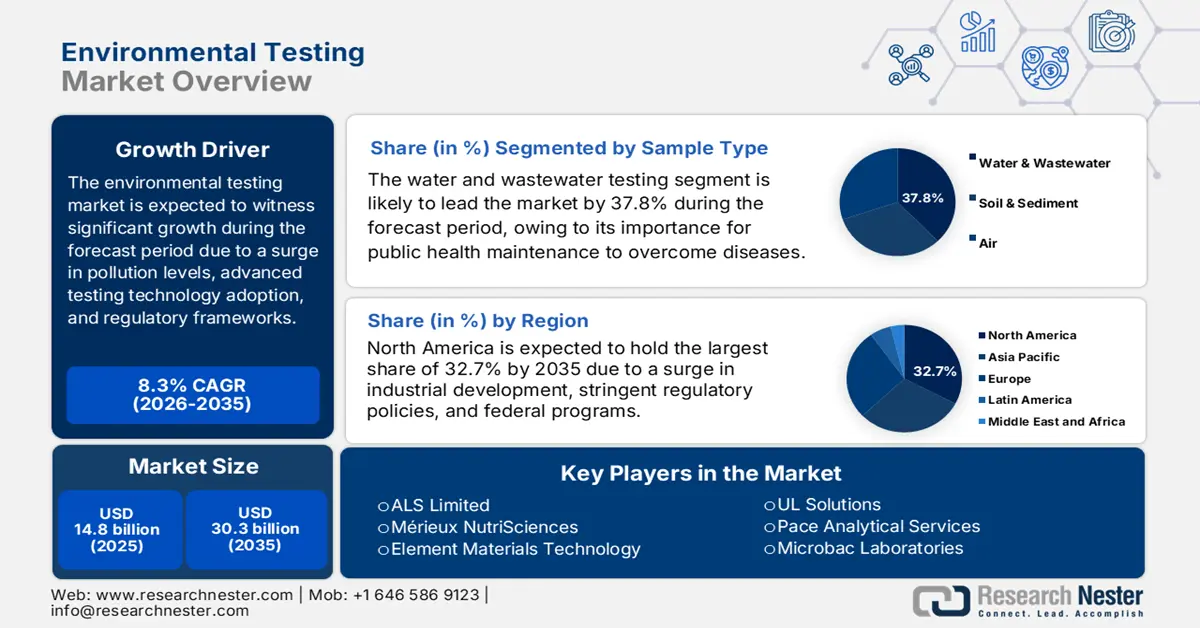
Environmental Testing Market Outlook:
Environmental Testing Market size was over USD 14.8 billion in 2025 and is estimated to reach USD 30.3 billion by the end of 2035, expanding at a CAGR of 8.3% during the forecast timeline, i.e., 2026-2035. In 2026, In 2026, the industry size of environmental testing is evaluated at USD 16 billion.
The international environmental testing market is continuously experiencing growth, which reflects a rise in pollution levels, the adoption of innovative testing technologies, and evolving regulatory frameworks. Besides, environmental testing has emerged as the critical factor for communities, governments, and industries to effectively ensure compliance, support sustainable development, and protect ecosystems. According to an article published by the World Bank Organization in October 2025, approximately 2.3 billion people are readily exposed to outdoor fine particulate matter levels above 35 µg/m³. This has resulted in over 5.7 million deaths every year, along with economic expenses approaching 5% of the overall international gross development product (GDP). Besides, with the presence of current policies, the exposure is anticipated to increase by 15% over the upcoming 15 years, owing to economic and population growth. Moreover, the change in air quality is also gradually increasing the market’s demand globally.
Global Change in Air Quality (Previous Years versus 2023)
|
Pollutant Type |
1980 vs 2023 |
1990 vs 2023 |
2000 vs 2023 |
2010 vs 2023 |
|
Carbon Monoxide |
-88 |
-79 |
-65 |
-18 |
|
Lead |
- |
- |
- |
-87 |
|
Nitrogen Dioxide (Yearly) |
-68 |
-62 |
-54 |
-30 |
|
Nitrogen Dioxide (1-hour) |
-66 |
-55 |
-40 |
-23 |
|
Ozone (8-hour) |
-26 |
-18 |
-12 |
-1 |
|
PM10 (24-hour) |
- |
-29 |
-36 |
-0 |
|
PM2.5 (Yearly) |
- |
- |
-37 |
-15 |
|
PM2.5 (24-hour) |
- |
- |
-29 |
+1 |
|
Sulfur Dioxide (1-Hour) |
-95 |
-92 |
-87 |
-78 |
Source: EPA Government
Furthermore, the adoption of rapid testing technologies, integration of artificial intelligence (AI) and digitalized platforms, increased focus on emerging contaminants, such as microplastics and PFAS, as well as the expansion of outsourced testing services, are other drivers boosting the environmental testing market globally. As per an article published by the OECD in September 2025, 70% of countries utilized AI to optimize internal governmental processes, while only 33% utilized it to enhance policy design and implementation. Besides, 5% to 6% of businesses in the U.S. utilize this technology to produce goods and services, and 7% are readily planning to adopt it in the upcoming years. Moreover, approximately 26% of organizations have the capabilities required to derive real value from AI, and on the other hand, 4% have succeeded in generating significant value. Therefore, with this increased AI utilization, the environmental testing market is continuously gaining increased exposure.