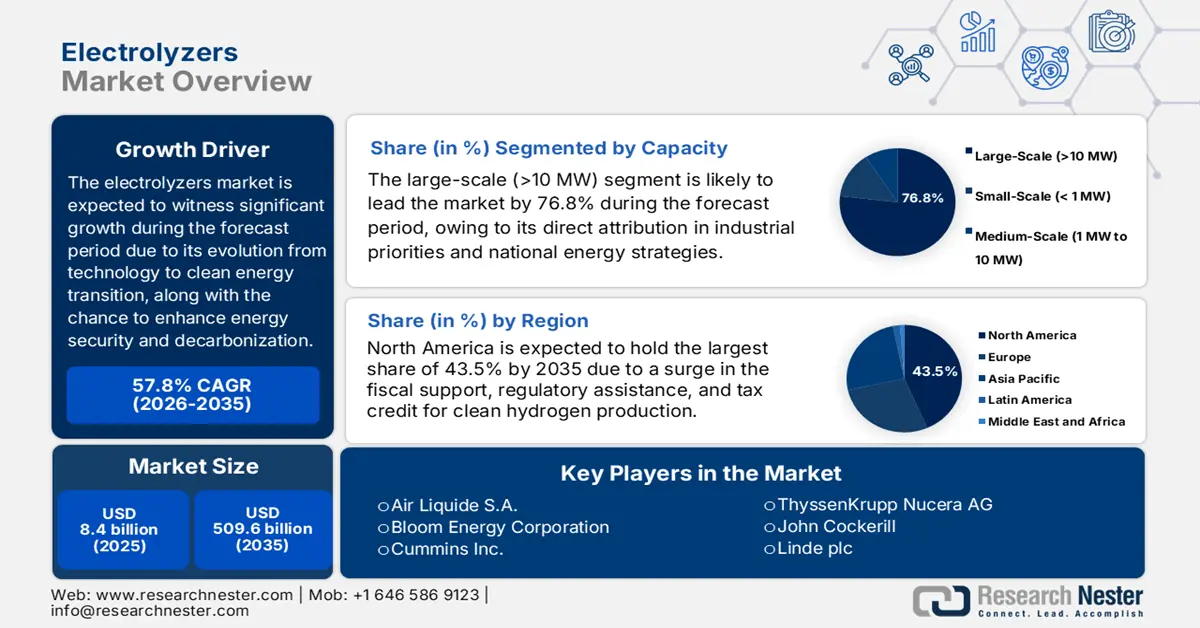
Electrolyzers Market Outlook:
Electrolyzers Market size was over USD 8.4 billion in 2025 and is estimated to reach USD 509.6 billion by the end of 2035, expanding at a CAGR of 57.8% during the forecast timeline, i.e., 2026-2035. In 2026, the industry size of electrolyzers is assessed at USD 13.2 billion.
The international electrolyzers market is currently witnessing a paradigm shift and is readily evolving from a niche technological segment to a cornerstone of the clean energy transition. This shift is significantly fueled by the urgent global imperative to enhance energy security and decarbonize hard-to-abate industrial fields. According to the 2025 IEA Organization data report, the electrolysis capacity for dedicated hydrogen production has been continuously growing and reached an installed capacity of 1.4 GW by the end of 2023. Likewise, the electrolyzer manufacturing capacity has also doubled from 2022, and reached 25 GW by the end of the same year. Therefore, projects in the pipeline have led to an installed electrolyzer capacity, ranging between 230 GW to 520 GW by 2030. Besides, the aspect of overall installed electrolysis capacity by technology to achieve net-zero emissions is also ensuring a huge growth opportunity for the overall market globally.
Total Installed Electrolysis Capacity by Technology for Net Zero Emissions
|
Year |
Alkaline (MW) |
PEM (MW) |
Other/Unknown (MW) |
Total (MW) |
|
2020 |
200 |
110 |
20 |
330 |
|
2021 |
370 |
150 |
50 |
570 |
|
2022 |
400 |
240 |
60 |
700 |
|
2023 |
840 |
300 |
250 |
1,390 |
Source: IEA Organization
Furthermore, gigawatt-scale manufacturing, technology hybridization and diversification, a rise in the hydrogen valley, strategic alliances, supply chain consolidation, and increased focus on stack durability and critical materials are also responsible for uplifting the electrolyzers market globally. For instance, according to an article published by the Renewable and Sustainable Energy Reviews in January 2025, there has been a surge in international hydrogen from 20 million tons to 70 million tons in its purest form. In addition, 45 million tons of hydrogen are utilized in the Direct reduction of iron (DRI) process, particularly in the steel sector, which significantly adds up to nearly 115 million tons of yearly hydrogen demand. Besides, it has been estimated that the worldwide hydrogen demand can reach between 500 million tons to 800 million tons by the end of 2050, thereby making it suitable for boosting the market’s exposure.