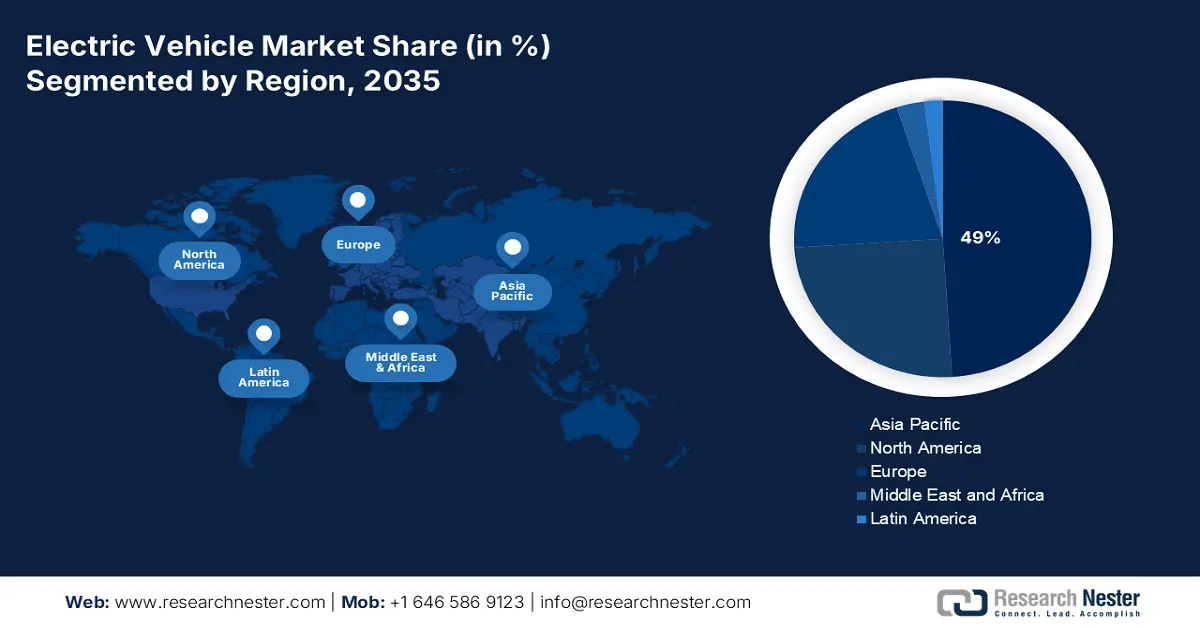
Electric Vehicle Market - Regional Analysis
Asia Pacific Market Insights
The Asia Pacific electric vehicle market is projected to hold a dominant global revenue share 0f 49% through 2035. Supportive government policies and long-term regulatory frameworks act as key drivers for electric vehicle adoption. The tax exemptions and subsidies for EV acquisitions and supportive importing regulations are driving producers and consumers toward electric mobility transitions. China and India are leading the EV production and sales, while Japan and South Korea are set to drive innovations in the coming years. The local manufacturers are increasing their electric vehicle production capacity owing to rising consumer demands. The public-private investments are significantly aiding in expanding electric vehicle manufacturing facilities, battery plants, and technological advancements. Local development initiatives are creating affordable EV purchasing options, driving economic growth, and providing employment opportunities.
The China electric vehicle market is developing significantly, owing to industrial policies that support companies. Manufacturers and consumers benefit from government-sponsored incentives comprising purchase subsidies, license plate preferences, and lowered road tax requirements. The measures implemented by the government are dramatically reducing barriers to EV adoption and driving the overall market growth. The local automotive manufacturers are contributing to the EV sales growth through their technological innovations. Research and development by key companies are promoting advancements in electric car models by decreasing their expenses and delivering better performance alongside desirable characteristics. The country’s position in the global landscape is continually intensifying through continuous technological improvements and market competitiveness.
The electric vehicle (EV) sector in India has experienced remarkable growth due to support from the government and policy, increased environmental consciousness, and a need to reduce dependence on purchased fossil fuels. The Indian Government has implemented some bold initiatives, especially the Faster Adoption and Manufacturing of Hybrid and Electric Vehicles (FAME) program, which offers financial incentives to consumers and manufacturers. The states also offer incentives, tax waivers, and subsidize the development of electric-vehicle infrastructure to support shared goals. With cities rapidly urbanizing and air pollution accumulating in the larger cities, there is an increased demand for both cleaner and more sustainable mobility from the political system and from citizens.
North America Market Insights
The North America electric vehicle market is witnessing rapid growth as manufacturers are establishing new electric vehicle production facilities. Companies are reinforcing the production of electric vehicles domestically, with rising demand, aimed at reducing their supply dependencies. The rise of manufacturing facilities strengthens supply chain performance while establishing new employment opportunities and stimulating local economic growth. Rising consumer awareness regarding environmental sustainability, the presence of tech-savvy consumers, and cost benefits are accelerating EV sales. The climatic commitments are also driving consumers to choose electric alternatives to reduce carbon footprints, lower fuel and maintenance costs.
The sales of electric vehicles are increasing in the U.S. owing to growing investments from various automakers for the development of next-gen electric vehicles. This trend is encouraging consumer adoption as the demand for sustainable vehicles continues to grow. The U.S. Energy Information Administration (EIA) states that both electric and hybrid vehicles are gaining traction in the country. The U.S. government has provided significant subsidies and tax credits as part of its efforts, under policies like the Inflation Reduction Act, to not only assist electric vehicle (EV) buyers but also domestic manufacturing of the EVs. In addition to this assistance, a growing charging infrastructure network, fueled by public and private investment, has made it easier than ever to own an EV.
The electric vehicle (EV) market in Canada is rapidly growing due to the financial incentives of provincial and federal government support, as well as environmental policies. The federal and provincial government supports the purchase of EVs by providing financial incentives and rebates to consumers who purchase EVs, especially in British Columbia and Quebec. Canada has also announced a ban on internal combustion engine (ICE) vehicles in 2035 to establish a clear long-term framework for automakers and consumers. Considering internal Canadian natural resources such as lithium and nickel, Canada is also positioning itself as a supplier to the global EV battery supply chain. A growing network of charging stations and an increased number of model offerings are also growing conditions for the EV market in Canada.
Europe Market Insights
The electric vehicle (EV) sector in Europe is increasing rapidly as a function of multiple converging forces: policy support and regulatory drivers; environmental imperatives; technological advancements; and changing consumer preferences. The EU has set forth some ambitious climate policies, such as the Fit for 55 packages, which also include proposals to ban the sale of all new petrol and diesel cars by 2035, all of which have accelerated the development and adoption of EVs in EU member states.
The electric vehicle (EV) sector in France is growing rapidly due to large government incentives and a solid environmental policy framework. The government has launched large subsidies for EV purchasers through bonus-malus schemes and scrappage schemes, which have made EV entry costs more accessible for consumers. In addition to these financial incentives, urban clean air and restrictions on usage of older combustion vehicles - especially in Paris and other urban environments - have removed many barriers for consumer EV adoption. In addition, large French vehicle manufacturers such as Renault and Peugeot invested meaningfully in the development of EV products and are starting to offer a wider range of cars that are designed for different mobility needs in urban and rural contexts.
Germany's electric vehicle (EV) market is undergoing a dynamic development process with support from government commitments, strong manufacturers, and the country's commitment to energy transition. The government has implemented programs like the environmental bonus (Umweltbonus) to stimulate direct EV purchases, while also investing in charging infrastructure development on highways and in cities to improve the convenience of being an EV owner. Germany has the world's top automakers, Volkswagen, BMW, and Mercedes-Benz, and we see rising product innovation and production capability for EVs.