Drug-resistant Tuberculosis Treatment Market Regional Analysis:
North American Market Insights
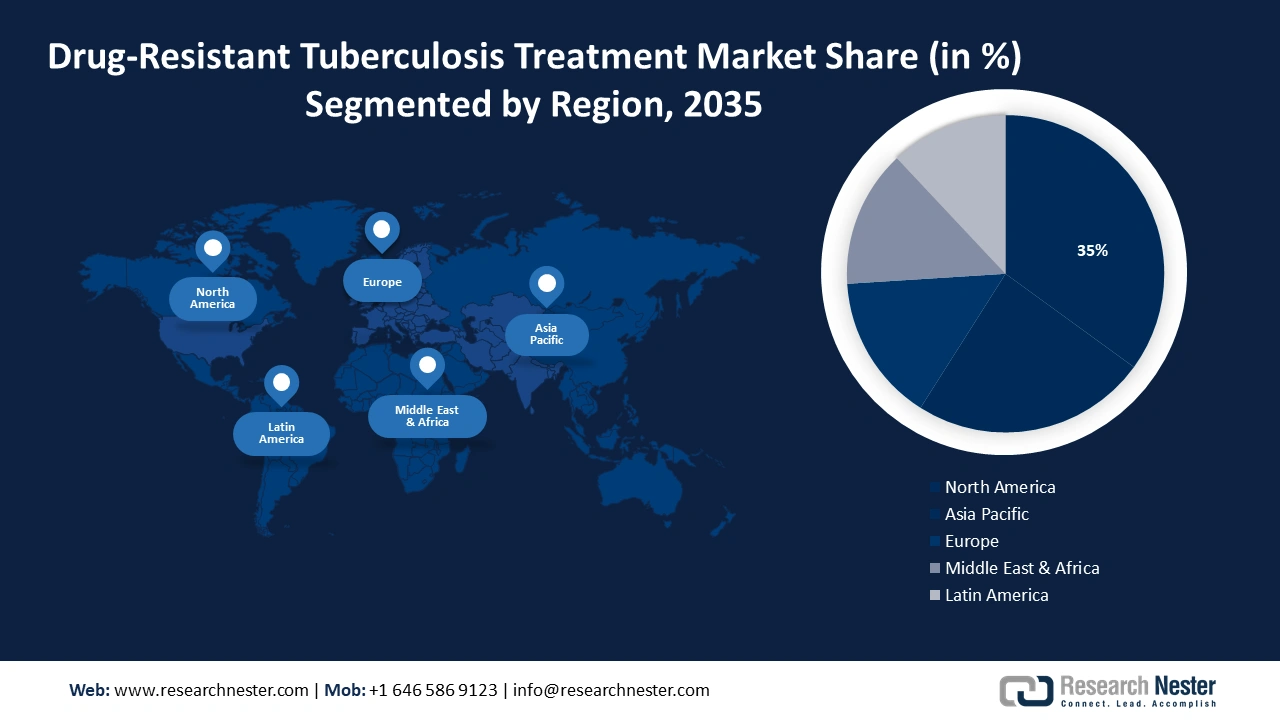
North America industry is set to account for largest revenue share of 35% by 2035. The region has the biggest key players in the market, and the high dominance of respiratory infections is the major factor driving the market growth. According to the Centers for Disease Control and Prevention (CDC) report published in 2022 states that more than 80% of TB cases in the United States were result from long established and untreated latent TB infection.
As per the latest report by the CDC, in 2022, 8331 cases of TB cases were reported in the US i.e., a rate of 2.5 cases per 100,000 persons. Additionally, there are many people living in the region dealing with inactive TB.
Due to the unavailability of appropriate treatment, people in Canada are diagnosed with active TB and in some extreme cases, eventually leading to death. Moreover, immigrants are highly prone to tuberculosis. According to the Canadian Medical Association Journal report issued in 2023, around 0.05% (95% UI 0.04%–0.08%) of foreign-born residents in Canada in 2021 had acquired tuberculosis infection in the preceding 2 years.
APAC Market Insights
By the end of 2035, Asia Pacific drug-resistant tuberculosis treatment market is estimated to hold over 25% revenue share. The growth is attributed to the strict actions taken by WHO along with UN General Assembly Indonesia to end tuberculosis on a global scale. According to WHO, most of the TB cases in 2021 were recorded in the South-East Asia (45%) region.
China has made huge investments in anti-TB agent research and development leading to the growth of the market. Furthermore, creating awareness among people to take the necessary precautions is important to control the increasing rate of the disease. For instance, Shanghai has implemented TB control measures in China very precisely, but the incidence rate was still above 25/100,000 in 2019.
Indonesia is a low-middle-income country, where TB remains prevalent and healthcare services are inadequate and drug supply is very limited. Furthermore, insufficient information regarding the disease contributes to an increase in TB cases. As per recent data, 969,000 TB cases in Indonesia were recorded in 2021.