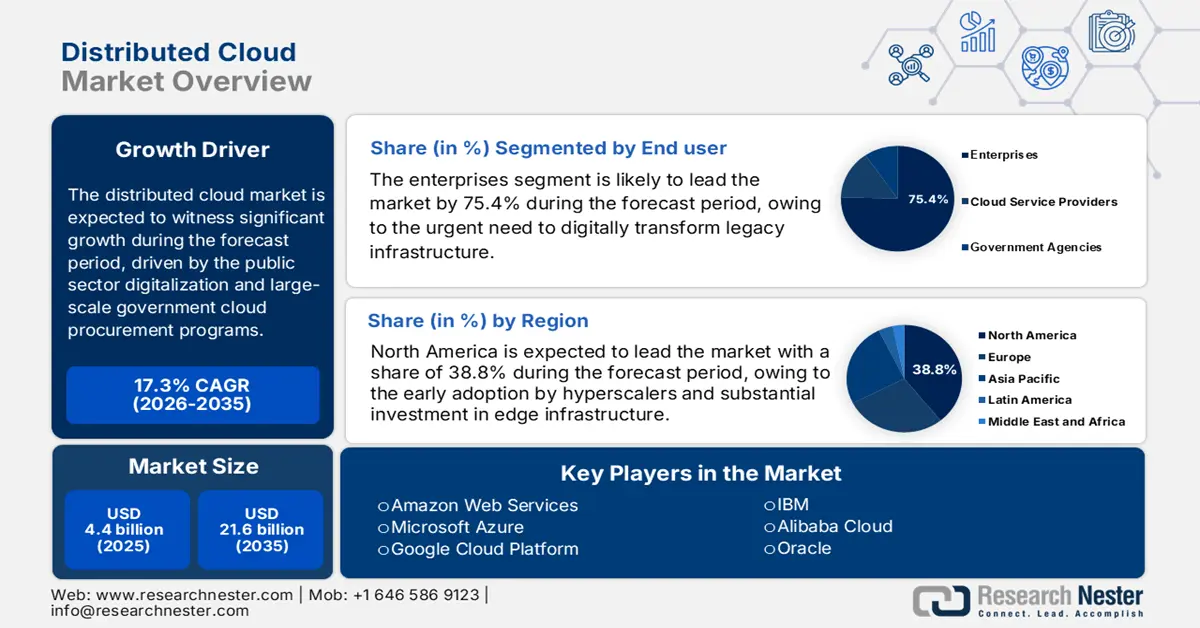
Distributed Cloud Market Outlook:
Distributed Cloud Market size was valued at USD 4.4 billion in 2025 and is projected to reach USD 21.6 billion by the end of 2035, rising at a CAGR of 17.3% during the forecast period, i.e., 2026-2035. In 2026, the industry size of distributed cloud is assessed at USD 5.1 billion.
The market is demanded by the enterprises for distributed cloud architectures and is being shaped primarily by public sector digitalization, mandates data residency enforcement, and large-scale government cloud procurement programs. In the U.S., the public cloud spending reached USD 411 billion in 2021, according to the U.S. Department of the Treasury in March 2022. This spending is driven by the IT modernization programs, defense workloads, and civilian agencies that require geographically dispersed compute environments for latency reliance and compliance purposes. The report from the leading cloud computing company, Nutanix, in August 2024 reports that nearly 8% of government agencies have currently deployed hybrid multicloud and is expected to surge to 33% within one to three years, which depicts a five-fold increase in adoption.
In Europe, regulatory enforcement is a central growth catalyst. The European Commission and ENISA have highlighted that GDPR, the EU Data Act, and sector-specific sovereignty rules are pushing enterprises to localize data processing while maintaining centralized control frameworks. The report from Eurostat in December 2023 indicated that 42.5 % of enterprises in the EU bought cloud computing services in 2023, with public administration, healthcare, energy, and financial services showing the fastest growth in regionally constrained deployments. On the other hand, the World Bank and OECD note that government-led digital public infrastructure investments are surging, spanning identity systems, tax platforms, and healthcare registries that require distributed compute footprints across national and sub-national jurisdictions. These spending patterns are reinforcing long-term enterprise adoption of distributed cloud models to meet regulatory, operational resilience, and public-sector interoperability requirements across regulated B2B environments.