Distributed Antenna Systems Market - Regional Analysis
North America Market Insights
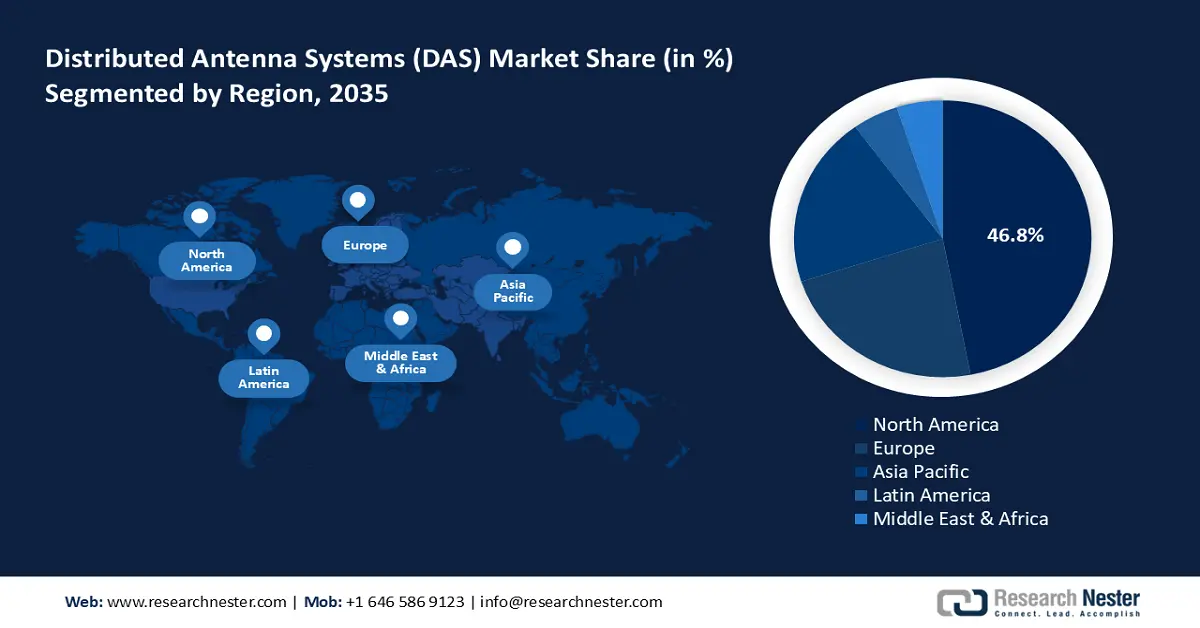
The North America DAS market is anticipated to account for 46.8% of the global revenue share by 2035. North America has a well-established telecommunications infrastructure, which has a direct impact on the demand for DAS solutions. Additionally, due to a digitalized economy, spurred by the U.S. and Canada, the demand for ultra-fast connectivity solutions is high in the region. The report by 5G Americas reveals that in the first quarter of 2025, the 5G connections reached 314 million, around 83% of the population in the region. The per-user base is 15x more than in other regions. Additionally, stakeholders in the market are buoyed by a well-established regional supply chain.
The U.S. DAS market is poised to hold a leading revenue share, owing to a greater demand for improved connectivity solutions. A key facet in the market is the intensifying competition between leading AI companies such as OpenAI, xAI, Microsoft, etc., broadening the frontiers and creating a favorable ecosystem for the adoption of DAS solutions. Moreover, the U.S. seeks to maintain its position as a global leader in communication technology, creating ample opportunities to proliferate DAS solutions. The table below highlights policy shifts in the U.S. that have a direct impact on the expansion of the U.S. DAS sector.
Canada is another lucrative market in North America supported by the government’s commitment to expanding high-speed internet access across the country. The Innovation, Science, and Economic Development (ISED) has established targets to expand broadband to the remote regions of the country, in a move that is expected to bolster demand for DAS solutions.
APAC Market Insights
The APAC distributed antenna systems market is poised to register the fastest expansion with a CAGR of 9.7% from 2026 to 2035. A major driver is the large percentage of consumers demanding high-speed connectivity solutions in the region. APAC has also been at the forefront of 5G adoption, especially in economies such as China, Japan, and South Korea. A key facet of the market is the presence of a strong supply chain, supported by the manufacturing capabilities of China, Japan, and India. Additionally, the Digital India Program and the 5G National Strategy of South Korea are examples of nationwide initiatives that will create long-term demand for DAS systems.
The China DAS market is expected to have the largest deployment during the forecast period, whilst maintaining a dominant revenue share in the region. A key facet is the country’s position as the largest 5G market in the world, owing to the presence of more than 4 million 5G base stations. The government has been extremely proactive in promoting nationwide hyper-connectivity, which augurs well for the future outlook. Major policy shifts include the Made in China 2025 initiative, which is expected to create lucrative opportunities for manufacturing antenna components within the country.
The Japan DAS market benefits from the Society 5.0 initiatives that envision a digitally connected, sustainable future of the country, which creates a high demand for advanced connectivity solutions. The JETRO report reveals that the government has granted nearly USD 660 million for the promotion of digitalization. The Ministry of Internal Affairs and Communications (MIC) has also set targets to hasten 5G penetration across the country, fueling the requirement for DAS systems. With Japan creating a favorable ecosystem for the entry of foreign companies, the market is set to be more competitive.
Europe Market Insights
The Europe distributed antenna systems market is likely to hold a significant share during the forecast period, owing to the expanding number of enterprises, telecom operators, and government offices. These all push for improved indoor wireless coverage to support rising data traffic, creating a profitable marketplace for DAS companies. The European Commission’s report reveals that more than 90% of households in the EU have 5G access. Further, with swift 5G rollouts accelerating across the region, mobile operators are partnering with infrastructure providers to deploy DAS in high-capacity venues such as airports, stadiums, shopping centers, and transport hubs.
The DAS sales in Germany are expected to be driven by the rapid digital transformation and Industry 4.0 adoption. The majority of the population living in urban areas is directly fueling the demand for indoor connectivity in the country. The office complexes, manufacturing facilities, and transport networks are mainly driving the sales of distributed antenna systems. The federal government’s Digital Strategy 2030, focusing on next-generation connectivity across industries, is also boosting DAS deployment.
The U.K. distributed antenna systems market is expected to increase at the fastest CAGR, owing to the strong enterprise demand and a dense urban landscape. The government-backed digital infrastructure initiatives are also contributing to the sales of distributed antenna technologies. The government’s Project Gigabit and 5G infrastructure investments, encouraging telecom operators and neutral-host providers to scale DAS deployments across commercial and public venues, are creating a profitable environment for key market players.