Direct Reduced Iron Market Outlook:
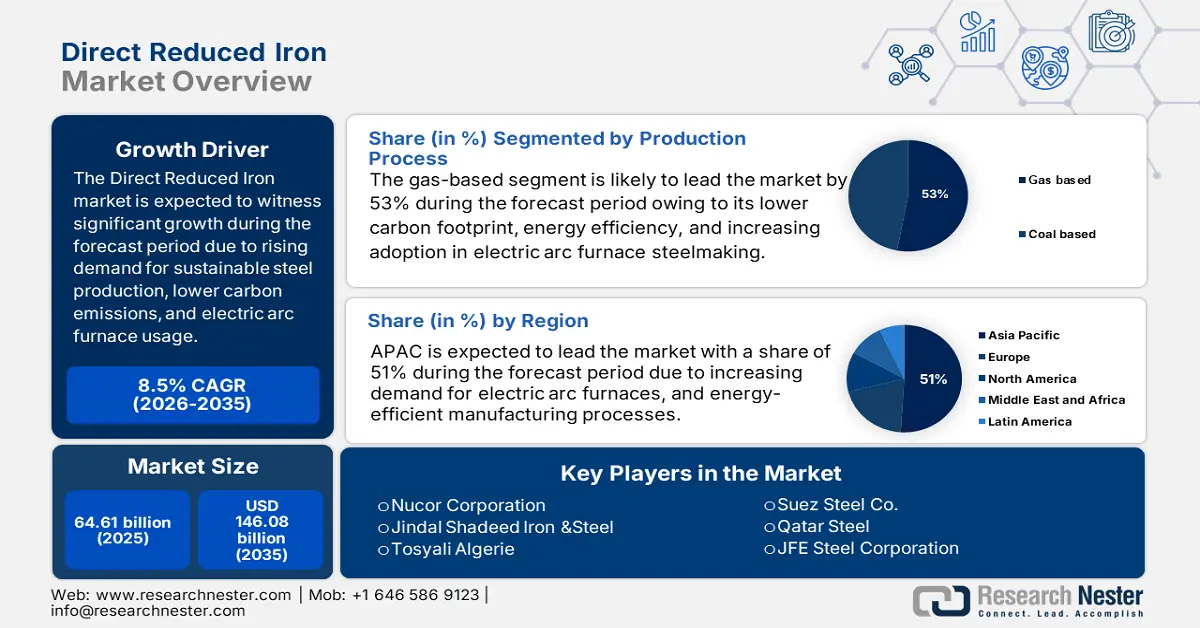
Direct Reduced Iron Market size was over USD 64.61 billion in 2025 and is projected to reach USD 146.08 billion by 2035, witnessing around 8.5% CAGR during the forecast period i.e., between 2026-2035. In the year 2026, the industry size of direct reduced iron is evaluated at USD 69.55 billion.
Globally steel industry is the biggest contributor to greenhouse gas emissions in the atmosphere. Generally, iron is produced with the help of a blast furnace route which is one reason behind high carbon emissions. However, the directly reduced iron does not produce a high amount of greenhouse gases, particularly carbon dioxide. It enables more environment-friendly approaches to be adopted by steel producers, which reduces their carbon footprint and mitigates climate change. The growing demand for direct reduced iron as a primary raw material for steel production due to its low carbon emissions compared with traditional Iron Production Process is an important factor driving the development of the direct reduced iron market driven by increasing focus on energy efficiency and reducing greenhouse gas emissions in the steel industry. Thus, growing steel production is predicted to drive the growth of the market in the forecast period. According to the World Steel Association, global crude steel production stood at 1,950.5 million tons in 2021 and is expected to grow by 3.7% compared with 1,880.4 million tons in 2020.
Steel is a principal raw material for products and projects in many sectors, including construction, the automobile sector as well as industry. The growth of infrastructure, urbanization, automotive manufacturing and industrial production is having a positive impact on steel demand. In view of continued increases in steel consumption, there is a corresponding need for iron production, which constitutes an essential part of the manufacture of steel.