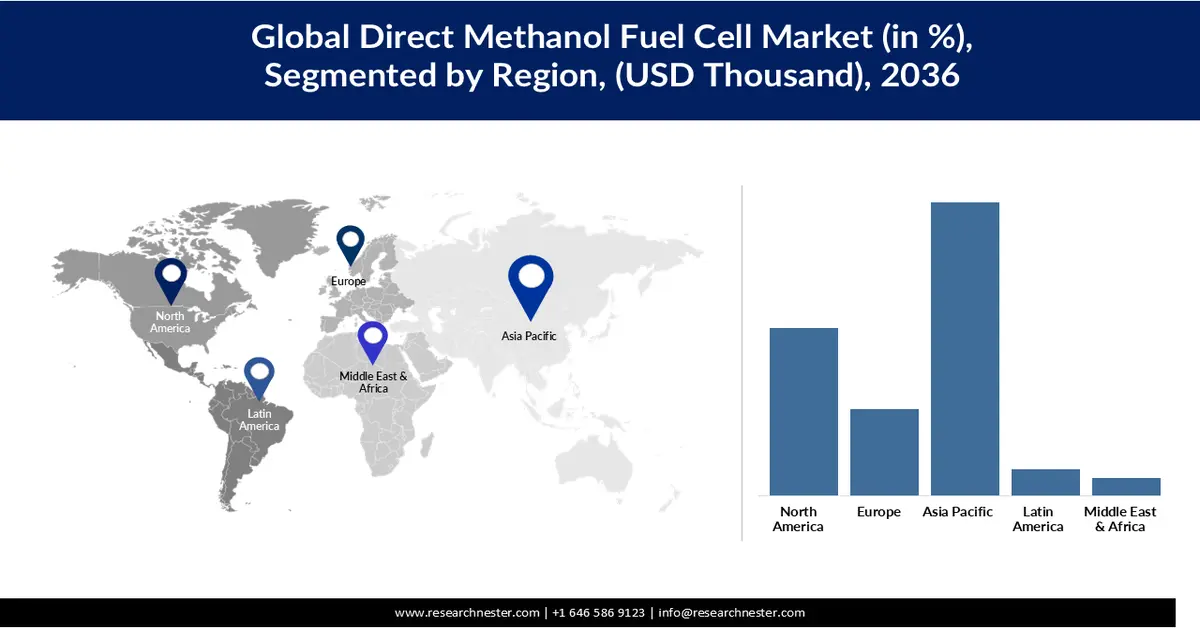
Direct Methanol Fuel Cell Market - Regional Analysis
Asia Pacific Market Insights
Asia Pacific is the most dominating market, expected to hold a market share of 35% by 2036, as the region is a leader in the manufacturing of electronics and electrical components, where the use of DMFC is quite high. Moreover, strong manufacturing and innovation of the region have fuelled the growth of the market, as defence, power, and transportation highly rely on methanol. The defence sector uses certain equipment and wireless radar systems that are located at distances in order to cover a large geographical space. As these are located in offshore and remote areas, frequent recharge of the battery can be avoided if methanol-based fuel cells are used in the generators.
China is one of the leading manufacturers of smart devices and mobile phones, which are transitioning towards the development of methanol-based batteries that can operate for long durations and are safe to carry. China is always on edge with innovation and the advancement of new technology. Thus, their adoption of DMFC has fuelled the growth of the global market. The adoption of DMFC increases the cost of the products, as there is a huge expense involved in the manufacturing of DMFC; also, the added supply chain risk further prohibits the growth of the market.
India, in its multi-energy strategy, has approved the usage of methanol, which can be obtained from animal waste, coal, and biomass, which is accelerating the expansion of the DMFC market. The defence sector has also enhanced the demand for reusable power systems that can operate for long working hours and minimize the need for frequent maintenance. Larger players such as SFC Energy supply DMFC units to the Indian defence to maintain their surveillance
North America Market Insights
The North American market is expected to hold a market share of 30% fuelled by the rapid expansion of high-performance power systems that can power the off-grid systems, such as telecommunication towers, radars, and solar power plants. North America also focuses on the maximisation of clean energy and reducing carbon emissions, which helps in sustaining clean and green energy. North America has also developed high-performance DMFC systems, which are sourced for military and defence. Soldiers often use night vision goggles and a position tracker that are equipped with methanol-based batteries to ensure superior longevity.
Canada has aimed towards carbon minimization, especially from the manufacturing sector, which contributes hugely to rising pollution levels. Canada has developed a Green Hydrogen Strategy through which the pollution levels would be reduced to a great extent. Canada’s emphasis on methanol adoption has enhanced its use in the production of a renewable source of energy, which is fuelling the DMFC market.
The U.S. has a broad consumer electronics industry that uses batteries made with methanol fuel cells, as they are lightweight and have high durability. Government-run R&D funding to improve the performance of fuel cells is further amplifying the growth of the market. The country hosts multiple off-grid power systems, such as solar power and telecommunication towers, which require reliable power. Methanol fuel cells hold great value for being an alternative viable option that not just reduces emissions but also reduces cost.
Europe Market Insights
The direct methanol fuel cell market of Europe is expected to hold a market share of 22% by the end of the forecast period. The market size in Europe will be USD 97,717.26 thousand by 2036, fuelled by innovation in catalyst and membrane technologies that are important components of a fuel cell. The demand is further driven by the policies of the EU that have enforced certain pollution control norms and increased the use of energy-efficient systems to maintain sustainability. Many regions have accelerated the growth of DMFC to curb carbon minimisation.
The sustainability measure of Germany is at par; the country has used green energy to enhance its sustainability. Germany uses hybrid engines in vehicles that can run on electric as well as methanol, amplifying the growth of DMFC. The low-carbon alternative is supporting the environment and acting as a key strategy in reducing government expenditures on public transportation.
The UK is quite established in terms of fuel cell manufacturing, with key players specialising in bipolar plates and stack components for DMFC. Moreover, companies are planning to expand the infrastructure that would manufacture products locally instead of relying on the volatile supply chain. Off-grid power stations are also increasing in the UK, which is demonstrating a strong demand for the DMFC market.