Dimethyl Ether Market Outlook:
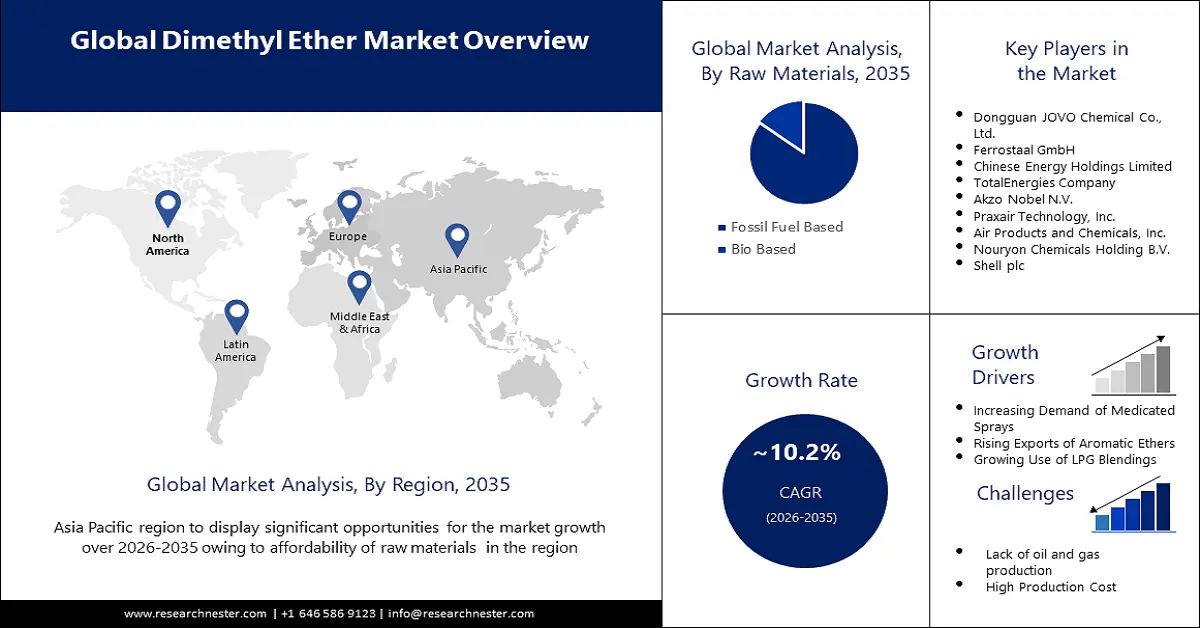
Dimethyl Ether Market size was over USD 10.28 billion in 2025 and is projected to reach USD 27.15 billion by 2035, witnessing around 10.2% CAGR during the forecast period i.e., between 2026-2035. In the year 2026, the industry size of dimethyl ether is evaluated at USD 11.22 billion.
The surging applications of dimethyl ether in LPG blending, and as a power plant gasoline are propelling the market growth. Dimethyl ether is blended with LPG as an alternative fuel additive to improve combustion, reduce harmful emissions, and limit reliance on LPG. By 2050, the UK government is required by law to attain net zero carbon dioxide emissions. This is anticipated to necessitate a reduction in CO2 emissions from the UK industrial sector, representing a dip from 78.2 x 10⁶ tons in 2019 to between 3.2 and 10.2 x 10⁶ tons by 2050. Similar standards have also been established by other major economies, including the U.S., China, Japan, and the EU.
In partnership with industry and academic institutions, Perkins Engines Company Limited (PECL) recognized the Red Diesel Replacement Phase 1 competition as a chance to accelerate the development of renewable DME (rDME) as a possible low carbon alternative fuel choice. Flogas Britain Limited (Flogas) is interested in investigating rDME as a fuel and expanding its customer base beyond its primary off-grid liquid energy clients. Owing to its long-standing research partnership with Perkins, Loughborough University was eager to contribute its prior knowledge of alternative fuels to the project and upgrade Perkins-specific engine test cells to accommodate alternative fuel testing.
In a broader sense, the prospects for rDME development as an off-highway engine fuel have also been evaluated. Although there isn't any rDME available in the UK right now, research indicates that global output will rise sharply in the upcoming years, reaching 39 million Tpa by 2050. Several important advantages of using rDME as a fuel have been identified, even though there are still obstacles to overcome, including the creation of regulatory pathways for certifying DME-fueled engines, competition for supply of the fuel and its feedstocks, and the cost of rDME in comparison to fossil diesel without low carbon fuel incentives. Among these are its limited emissions and compression ignition performance, the ease with which engines might be converted to use it, and-most importantly-its capacity to drastically cut WTW CO2 emissions. According to Flogas, rDME's designation as a "development fuel" under the RTFO is a critical first step in promoting its use as a transportation fuel and enabling the realization of these advantages.