Digital Transformation Market - Growth Drivers and Challenges
Growth Drivers
- Cloud-first government policies driving growth: Governments across the world are mainly focusing on cloud-first strategies to boost their digital infrastructure. The favorable cloud policies are fueling public-private investments to accelerate the growth of the digital transformation sector. For instance, the Indian government's adoption of a cloud-first approach is bolstering the growth of the sector. This approach not only improves public sector efficiency but also promotes private sector investments, thereby speeding up the adoption of next-generation digital technologies. The Ministry of Electronics and Information Technology (MeitY) has introduced several initiatives to boost digital infrastructure. These involve the establishment of over 5.84 lakh Common Service Centres (CSCs) in October 2024, the implementation of DigiLocker for paperless governance, and the creation of more than 67 million Ayushman Bharat Health Account (ABHA) numbers. These developments create a strong foundation for cloud-based services, facilitating the growth of cloud infrastructure and services in the public sector.
- Smart manufacturing & Industry 4.0 adoption: The growing smart manufacturing trend and the rise in Industry 4.0 adoption are projected to drive the sales of next-gen digital technologies. Technologies, such as digital twins, IoT-enabled machinery, and industrial automation, are expected to exhibit a high demand in North America, Germany, and East Asia to enhance their manufacturing systems. The World Robotics Report 2024 states that Germany holds the fourth position, with 429 robots deployed for every 10,000 employees. High robot density is a strong indicator of mature automation and Industry 4.0 adoption. This level of automation pushes demand for robotics, IoT, AI, and control systems. This highlights the importance of digital technologies in transforming the GDP of the country.
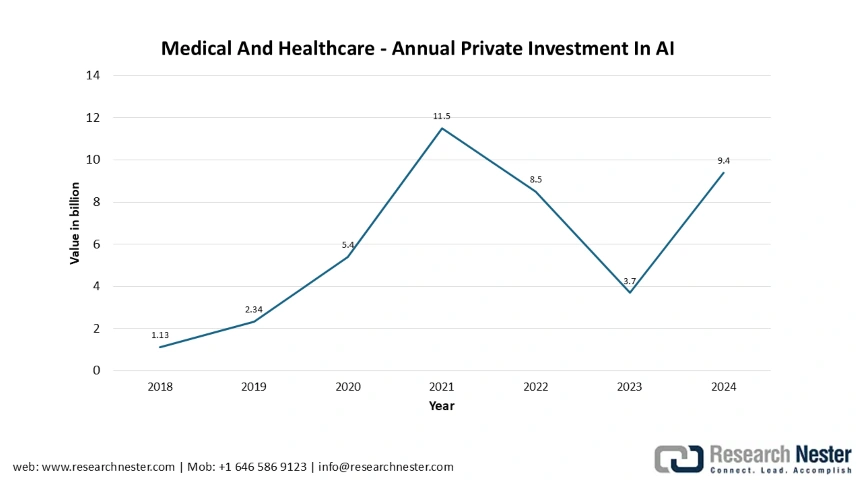
- Rising demand in the health sector: The demand for digital transformation in healthcare is significantly driving the growth of the global digital transformation market. AI is at the forefront of this shift, offering transformative possibilities in diagnostics, treatment, and operational efficiencies. The WEF report 2025 states that with 4.5 billion people lacking access to essential healthcare and a projected shortfall of 11 million health workers by 2030, AI holds the capability to close this gap and transform healthcare worldwide. AI technologies are already assisting healthcare professionals in detecting early signs of diseases, triaging patients, and analyzing complex medical data, thereby improving patient outcomes and reducing treatment costs.
Challenges
- Infrastructure readiness gaps: Many developing countries are witnessing a lack of proper digital infrastructure due to limited budgets. This gap limits the sales of digital technologies in the price-sensitive markets and hampers the producers' profit margin. However, the supportive government policies and initiatives aimed at digital transformation are projected to offer gainful returns to leading companies in the coming years.
- Strict data protection regulations: The strict data protection regulations are affecting the digital transformation growth across the world. The EU’s GDPR, India’s DPDP Act (2023), and China’s Cybersecurity Law, focusing on the protection of personal data of individuals, are limiting the flow of cross-border information. The strict compliance with this law slows the innovation process and delays new market entries, hampering the profits of global producers.
Digital Transformation Market Size and Forecast:
|
Base Year |
2025 |
|
Forecast Year |
2026-2035 |
|
CAGR |
22.1% |
|
Base Year Market Size (2025) |
USD 1.7 trillion |
|
Forecast Year Market Size (2035) |
USD 12.5 trillion |
|
Regional Scope |
|
Browse key industry insights with market data tables & charts from the report:
Frequently Asked Questions (FAQ)
The global digital transformation market will be valued at USD 1.7 trillion by the end of 2025.
The global market is expected to increase from USD 1.7 trillion in 2025 to USD 12.5 trillion by 2035 and expand at a CAGR of 22.1% during the forecast period.
Some leading companies are Microsoft Corporation, Amazon Web Services (AWS), Alphabet Inc., IBM Corporation, and SAP SE.
The cloud-based segment is estimated to capture a high 64.1% of the market share through 2035.
North America is expected to hold 33.6 % of the global market share through 2035.

