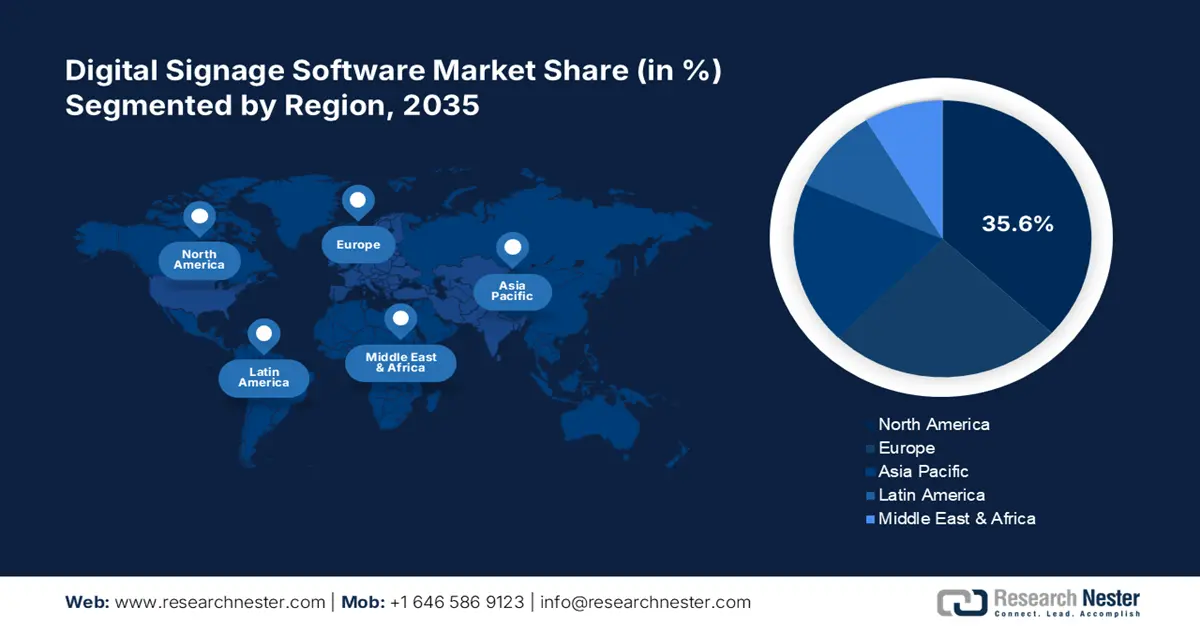
Digital Signage Software Market - Regional Analysis
North America Market Insights
North America digital signage software is anticipated to acquire the largest market share of 35.6% by the end of 2035, owing to the high digitalization of enterprises, indicating the probability of an increasing adoption. The availability of high-speed internet connectivity across the region indicates an opportunity to manage content, enabling real-time updates, and gaining utmost control over displays. For instance, in October 2024, the federal government allocated funding of USD 42.4 billion under the Broadband Equity, Access, and Deployment Program (BEAD), to enable affordable, reliable, and high-speed throughput internet coverage throughout. This is likely to encourage potential users to adopt the use of digital signage software as a convenient option.
The digital signage software market in the U.S. is set to register a rapid CAGR throughout the forecast timeline, on account of government-sponsored initiatives for smart cities. This is expected to accelerate the adoption of virtual displays in public places. The increasing smart city initiatives in the U.S. is expected to fuel the adoption of digital signage software for the enhancement of efficiency, communication, and public engagement. In addition, rising demand for integrated visual solutions across several organizations from various sectors is expected to accelerate the adoption of digital signage software in the coming years.
Canada market is projected to witness a robust CAGR between 2026 and 2035, owing to various federal ICT strategies. The government has announced several subsidies for businesses to encourage further advancement of digital signage, likely to lead to an increased adoption of advanced digital signage software. For example, in October 2023, the government of Canada announced an investment of USD 1.75 million to support L Squared Digital signage in upgrading communication platforms, creating 15 skilled jobs, and expanding globally. With the global expansion of key players associated with the market, the market is also projected to grow extensively.
Europe Market Insights
Europe digital signage software market is anticipated to account for a significant revenue share between 2026 and 2035, on account of the surge in demand for real-time communication, retail expansion, and rising digitization across several sectors. Rapid smart city infrastructure development, driven by different regulatory initiatives, is likely to increase the adoption of the digital signage software. As reported by the European Commission, an annual funding of USD 140.9 million was raised by Horizon Europe for the development of smart cities. With the rapid advancement of AI and ML, the opportunity of managing more personalized content for the target audience of the end use industries of the software fuels the market growth.
Germany is expected to emerge as an expanding digital signage software market at a high CAGR from 2026 to 2035, due to the growing adoption of Industry 4.0 and smart factories. The government is significantly encouraging the adoption of new technologies, including digital signage software for real-time monitoring of manufacturing processes and enhancing safety in the same. Moreover, increasing investments in digital infrastructure by German retailers and growing use of digital signage for digital out-of-home (DOOH) are expected to increase the demand for digital signage software in the coming years.
In the UK, the market is expected to flourish rapidly during the forecast period, due to innovation in the retail sector, public sector digitization, and tremendous efforts towards smart cities. For instance, Transport for London (TfL) included 1,100 advanced signage units across 25 boroughs, with Bexleyheath and Croydon emerging as the latest locations enabled with the technology. In the retail sector, a wide range of organizations are investing in the adoption of digital signage to install in different departments, support seasonal marketing campaigns, and generate inspirational content that can enhance the customer journey. The incorporation of digital signage in transportation and retail management is expected to accelerate the use of digital signage software.
Asia Pacific Market Insights
The digital signage software market in the Asia Pacific is projected to acquire a significant share by the end of 2035, owing to growing preference for tailored marketing content among consumers from different industries. The use of digital signage software facilitates the generation of marketing content tailored to the needs of the target audience. Similarly, smart city initiatives across the region are expected to fuel the market growth in the near future. Moreover, rapid adoption of cloud-based platforms is expected to boost the adoption of digital signage software during the forecast period.
China market is estimated to experience a robust CAGR during the forecast period, attributed to the rapid expansion of 5G infrastructure. With rapid 5G infrastructure development, the efficiency and capability of digital signage software are likely to improve. As reported by People’s Daily Online in September 2025, around 4.6 million 5G base stations were established across China as of August 2023. The involvement of a vast number of key market players within the country is expected to fuel the market growth through the development of relevant hardware technologies.
India is anticipated to emerge as an expanding digital signage software market at a high CAGR during the forecast timeline, with the rapid advancement of IoT and AI technologies. The integration of these technologies is expected to convert signage into smart tools for communication. The rising deployment of advanced digital technologies, especially in the retail sector, is expected to boost the use of digital signage software. Growing preference for cloud adoption across the country is also expected to drive the demand for digital signage software significantly. As reported by the India Brand Equity Foundation in January 2024, government organizations in the country are frequently adopting cloud services for the improvement of service delivery, reducing expenses, and enabling data-driven governance.