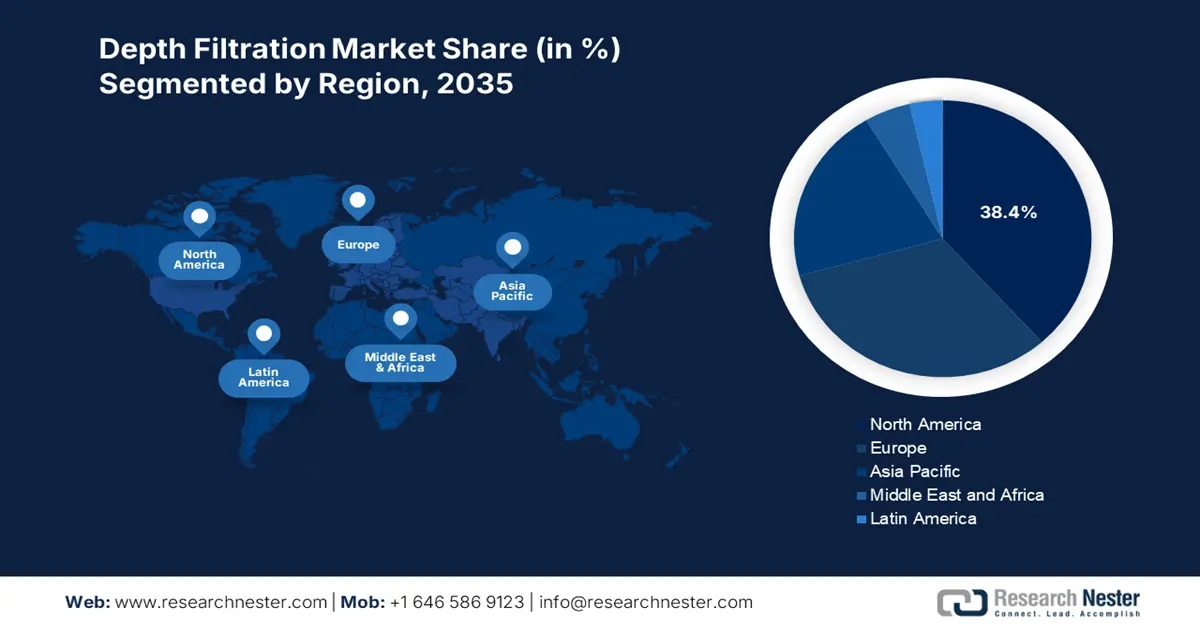
Depth Filtration Market - Regional Analysis
North America Market Insights
North America dominated the global depth filtration market and is anticipated to hold a market share of 38.4% by 2035. The NIIMBL evidence in April 2024 announced an investment of USD 10 million in projects related to multiple novel technologies and workforce development projects based on biopharmaceuticals. According to the National Health Institution, cell and gene therapy growth is currently high in market demand in North America, which leverages the demand for depth filtration. Government supports to elevate the research and development in depth filtration to make innovations and demand market growth.
The U.S. market of depth filtration is currently dominating in North America. Rapid expansion of biopharma has created a significant demand for depth filtration. Expansion in Medicaid support ensured market accessibility and raised the scope of revenue accumulation for the concerned market. As per the KFF report in July 2025, Medicare spending expanded to USD 60.3 million in 2024, for people aged above 65, including filtration-based therapies, increasing patient access and expanding the market. The key trends, like single-use systems and viral filtration guidelines, pushed the market of depth filtration in the U.S.
Depth Filtration Government Spending
|
Country |
Category |
Data |
Year |
|
U.S. |
NIH |
$48 billion budget, including filtration-based research |
2025 |
|
Canada |
Federal government’s 2023 |
$344 billion total health spending including R&D in pharmaceuticals |
2023 |
Sources: NIH, CMA
Asia Pacific Market Insights
The depth filtration market of Asia Pacific is identified with the emerging region and is expected to hold a market share of 20.8% by 2035. The key driving factor of growth includes robust growth of biopharmaceutical usage in the healthcare sector and an increased number of vaccine productions. The EFPIA report in August 2022 states that the clinical trials in Asia has increased to 10% over the past decade, particularly in biopharmaceutical manufacturing and drug development including monoclonal antibodies (mAbs), vaccines, and cell & gene therapies. The government is exhibiting a sincere approach to support the growth of the depth filtration market. Fast urbanization and diagnosis led to an increased number of chronic disease burdens in the Asia Pacific.
The depth filtration market in China is expanding rapidly with the rise in biologics, vaccines, and plasma-derived medicines. Government support for advanced pharmaceutical manufacturing and biotech R&D highlights this growth. The 2025 China Power report illustrates that China allocated $54.6 billion on science and technology, which is 10.2% of its total budget. This funding also includes the research in single-use filtration, sterile manufacturing, and biologics manufacture, allowing domestic manufacturers to build capacity, increase efficiency, and comply with regulations within the fast-changing depth filtration industry.
Europe Market Insights
The Europe depth filtration market is experiencing sustained growth with rising demand for biologics, vaccines, and sterile advanced pharmaceuticals. The market is driven by increasing patient populations that are demanding cell and gene therapies, robust regulatory requirements for controlling contamination, and government funding in the production of pharmaceuticals. According to the vaccines Europe report in November 2024, the EU has spent close to €46.2bn on pharmaceuticals R&D. In addition, the worldwide R&D has a value of €143.6 billion in 2022, and Europe accounts for 32.2% of this investment. Germany, France, and the UK are the essential markets, as there is high use of single-use systems and advanced filtration modules in commercial production.
Germany is dominating the depth filtration market in Europe, and it is the largest medical biotechnology and diagnostics market. According to the GTAI report in 2025, Germany is the second strongest in biotech worldwide after the U.S. In 2022, the country saw a 19% boost in medical biotechnology R&D expenditures, aided by robust government programs through the Federal Ministry of Health (BMG) and EU initiatives. Germany spent more than EUR 6.3 billion in 2021 in the in vitro market, and it is stated that nearly 70% of clinical diagnoses are dependent on IVD. Further, the country will have a strong demand for biologics, robust infrastructure, and increasing adoption of bioprocessing and single-use filtration systems.