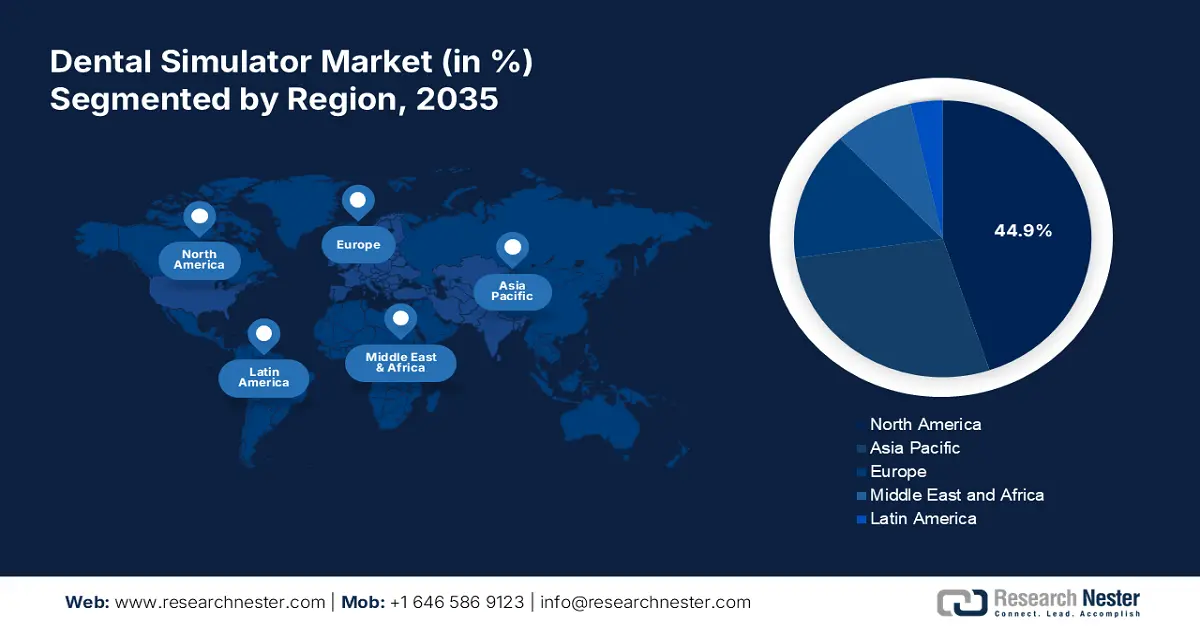
Dental Simulator Market - Regional Analysis
North America Market Insights
North America industry is set to dominate majority revenue share of 44.9% by 2035, driven by the presence of key market players and the increase in healthcare spending in the region. Moreover, factors such as high healthcare IT expenditure, extensive use of technologically innovative models in dental schools, and rising awareness of simulation studies within the dental community are projected to drive the region's growth.
In the U.S, the dental simulator market is expected to account for a significant share between 2026 and 2035 owing to rising healthcare spending and increasing product launches. According to the American Medical Association, healthcare spending reached USD 4.3 trillion per capita in 2021.
The dental simulator market in Canada has also steadily expanded over the years owing to a high focus on improving healthcare infrastructure and rising investments in R&D activities. For instance, Overjet, a top player offering AI solutions in the dental industry in China, announced its expansion in Canada to improve oral health.
Asia Pacific Market Insights
Asia Pacific dental simulator market is projected to experience a stable CAGR during the forecast period owing to the improving penetration of simulation education in dental practices and rising adoption of dental tool manufacturing facilities in the region. Moreover, growing investments in the dental healthcare sector in countries such as China, South Korea, India, and Japan, among other regions are also projected to augment the region’s growth.
In China, the market is expected to account for significant market growth by the end of 2035 owing to rising healthcare expenditure, high disposable income, and rising adoption of advanced tools and technologies in dental clinics and institutes. Moreover, rising product approvals is expected to boost dental simulator market growth going ahead. For instance, in September 2024, Linden Capital Partners announced that it had received regulatory support from the National Medical Products Administration (NMPA) for its new crosslinked bioresorbable collagen dental membrane designed for use in oral surgical procedures.
In Japan, the increasing emphasis on technological developments drives the adoption of innovative dental simulators, including features such as virtual reality and real-time feedback that provide students or learners with an immersive experience.