Defense Integrated Antenna Market Outlook:
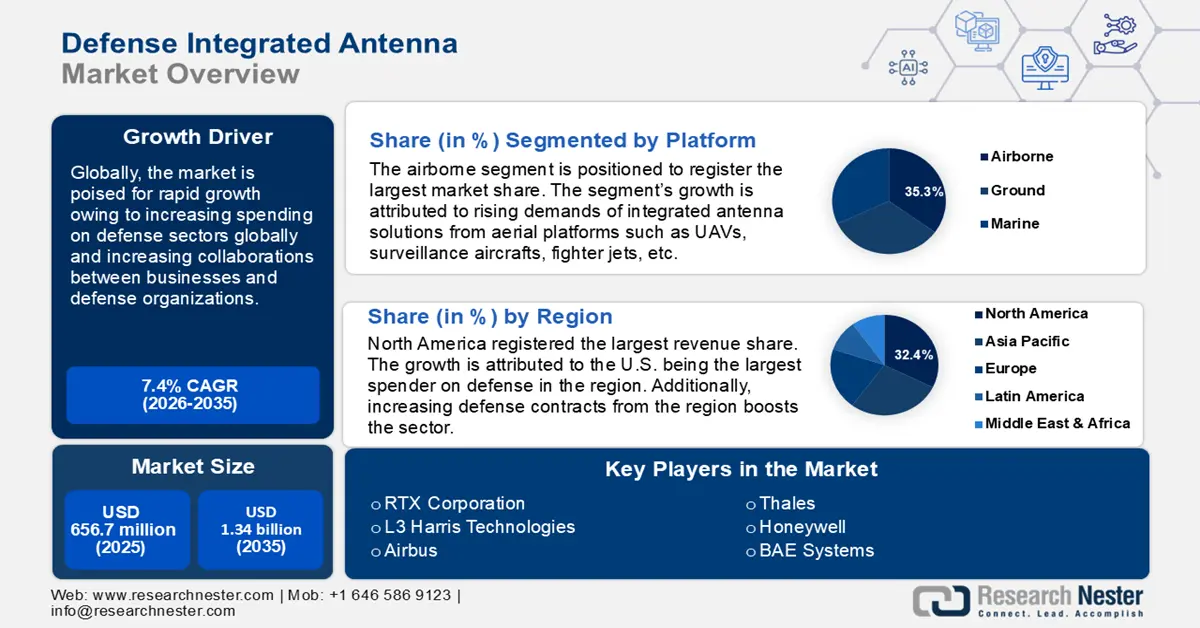
Defense Integrated Antenna Market size was valued at USD 656.7 million in 2025 and is expected to reach USD 1.34 billion by 2035, registering around 7.4% CAGR during the forecast period i.e., between 2026-2035. In the year 2026, the industry size of defense integrated antenna is evaluated at USD 700.44 million.
The growth of the market is attributed to large-scale investments in defense budget and advancements in 5G boosting defense communications allowing secure and fast communication. The trends are boosting demands for versatile antennas that can withstand extreme conditions in the defense sector across land, sea, and air. For instance, in December 2023, TX’s Raytheon announced that it would design, build, and test two high-powered microwave antenna systems under the 3-year USD 31.3 million contract from the Naval Surface Warfare Center Dahlgren Division.
A major growth driver of the defense integrated antenna market is the increasing allocation of funding by governments for innovative technologies to boost communications in the defense sector. Defense agencies worldwide are prioritizing the modernization of communication and data systems, by using integrated antennas capable of high-frequency satellite communication in the Ka-band network. For instance, in May 2023, the U.S. Department of Defense (DoD) announced the second set of projects for funding via the Accelerate the Procurement and Fielding of Innovative Technologies (APFIT) program, opening opportunities for manufacturers of integrated antenna solutions to provide innovative solutions for the contracts.
Additionally, the rising factor of electromagnetic threats that can disrupt communication systems necessitates the requirement of integrated antenna systems that can provide secure signal processing. For instance, in April 2023, the Defense Advanced Research Projects Agency (DARPA) announced that it was looking for ideas from non-traditional defense contractors and small businesses or novel antenna designs, materials, and manufacturing.
The defense-integrated antenna sector provides profitable opportunities to established players as well as new entrants to the market. The sector is positioned to leverage opportunities arising out of the rise of geopolitical tensions. Key market players have the opportunity to provide robust integrated antenna solutions in emerging economies of Asia Pacific that are undergoing an increase in defense spending. Opportunities are available for manufacturers that can integrate multiple offerings in a defense integrated antenna such as satellite communications (SATCOM), radar, GPS, and EMP protection are poised to benefit from the surging demands in the sector. Additionally, growing collaborations between defense agencies and companies foster greater innovation in the defense integrated antenna market. The global sector is positioned to leverage the favorable trends and continue its robust profit surge during the forecast period.