Custom Virtual Router Market - Growth Drivers and Challenges
Growth Drivers
-
Increasing government support for network infrastructure modernization: The rising government push to bolster network infrastructure in a bid to digitalize economies is a major driver of the custom virtual router market. Modernization of network infrastructure creates a favorable ecosystem for the heightened deployment of custom virtual routers. Major such initiatives include the USD 42.5 billion commitment by the U.S. National Telecommunications and Information Administration (NTIA) under the aegis of the BEAD program. A key push by the program is to create scalable routing technologies that can support next-generation networks and mitigate dependency on traditional routers. The table below highlights recent major investments across the world in a bid to modernize network infrastructure:
|
Country
|
Initiative |
Budget/Investment |
Key Details |
|
India
|
National Quantum Mission (India) |
₹6,003.6 crore (approx. USD 60.0 billion) |
Research and development in quantum computing, communication, sensing, and materials. Implementation: Approved in April 2023 for the period 2023-24 to 2030-31. |
|
Australia
|
National Broadband Network (NBN) Upgrade (Australia) |
AUD 3 billion |
Expanding the fiber network and increasing internet speeds for eligible customers on Fibre to the Premises (FTTP) and Hybrid Fibre Coaxial (HFC) connections. |
|
India
|
Assam Digital Infrastructure Investment (India) |
₹400 crore (approx. USD 4 billion) |
Strengthening telecom and IT infrastructure, including the development of advanced data centers. Announced: This investment was confirmed at the Advantage Assam 2.0 summit in February 2025. |
Source: PIB, ABC
- Growing use of cloud-based services: The accelerating shift toward cloud computing is a major driver for the custom virtual router market. As enterprises migrate their applications and data to the cloud, the need for agile and scalable networking solutions becomes paramount. Virtual routers provide the flexibility to manage network traffic efficiently between cloud environments and on-premises infrastructure. Cloud providers are also expanding their native networking services, further boosting the adoption of virtual routing technologies. In July 2025, Microsoft Azure announced the retirement of its Basic Load Balancer service, requiring customers to migrate to the more advanced Standard Load Balancer. This change encourages the adoption of more sophisticated load balancing and routing services, reflecting the growing demand for high-performance cloud networking.
- Growing demand for network automation: Increasing network sophistication is driving automation, which facilitates easy network management and lowers the costs of operations. Automated network environments include custom virtual routers, which support programmatic configuration and management of route policies. Organizations can more rapidly adapt to shifting business needs, and network efficiency improves. Incorporation of artificial intelligence and machine learning is also improving network automation, facilitating predictive insight as well as proactive optimization of networks. In July 2023, Riverbed Technology, Inc. introduced Alluvio IQ, an AI-based observability service that complements its SD-WAN as well as virtual routing offerings to optimize traffic as well as automate network data analysis. The service facilitates organizations to diagnose performance issues proactively.
Impact of Wi-Fi 6 and 6E Adoption on the Custom Virtual Router Market
Wi-Fi 6 and 6E continue to shape the custom virtual router market by offering better capacity, efficiency, and coverage. In 2022, over 2.3 billion Wi-Fi 6 devices and 350 million Wi-Fi 6E devices were shipped worldwide. This rapid adoption is fueled by the need for seamless connectivity across enterprise and consumer environments. As Wi-Fi is projected to contribute nearly US$5 trillion to the global economy by 2025, these technologies present exceptional opportunities for companies developing next-generation virtual routers.
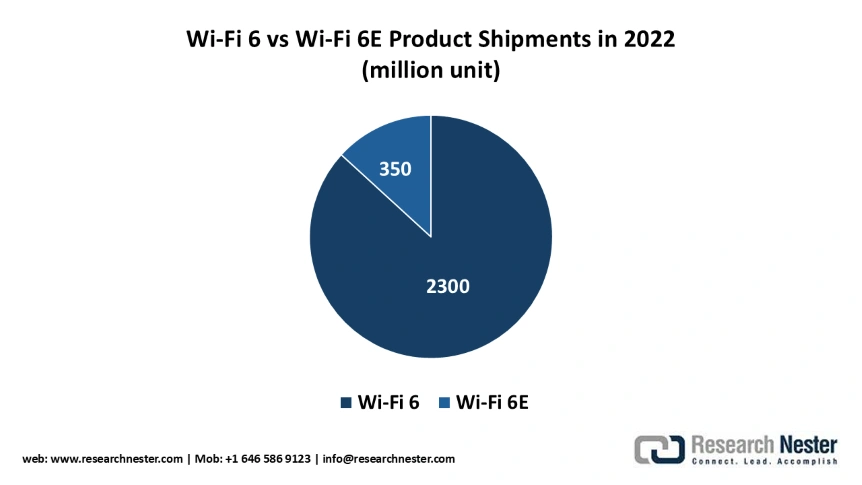
Source: IEEE
Technological Trends Shaping the Custom Virtual Router Market
The global custom virtual router market is bolstered by technological advancements in virtualization and network automation. For instance, network function virtualization (NFV) and software-defined networking (SDN) have enabled telecom operators to decouple network functions from hardware. An example of a successful use case is 6WIND introducing its virtual host-based router in July 2024 to provide Kubernetes integration. The table below highlights a few major advancements in the custom virtual router market.
|
Industry |
Technology Adoption |
Example |
|
Manufacturing |
5G integration for smart manufacturing and real-time data processing |
In March 2023, Cisco announced 800G innovations for its 8000 series routers, specifically touting major power and space efficiency benefits for service and cloud providers |
|
Finance |
Cloud-based virtual routers for secure and scalable network infrastructure |
Equinix's fabric cloud router facilitates multi-cloud networking with up to 25 Gbps scalability. |
|
Defense |
Secure virtual routers for rapid deployment over various communication networks |
In July 2024, Persistent Systems announced its Cloud Relay Virtual Hub Router for enabling mobile ad hoc networking (MANET) for military, government, and commercial users. |
Source: CISCO, Equinix, Persistent Systems
Challenges
-
Security vulnerabilities in virtualized environments: With a number of organizations proactively adopting virtualized networking solutions, the attack surface of cyber threats has expanded. Custom virtual routers introduce additional layers of complexity that can cause challenges if proper configuration solutions are not accessible. Additionally, the dual challenge of securing virtualized infrastructure and meeting compliance mandates has pushed vendors in the custom virtual router market to inculcate cybersecurity features in their offerings.
-
Interoperability and integration challenge: Achieving interoperability across varying virtual routing solutions, as well as with preexisting physical network infrastructure, can prove to be a daunting task. The absence of industry-standard interfaces and protocols can cause integration headaches, as it might become challenging to develop a seamless and efficient networking aspect. Organizations might also struggle in regard to managing a hybrid network that incorporates both physical and virtual routers from varying vendors. In January 2025, the U.S. Department of Justice sued to stop HPE's planned $14 billion purchase of Juniper Networks over fears it would reduce competition in the networking industry. The lawsuit highlights the networking industry's complicated nature as well as custom virtual router market consolidation, having a positive impact on interoperability as well as customer choice.
Custom Virtual Router Market Size and Forecast:
|
Base Year |
2025 |
|
Forecast Year |
2026-2035 |
|
CAGR |
7.5% |
|
Base Year Market Size (2025) |
USD 6.8 billion |
|
Forecast Year Market Size (2035) |
USD 14 billion |
|
Regional Scope |
|

