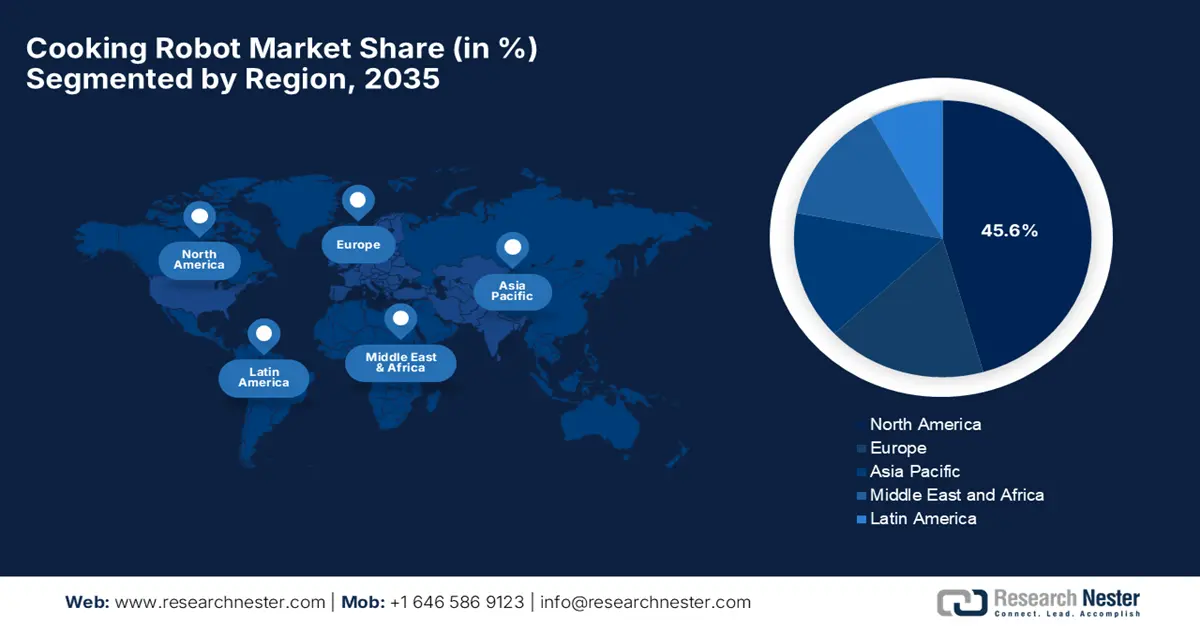
Cooking Robot Market - Regional Analysis
North America Market Insights
The cooking robot market in North America is expected to lead the entire global dynamics, capturing the largest stake of 45.6% by the end of 2035. The region’s focus on technological innovation and AI integration in food service operations has propelled it to gain a dominant position in this field. In January 2023, Nala Robotics, with Ovention, Inc. and Hatco Corporation, announced that it had unveiled a compact, fully autonomous robotic pizza-making system at NAFEM 2023, which is designed for convenience stores, QSRs, as well as ghost kitchens. It also stated that this AI-powered system automates dough pressing, sauce and topping application, cooking, slicing, boxing, and storage in Hatco’s Pizza Locker, all within a 10' x 10' footprint. Hence, this integrated solution enhances operational efficiency and allows operators to increase revenue by providing consumers with convenient, customizable pizza options.
The U.S. has captured the commanding position in the regional cooking robot market owing to a combination of factors such as increased adoption in commercial kitchens, as well as the need for operational scalability in large restaurant chains. In November 2024, Serve Robotics announced that it had acquired Vebu Inc., which is the developer of the Autocado robotic system, to expand its automation offerings beyond delivery into back-of-house restaurant operations. In this regard, the Autocado automates avocado processing, allowing staff to focus on other tasks, and is currently piloting at Chipotle in Huntington Beach, California. Hence, this acquisition strengthens Serve’s partnerships with major restaurant chains, broadens market opportunities, and integrates Vebu’s expertise in kitchen automation into Serve’s operations, making it suitable for overall market growth.
Canada is reaping advantages in the cooking robot market, wherein the foodservice operators are turning to automation to maintain consistent food quality by optimizing kitchen workflow and reducing operational risks. The country’s strong emphasis on workplace safety, along with compliance with stringent hygiene standards, is also readily encouraging the deployment of NSF-certified robots. In July 2022, Compass Group Canada and SJW Robotics announced that they had entered into an exclusive partnership to pilot the RoWok, which is a 24/7 autonomous kitchen robot, in select locations in the country. Moreover, the initiative targets gaps in around-the-clock meal availability by offering hot, fresh, and customizable meals for healthcare workers, students, and office staff outside the normal kitchen hours. The company also underscored that RoWok combines robotics, AI, machine learning, and cloud analytics to deliver more than 60 meals per hour while occupying just 100 square feet, hence enabling innovative service in spaces without a full kitchen.
APAC Market Insights
The cooking robot market in the Asia Pacific is considered to be the fastest-growing region during the forecast period. This rapid growth is effectively propelled by factors such as rising urbanization, increasing disposable income, and an expanding foodservice industry. Simultaneously, countries across the region are facing acute shortages of skilled kitchen labor, encouraging restaurants and hotels to integrate robotics. In March 2024, SoftBank Robotics announced that it would take over the distribution of Yo-Kai Express’s autonomous cooking robot called CHEFFY in Japan, thereby aiming to expand usage and enhance service quality. Besides, this partnership builds on existing deployments of Yo-Kai’s ramen-preparing robots across offices, commercial spaces, and major transit hubs. Furthermore, the company also stated that it's planning to drive further innovation and broaden the reach of autonomous food-service technology.
China has gained huge exposure in the regional cooking robot market since it has a massive foodservice sector and the ever-increasing popularity of smart kitchens. The surging labor costs are encouraging both small eateries as well as large restaurant chains to adopt these robotic cooking systems. For instance, in June 2025, DOBOT announced the launch of its mass production and delivery of its humanoid robot, DOBOT Atom, marking a major milestone in embodied intelligent robotics. The company also stated that Atom features DOBOT’s proprietary neuro-driven system for coordinated motion and industrial-grade precision, enabling tasks from soldering to delicate cherry picking. In this context, the debut reflects the company’s achievements and advances its mission to make next-generation robotics widely accessible, hence making it suitable for overall market growth.
India also holds a strong position in the regional cooking robot market, effectively attributable to the heightened demand for hygienic fast food preparation. Food operators in the country are opting for these robots to perform multiple functions such as automating frying, griddling, and food assembly operations, especially in metro cities with high footfall. Simultaneously, the country also hosts burgeoning startups that are readily fueling innovation in affordable, modular cooking robots that are suitable for domestic cuisines. Government initiatives promoting smart kitchens, Make in India manufacturing, along with AI adoption, are also encouraging market expansion. Furthermore, the rising awareness among consumers about food safety, consistency, and quick service is encouraging operators to deploy robots, particularly in QSRs, hotels, and catering segments, hence fueling adoption across the country.
Europe Market Insights
Europe has acquired the most prominent position in the regional cooking robot market, positively influenced by factors such as stringent labor laws and high wages. Automation is increasingly being implemented in commercial kitchens, hospitals, and institutional food services to reduce dependency on human labor. In December 2024, Circus SE announced that it had entered the European nursing and elderly care sector with its fully autonomous AI-powered CA-1 food-service robot, which delivers personalized, hygienic meals by easing staff workloads. The robot uses AI and machine learning, and it tailors menus to individual dietary needs, supporting care facilities that are facing rising demand. Furthermore, it also stated that with over 30 million people in need of care across the region, the company positions itself as a key innovator in a rapidly growing, multi-billion-euro sector.
Germany has gained enhanced momentum in the cooking robot market, facilitated by its advanced automation ecosystem and strong focus on workforce efficiency. Manufacturers in the country are readily making investments in robots that have high precision, energy efficiency, and compliance with strict food safety standards. In June 2023, dnata reported that it showcased an AI-powered cooking robot developed by Moley Robotics at the 2023 World Travel Catering & Onboard Services Expo, reflecting the future of automated culinary operations. It also stated that the robot replicates chef-made dishes utilizing sensors and machine learning, thereby highlighting the company’s crucial role in boosting quality and efficiency through advanced technologies. Therefore, such instances are expected to boost the country’s market at a rapid pace, positioning it as a key growth engine in the regional landscape.
The U.K.’s cooking robot market is growing owing to the rising operational costs and increased adoption of technology in foodservice operations. The country’s market also benefits from the growing trend of contactless service, along with digital ordering has created demand for scalable, AI-driven robotic systems that can handle repetitive tasks consistently while enhancing overall kitchen productivity. In January 2024, Moley Robotics announced that it had inaugurated the first ever world’s first luxury robot kitchen showroom in London, which is offering an immersive look at automated gourmet cooking powered by advanced robotic arms and AI. It also stated that the space showcases premium kitchen designs and live demonstrations of Moley’s Chef’s Table, X-Air, and A-Air systems, which can recreate recipes from world-renowned chefs, hence denoting a positive market outlook.