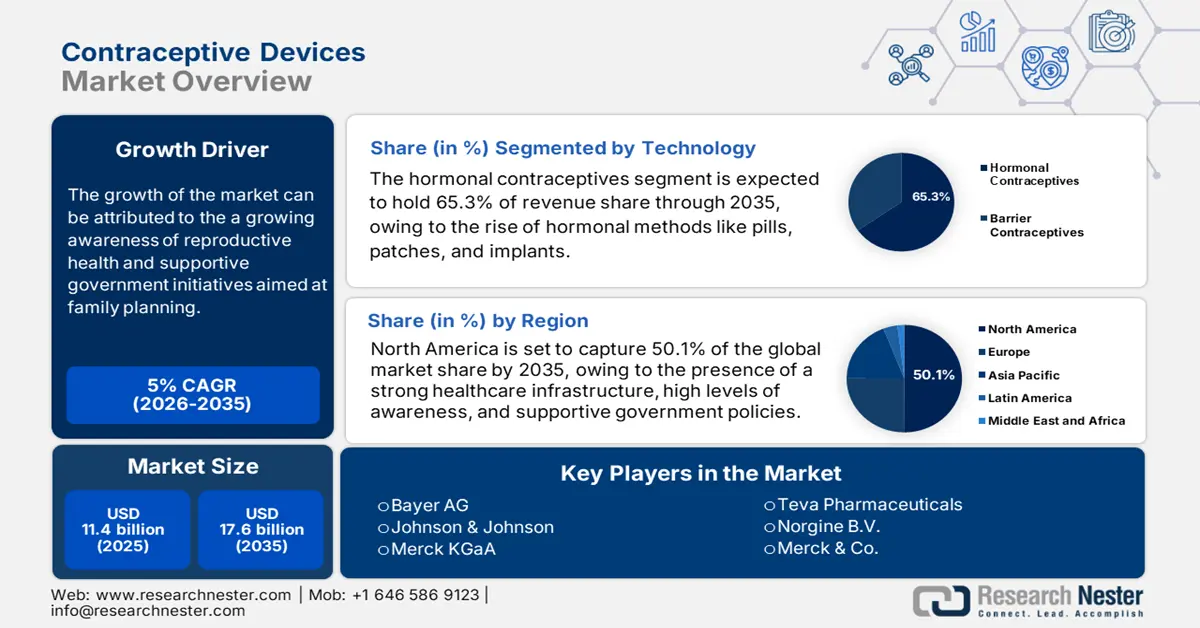
Contraceptive Devices Market Outlook:
Contraceptive Devices Market size was over USD 11.4 billion in 2025 and is estimated to reach USD 17.6 billion by the end of 2035, expanding at a CAGR of 5% during the forecast timeline, i.e., 2026-2035. In 2026, the industry size of contraceptive devices is assessed at USD 11.9 billion.
The growing awareness about reproductive health is primarily fueling the market. Particularly, the worldwide surge in solutions to prevent sexually transmitted infections (STIs) is creating a substantial consumer base for this sector. Testifying to the same, the 2025 findings by the World Health Organization (WHO) unveiled that, every day, more than 1.0 million people around the globe acquire STIs, where 520 million individuals aged between 15 and 49 are afflicted by herpes simplex virus type 2 (HSV-2). These figures indicate the urgent need for an adequate supply of effective birth control commodities, which is propelling demand in this field.
Payers' pricing dynamics in the contraceptive devices market are highly influenced by regulatory mandates aimed at expanding public access. For instance, under the federal guarantee and additional guidance, insurers in the U.S. are forced to offer financial backing for all contraceptives approved by the FDA, even the over-the-counter (OTC) products, without charging copayment or coinsurance. Despite such coverage, some plans still impose restrictions, particularly in resource-constrained regions, for certain devices. For instance, in 2022, the cost of modern birth control options in India ranged from USD 12 for condoms to USD 48 for a contraceptive implant, as per the NLM findings.