CMOS Image Sensor Market Outlook:
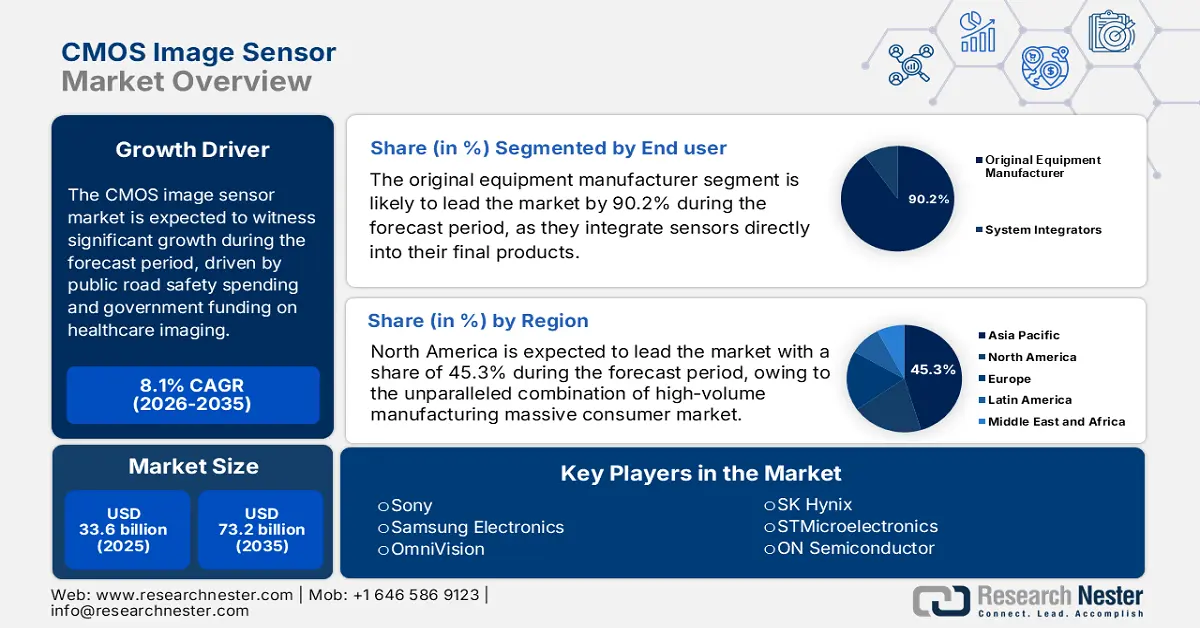
CMOS Image Sensor Market size was valued at USD 33.6 billion in 2025 and is projected to reach USD 73.2 billion by the end of 2035, rising at a CAGR of 8.1% during the forecast period, i.e., 2026-2035. In 2026, the industry size of CMOS image sensor is assessed at USD 36.3 billion.
The global demand for the CMOS image sensor market is closely tied to government-backed spending in automotive safety, healthcare, imaging, industrial automation, and space and earth observation programs. The U.S. National Highway Traffic Safety Administration reports that the rear view cameras are becoming mandatory in all new light vehicles, contributing to near-universal camera adoption across the passenger fleets, while ongoing rulemaking around pedestrian safety and crash avoidance systems is increasing the number of imaging modules per platform. The report from the NHTSA in April 2024 indicated that the Lidar Coalition’s submission to NHTSA is part of an active regulatory process. The safety agencies prioritize testing in the darkest realistic conditions, and OEMs and Tier-1 suppliers demonstrate performance under low-light and night scenarios. This directly affects the sensor selection, volume sourcing, and system architecture, influencing the market demand across imaging and perception components.
Parallel trends are visible in Europe, where the European Commission’s General Safety Regulations require multiple camera-based systems in new vehicles, reinforcing sustained OEM procurement volumes. The OEC 2023 indicates that the global trade in optical photo and film equipment reached USD 662 billion, reflecting the scale of cross-border movement of imaging-intensive systems. A substantial share of this trade is related to the automotive, medical, and industrial equipment, where image sensors are embedded rather than shipped as standalone components. Continued growth in intra-EU and extra-EU trade signals a stable downstream demand for optical and imaging subsystems. These trade flows support capacity utilization across the imaging supply chain and provide indirect validation of sustained sensor integration across regulated vehicle platforms and other precision equipment categories.