Chikungunya Treatment Market - Regional Analysis
Asia Pacific Market Insights
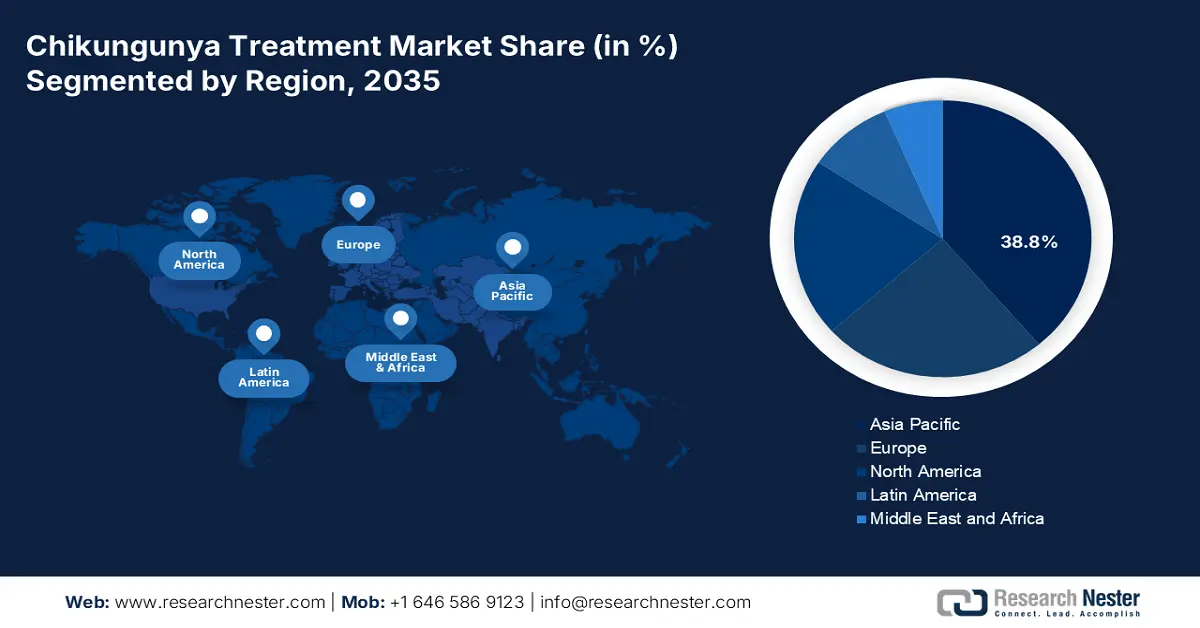
APAC is the leading region in the chikungunya treatment market and will retain the market share of 38.8% at a CAGR of 8.2% in 2035. The region is driven by the increased government spending, endemic outbreaks, and enhanced diagnostic surveillance in countries such as Malaysia, India, Japan, China, and South Korea. According to the WHO September 2024 report, vector-borne diseases constitute more than 17% of all infectious diseases, including chikungunya disease, recording 700,000 deaths every year, with Asia-Pacific nations, being major contributors to the burden of the disease.
India holds the largest share in the chikungunya treatment market and is expected to have a revenue share of 35.5% by 2035. As per India’s National Health Mission report published I August 2025, the total number of confirmed chikungunya cases in 2023 was 11477 in all states. Further, the Ministry of Health and Family Welfare report in December 2022 states that the budget outlay for vector-borne disease in the year 2022 to 2023 was Rs. 575.65 crore. On the other hand, the rising patient pool has led to expanded procurement contracts with leading manufacturers like Bharat Biotech and Cipla for drug availability.
No. of Cases Registered in APAC region in 2025
|
Country |
Year |
No. of Cases |
|
India |
2025 |
1741 |
|
Sri Lanka |
2025 |
151 |
|
China |
2025 |
478 |
|
Australia |
2025 |
77 |
Sources: National Health Mission, Ministry of Health & Mass Media, Government of Hong Kong Special Administrative Region, Relief Web
North America Market Insights
North America is the fastest-growing region in the chikungunya treatment market and is expected to hold a considerable market share by 2035. The market is driven by the increasing outbreaks in government reimbursement programs and public health surveillance. As per the Lancet regional Health data in February 2024, 0.3% which is 12,172 out of 3,684,554 are the reported cases in the population of North America. Pharmaceutical R&D incentives and private-public partnerships are creating a structured growth model for emerging manufacturers in the region.
The U.S. chikungunya treatment market for chikungunya treatment is seeing increasing demand with sporadic outbreaks in Florida, Texas, and Puerto Rico, where subtropical environments have increased vector activity. Based on the Science Direct report in February 2024, more than 3.7 million acquired cases were reported till date, triggering state-level acquisition and clinical response development. NIH and AHRQ have amplified antiviral and supportive therapy R&D funding under federal grants. The market in America is ready for suppliers of cost-effective, scale-up-capable, and Medicare-covered oral therapies, particularly in areas with outbreak repetition.
Europe Market Insights
The Europe chikungunya treatment market is projected to have the largest market share by 2035. The market is expected to be the second largest regional market and is driven due to the warming temperature in Southern and Western regions in Europe. This temperature accelerates the rise in patient volume requiring the treatment. As per the NLM report in March 2025, nearly 4730 chikungunya cases were reported till 2023 in Europe. France, the UK, and Germany substantially increase the allocations to treatments related to chikungunya diagnosis, protocols, and vaccine R&D support.
Germany will lead Europe's chikungunya treatment market and is fueled by strong expenditure on healthcare and a highly developed medical infrastructure. Germany's healthcare budget allocation exceeded 474 billion euros in 2021, according to the Destatis report published in April 2023. Till 2023 Germany has reported 684 cases which is the 14.5% of the overall cases registered in the Europe, based on the NLM article in March 2025. This increase is due to the rise in Aedes mosquitoes, vector surveillance programs, and increased prescription rates for corticosteroids and antivirals. The German Medical Association incorporated vector-borne treatment modules into physician education, an indication of systemic preparedness.