Carvedilol Drug Market Outlook:
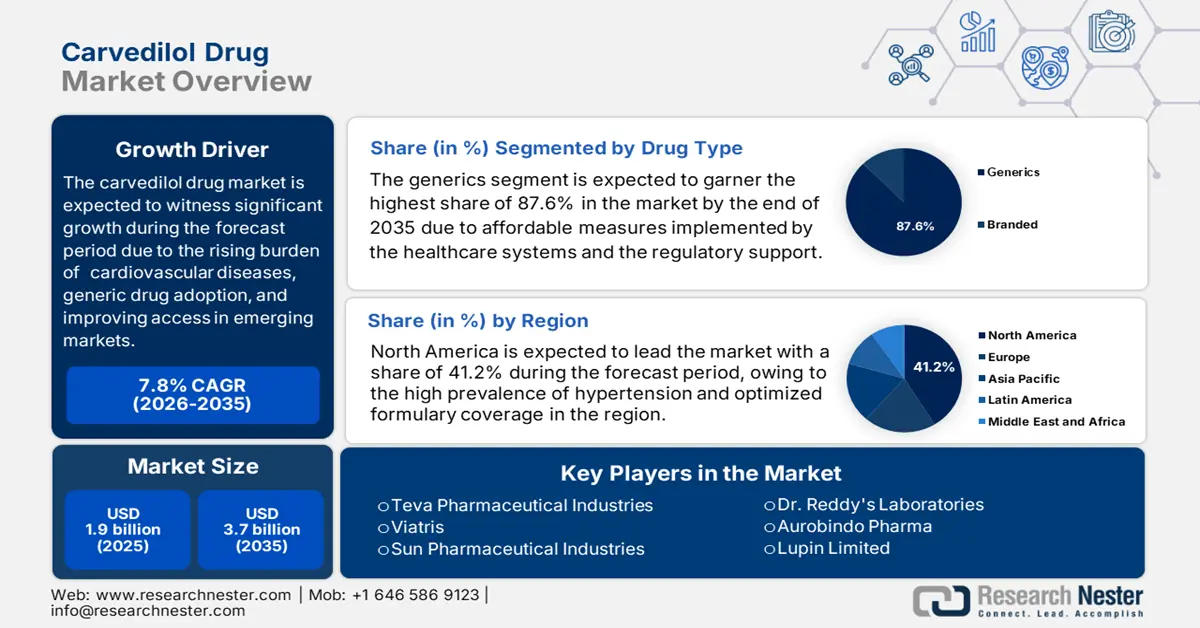
Carvedilol Drug Market size was valued at USD 1.9 billion in 2025 and is projected to reach USD 3.7 billion by the end of 2035, rising at a CAGR of 7.8% during the forecast period, i.e., 2026-2035. In 2026, the industry size of carvedilol drug is assessed at USD 2 billion.
The amplifying cardiovascular disease (CVD)-afflicted population and generic drug adoption in emerging economies are the main driving factors in the carvedilol drug sector globally. The proven efficacy of this drug as a beta-blocker to treat heart failure and hypertension uplifts the sustained demand. Testifying to this substantial nature, the World Health Organization (WHO) states that CVDs account for over 17.9 million yearly deaths, where 4 out of 5 of them are caused by heart attacks and strokes. It also mentioned that 33.3% of these events occur prematurely in people under 70 years of age. This demonstrates the growing need to control CVD comorbidities before worsening.
The supply chain of the market involves a concentrated manufacturing landscape, primarily in China and India. This can be displayed through the 2025 findings from the US Pharmacopeia study, where 32% of API production for all drug products (excl. IV fluids) worldwide originated from India. As a result, the payers’ pricing of these beta-blockers witnesses a year-over-year increase, particularly in the U.S., due to its import dependence. However, better adherence to public affordability thresholds ensures consistency in uptake rates of carvedilol, where a 2022 comparative cost analysis calculated the incremental cost-effectiveness ratio (ICER) of this drug to range between USD 10,902 and USD 34,237 per life-year.