Carbon Capture and Storage Market Regional Analysis:
North American Market Insights
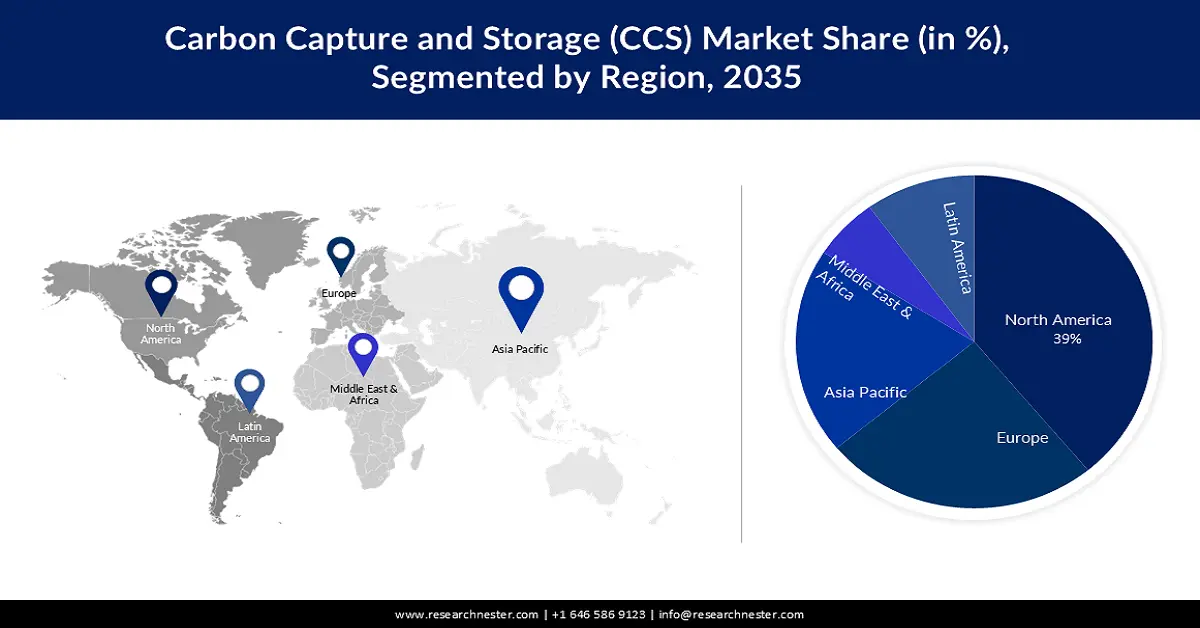
North America region is expected to account for more than 39% market share by 2035, driven by growing investment in clean energy technologies. For instance, in March 2025, the Government of Canada contributed more than USD 11 million in funding, mainly through the Clean Energy for Rural and Remote Communities (CERRC) program. Major funding initiatives and legislative support have also boosted project development, especially in sectors including cement, steel, and power generation. The IEA stated that the U.S. announced investments worth USD 1.7 billion for carbon capture demonstration projects in 2023. Additionally, growing initiatives of net zero will influence the market growth.
The U.S. is witnessing robust policy incentives and active participation from major energy companies. Tax credits have significantly increased the financial attractiveness of CCS projects, while federal infrastructure programs continue to stimulate innovation. According to the Congressional Budget Office, in December 2023, about 15 CCS facilities were operating in the U.S., as of September 2023, which, when combined, can capture about 22 million metric tons of CO2 per year, or 0.4 percent of the United States’ total annual emissions of CO2. The focus is largely on decarbonizing power generation and industrial emissions, with new projects emerging across various states.
APAC Market Insights
The Asia Pacific carbon capture and storage market is set to have significant growth over the forecast period due to the growth in industrialization and rising investments in the expansion of manufacturing facilities. Additionally, the rapid construction of gas and coal power plants and coal mining to meet the region's rising energy demand is anticipated to further hasten the expansion of the Asia Pacific market. In June 2022 National Energy Investment Group, CNOOC, announced the completion of equipment construction for China’s first CO2 offshore storage project. Post operation, the annual CO2 storage was projected to range up to 300 kt.
A study, titled Carbon Capture, Utilisation, and Storage Policy Framework and its Deployment Mechanism in India, was published by NITI Aayog in November 2022. It stated that the NDC aims to achieve 50% of its overall installed capacity from energy sources that are non-fossil-based, a 45% decrease in emission concentration by 2030, and initiating steps towards accomplishing Net Zero by 2070. It further highlights the significance of CCUS as a reduction strategy to attain decarbonization from the hard-to-abate sectors.