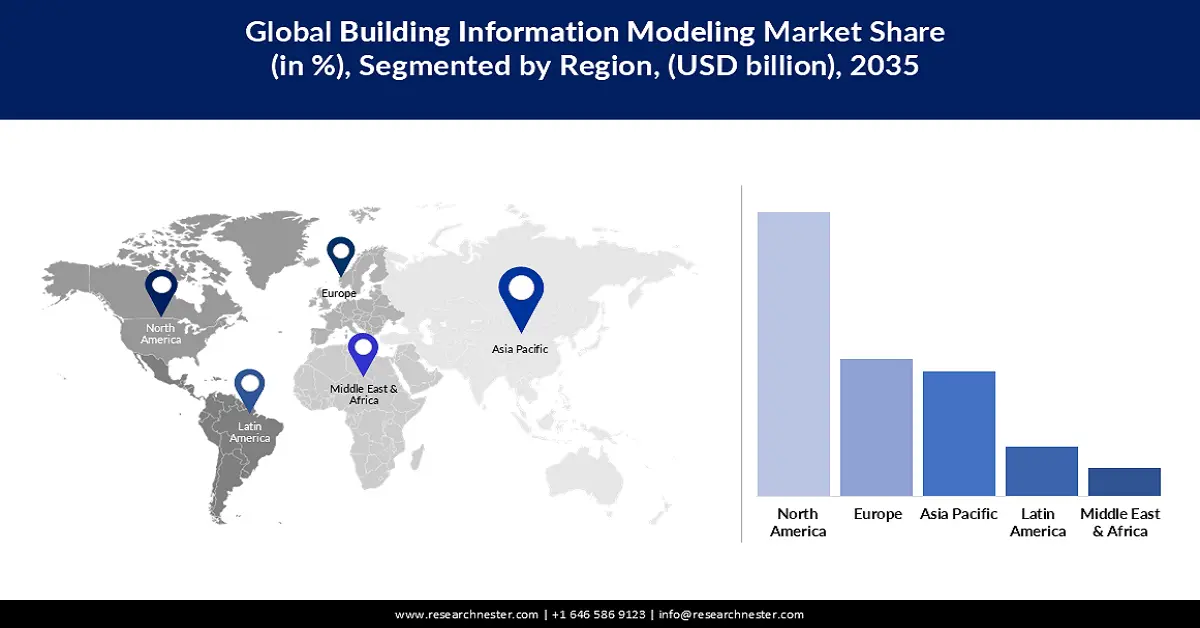
Building Information Modeling Market Regional Analysis:
North America Market Insights
North America region is poised to dominate around 45.5% market share by 2035, due to technological adoption and mandatory BIM regulations. In addition, governments in the U.S. and Canada are supporting the market growth by implementing regulations that require BIM usage in public and private infrastructure projects.
In the U.S., the building information modeling (BIM) market is expected to account for a significant share by 2035. This growth can be attributed to the presence of well-developed infrastructure, increasing funding from various public and private sectors, and the high usage of BIM to design and build energy-efficient buildings. Manufacturers in the U.S. are focused on integrating advanced technologies such as AI, IoT, and digital twins.
The Canada market will expand at a rapid growth rate owing to rising government investments to support urban growth and sustainability goals, high focus on green building, and increasing adoption of advanced technologies for better project and risk management.
Asia Pacific Market Insights
Asia Pacific building information modeling (BIM) market is expected to register lucrative CAGR through 2035, led by rising investments in building and construction activities across the region, rapid urbanization, and the implementation of BIM mandates by governments for public projects to enhance building efficiency and transparency. China, India, Japan, and South Korea are some of the largest revenue-generating countries in the APAC.
In India, building information modeling (BIM) market is likely to generate a significant revenue share throughout the forecast period owing to rising investments by the government in urban infrastructure and initiatives such as the Smart Cities Mission, Housing for All by 2022, and the National Infrastructure Pipeline.
The building information modeling market in China is expected to register robust revenue growth due to massive infrastructure initiatives, the presence of robust key players, and government mandates to support the adoption of BIM in recent infrastructure projects. Shanghai and Beijing heavily rely on BIM to optimize urban planning and resource management.