Brain Fingerprinting Technology Market Outlook:
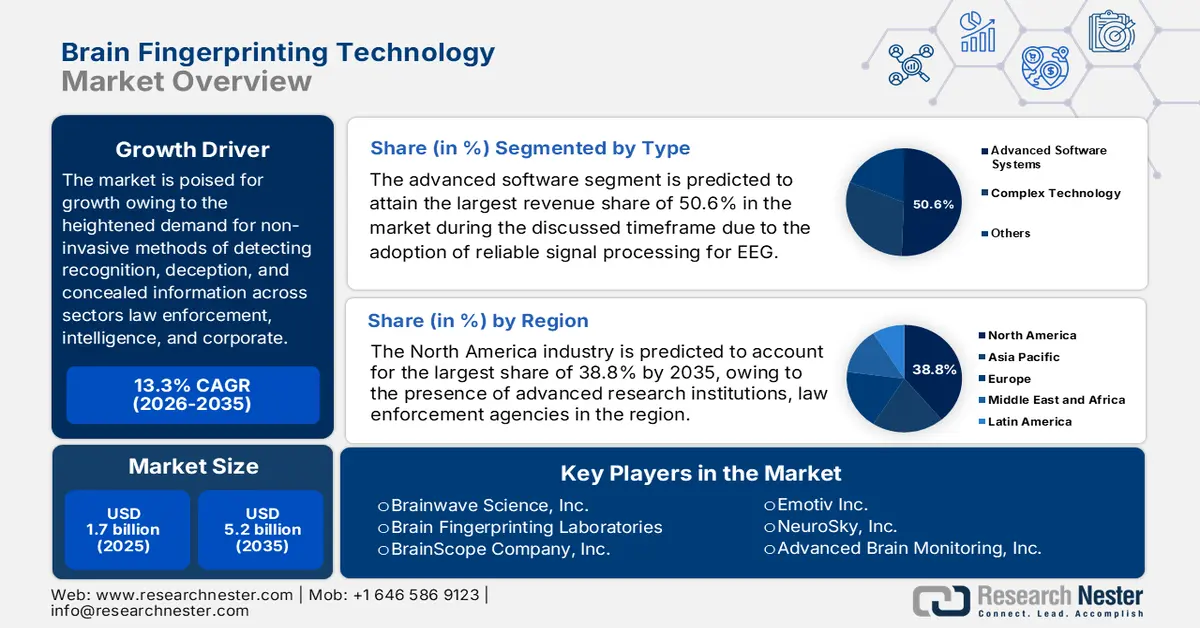
Brain Fingerprinting Technology Market size was valued at USD 1.7 billion in 2025 and is projected to reach USD 5.2 billion by the end of 2035, rising at a CAGR of 13.3% during the forecast period, i.e., 2026-2035. In 2026, the industry size of brain fingerprinting technology is estimated at USD 1.9 billion.
The brain fingerprinting technology market is poised for extensive growth over the years ahead, owing to the heightened demand for non-invasive methods of detecting recognition, deception, and concealed information across sectors such as law enforcement, intelligence, and corporate. In this context, NINDS in 2024 revealed the NIH BRAIN Initiative, which was led by NINDS and NIMH with support from eight other institutes, has invested more than USD 3 billion in over 1,300 research projects to advance tools and technologies for understanding brain function and developing treatments for neurological diseases. It also stated that collaborative efforts, such as the BRAIN Initiative Cell Census Network, have mapped cell types and neuronal wiring. The program also supports adaptive brain stimulation, brain-computer interfaces, and translational projects moving innovations from labs to clinical applications. In addition, the upcoming projects as BICAN, Armamentarium, and BRAIN CONNECTS, aim to expand human brain mapping and circuit analysis capabilities, positively influencing brain fingerprinting technology market growth.
Furthermore, the increasing adoption of EEG and BCI-based systems is enhancing the efficiency of these solutions, driving growth in the brain fingerprinting technology market. As per the article published by NIH in June 2022, brain fingerprinting uses ERP-based EEG signals to detect if an individual has knowledge of a real-life incident, such as a crime. A 2022 study involving around 31 university students and 17 parolees was tested, with BFP correctly classifying most information-present and information-absent subjects, though some false positives, indeterminates, and exclusions occurred. Moreover, each test involved a minimum of 720 trials per subject, which also had rigorous artifact rejection and behavioral accuracy checks to ensure reliable data collection. The results demonstrated high classification accuracy, limitations such as fatigue, eye-blinking artifacts, and incomplete data indicate that BFP is not yet complete or robust for legal use. Nevertheless, the technology shows strong potential for confirming a suspect’s knowledge of crime-relevant details in forensic investigations.