Brain Fingerprinting Technology Market - Regional Analysis
North America Market Insights
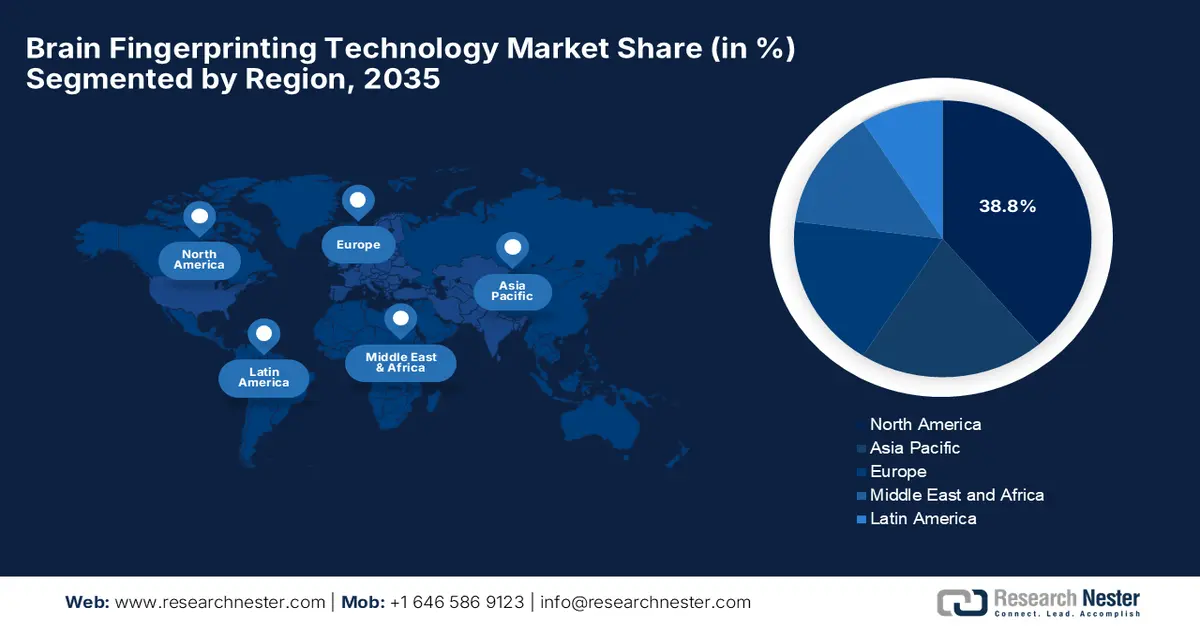
North America is likely to maintain its leadership, contributing around 38.8% of total brain fingerprinting technology market revenues by the end of 2035. The region benefits from the presence of advanced research institutions, law enforcement agencies, and well-funded defense programs. In addition, the increased adoption of neuroimaging and EEG technologies supports both forensic investigations and cognitive research initiatives, also benefiting market growth in the region. Firefly Neuroscience reported that FDA-cleared brain network analytics offer a next-generation approach to neurological assessment by combining advanced AI with a proprietary EEG database. It also mentioned that the platform automatically analyzes event-related potentials, spectral EEG, and behavioral performance data to deliver an evaluation of brain function. Furthermore, this objective, data-driven system enhances the accuracy and efficiency of brain health diagnostics, hence denoting a positive brain fingerprinting technology market outlook.
The U.S. is augmenting its leadership in the brain fingerprinting technology market owing to the commercial and research activity in brain fingerprinting. Agencies focusing on national security, counterterrorism, and criminal investigations are exploring applications that improve interrogation accuracy and forensic evidence collection. Neurovation Labs, in April 2025, announced the issuance of a new U.S. patent, which covers a radiological imaging technology designed to detect GluA1-related brain biomarkers associated with PTSD. It also stated that this patented innovation leverages advanced neuroscience, machine learning, and precision diagnostics to enable objective identification of neurobiological indicators underlying mental health conditions. Therefore, this expansion of Neurovation Labs’ intellectual property portfolio strengthens its efforts to advance biomarker-based diagnosis and treatment across PTSD, traumatic brain injury, and other neurological disorders.
Canada is growing in the brain fingerprinting technology market owing to the strong focus on medical and scientific applications of brain fingerprinting, in which the research is primarily centered in universities and healthcare institutions. The country explores use cases in criminal justice and medical diagnostics by leveraging EEG and advanced neuroimaging to expand the understanding of memory-based recognition. In this regard, researchers from the Baillet Lab in June 2024 published an open-access study in eBioMedicine (The Lancet group) demonstrating that brain-fingerprinting using MEG imaging can distinguish individuals with Parkinson’s disease from healthy controls. The study also identified some unique rhythmic brain activity patterns with high diagnostic accuracy and represented associations between these brain fingerprints and Parkinson’s symptoms. Such findings highlight the capability of brain fingerprints to support earlier diagnosis, symptom monitoring, and more targeted treatment strategies.
APAC Market Insights
Asia Pacific is considered to be the fastest-growing region in the worldwide brain fingerprinting technology market due to rising government interest in security technologies, along with increasing investment in neuroscience research. Simultaneously, the population in this region offers opportunities to test and validate neurotechnologies across different demographics, boosting the development of EEG systems. In April 2025, Toyohashi University of Technology and Caltech announced that their researchers had published a study demonstrating that neural fingerprints derived from EEG data can predict team flow and collaborative performance. It also mentioned that using a rhythm-based cooperative task, the study showcased that individuals with closely aligned neural fingerprints were more likely to achieve synchronized focus and effective teamwork. Therefore, these findings highlight the role of brain-based signatures can informing team formation, training, and performance optimization in environments that require high levels of collaboration.
China is proactively integrating brain fingerprinting technology into forensic and security applications, in which the government-backed programs are supporting AI-assisted EEG analysis and neurocognitive research. The country’s brain fingerprinting technology market also benefits from collaborative efforts between academic institutions and tech companies that are focused on enhancing automated signal interpretation in law enforcement. In June 2025, researchers from the Chinese Academy of Sciences (CAS) and Huashan Hospital, Fudan University, reported that they had launched China’s first-ever human clinical trial of an invasive brain–computer interface in Shanghai. This implantable system demonstrated stable, high-resolution neural signal acquisition and real-time decoding, enabling a patient with limb loss to control digital applications using brain signals alone. Further, by advancing precise brain-signal recording and interpretation, the trial marks a major step in translating neural decoding technologies from laboratory research to real-world applications.
India is at the forefront of developing cost-effective brain fingerprinting solutions, combining academic research with government-backed pilot programs in criminal investigations, driving business in the brain fingerprinting technology market. Innovative approaches, such as portable EEG devices and algorithms that are suitable for rapid recognition of stored information, make forensic applications even more accessible in both urban and rural areas. In this regard, a government-funded project, which was led by Birla Institute of Technology, supported by the Anusandhan National Research Foundation or SERB under the Department of Science & Technology, is advancing cost-effective brain fingerprinting using portable EEG systems. The program is running from 2023 to 2026, whereas the research focuses on deep-learning-based EEG classification and visual image regeneration to identify recognition responses that are relevant to forensic investigations. Furthermore, this official initiative highlights the country’s integration of academic research and government support to develop accessible brain fingerprinting solutions for criminal justice applications.
Europe Market Insights
Europe is one of the largest and most influential landscapes for the brain fingerprinting technology market, which is emphasizing scientific validation, regulatory compliance, and ethical considerations. Research institutions in this region also contribute to developing protocols, software tools, and applications in forensic and cognitive assessment by enabling cross-border collaboration, along with increased adoption. In October 2021, researchers at EPFL, the Swiss Federal Institute of Technology in Lausanne, reported that each person’s brain has a unique brainprint, which is a functional connectivity profile that can identify individuals with near-perfect accuracy. By using short-duration MRI scans of just 100 seconds, they mapped neural networks to capture these distinctive patterns, which could help in the early detection of neurological conditions such as Alzheimer’s. Thus, such a study highlights the potential of brain-based biometrics for identification and medical applications, benefiting the overall brain fingerprinting technology market growth.
Germany is efficiently growing in the brain fingerprinting technology market due to a focus on high-precision neuroimaging and EEG solutions, which are integrating brain fingerprinting into forensic labs and clinical neuroscience centers. The country’s market also benefits from collaborative projects with universities and technology providers advance signal processing techniques. In December 2025, the University of Bonn announced that it had launched a quantum sensor-based optical pumped magnetoencephalography facility at the University Hospital Bonn, which is enabling high-precision brain scans while patients move, overcoming limitations of traditional EEG and MRI. It was funded with nearly €4 million (approximately USD 4.4 million) by the EFRE/JTF program of North Rhine-Westphalia and the EU, and the infrastructure integrates VR tasks and behavioral monitoring to advance both clinical neuroscience and forensic neuroimaging applications.
The U.K. has gained immense exposure in the brain fingerprinting technology market, primarily fueled by forensic and legal applications of brain fingerprinting, combining strong regulatory oversight with innovation in EEG-based detection systems. In addition, the existence of government research councils and academic institutions that work closely with law enforcement to test protocols and ensure that neural data can be used responsibly in criminal investigations. In December 2024, Neuroelectrics and Neuronostics announced that they had entered into a partnership to deliver an integrated EEG platform for clinical trials by combining Neuroelectrics’ wireless EEG systems with Neuronostics’ advanced analytics. This collaboration aims to streamline neurological research by enabling targeted participant selection, precise EEG data analysis, and optimized trial protocols. Furthermore, this integrated solution enhances efficiency and reliability in neurological studies, supporting pharmaceutical, CRO, and academic partners, hence benefiting the overall market growth.