Boron Doped Diamond Electrode Market Outlook:
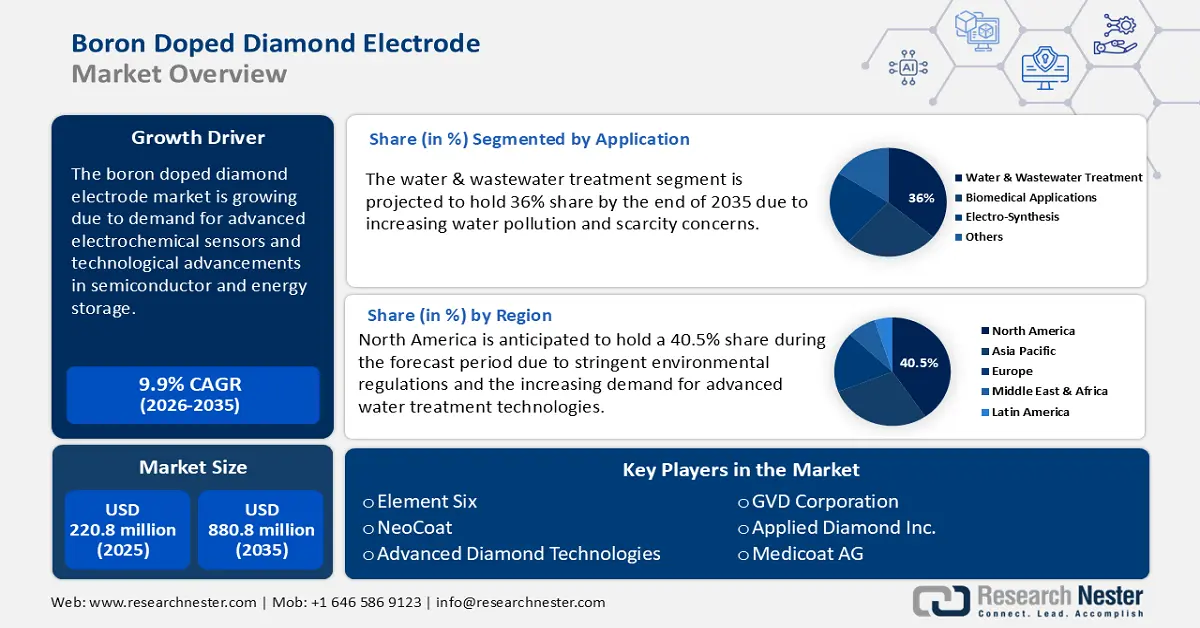
Boron Doped Diamond Electrode Market size was valued at USD 220.8 million in 2025 and is projected to reach USD 880.8 million by the end of 2035, rising at a CAGR of 9.9% during the forecast period, i.e., 2026-2035. In 2026, the industry size of boron doped diamond electrode is estimated at USD 290.9 million.
The global boron doped diamond electrode market is characterized by a multifaceted, complex supply chain consisting of the procurement of ultra-high-purity carbon substrates, boron sources, and advanced chemical vapour deposition (CVD) systems. Japan leads in the commercialization of CVD diamond technologies, supported by substantial public and private sector investments aimed at technological advancement. From January to November 2023, China’s water conservancy projects employed 2.6 million people, up 9.1% year-on-year, including 2.1 million rural workers. Wages totalled 50.5 billion yuan, with 38.1 billion for rural areas. The sector completed 17,881 rural water projects, benefiting 82.1 million residents, while over 4 billion yuan maintained 98,800 existing rural projects. In the U.S., the Department of Energy (DOE) has categorized certain essential materials important to renewable energy innovations, some of which may pertain to components used in BDD electrode manufacturing.
On the technology side, boron doped diamond electrodes are highly used in environmental applications, especially for breaking down stubborn contaminants such as per- and polyfluoroalkyl substances (PFAS). With 100 low-carbon treatment plants expected to be constructed by 2025, a January 2024 recommendation from the plan also combines sewage treatment with carbon emission control. The plan also includes upgrading and extending 45,000 kilometres of sewage collection networks and adding 12 million cubic meters of sewage treatment capacity per day. Although precise producer and consumer price indices are lacking, industry efforts are focused on enhancing cost-efficiency and scalability, reflecting a broader trend toward more affordable and commercially viable BDD technologies.