Body Worn Camera Market Outlook:
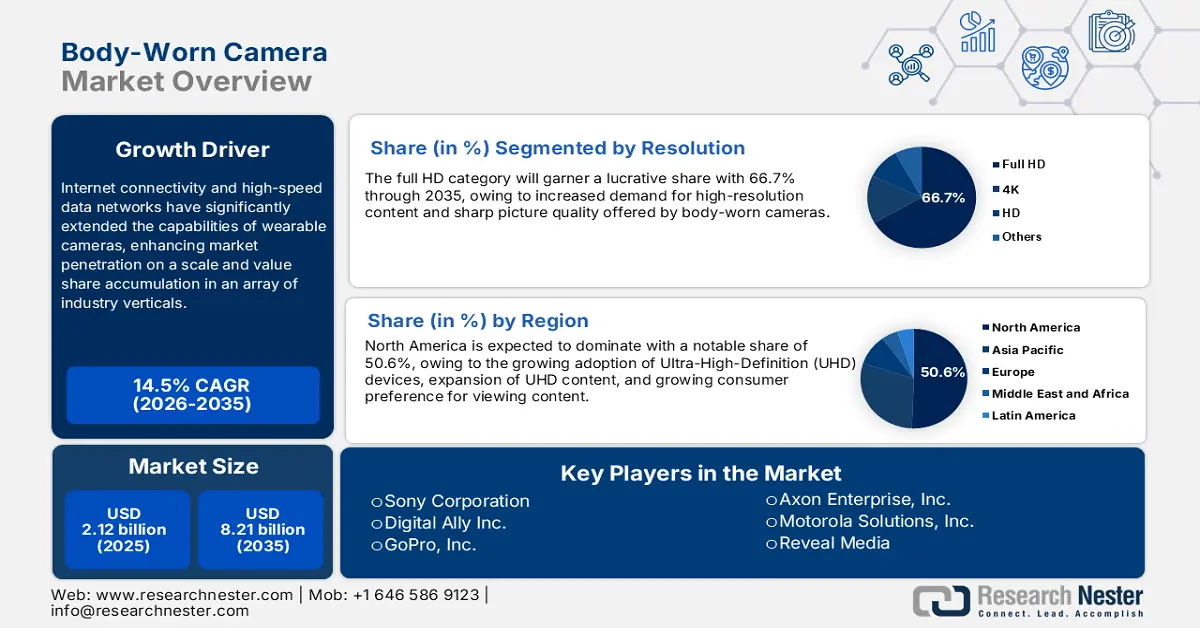
Body Worn Camera Market size was over USD 2.12 billion in 2025 and is poised to exceed USD 8.21 billion by 2035, growing at over 14.5% CAGR during the forecast period i.e., between 2026-2035. In the year 2026, the industry size of body worn camera is evaluated at USD 2.4 billion.
The body worn camera market is driven by a confluence of technological advancements, regulatory changes, and increasing public demand for transparency and accountability in both law enforcement and private security sectors. For instance, in October 2024, Utility Inc. unveiled next-generation public safety solutions and a vision of the future at IACP 2024. New EOS EXO Body worn camera, AI-powered reporting, and unified sister brands set the gold standard in public safety innovation.
The body worn cameras are instrumental in fostering the clarification of operations, improved evidence collection, and accountability. In addition, advancements in camera technology have come to encompass higher resolution, longer battery life, and improved data storage solutions that lead to greater reliability and cost-effectiveness in BWCs. For instance, in October 2024, Veritone, Inc. announced that Getac Technology Corporation, offered its customers Veritone Redact, an AI-powered software designed to streamline the redaction process for body worn cameras, in-car video, interview rooms, and transport camera footage. The Evidence Management System by Getac will thus incorporate this Redaction of Veritone so that law enforcement agencies get an advanced tool meant for video evidence management under privacy regulations.
State and federal government mandates and regulations now require BWCs in many countries as part of standard law enforcement protocols, which further fuels body worn camera market growth. Concurrently, the growing integration of BWCs with cloud storage, AI-driven analytics, and real-time streaming capabilities is enhancing functionality, which is increasingly becoming a useful tool in both real-time monitoring and post-event analysis. Thus, the market size of body worn cameras is likely to continue growing across the various sectors with improved security, efficient management of data, and increased public trust and accountability.