Body Composition Analyzers Market Outlook:
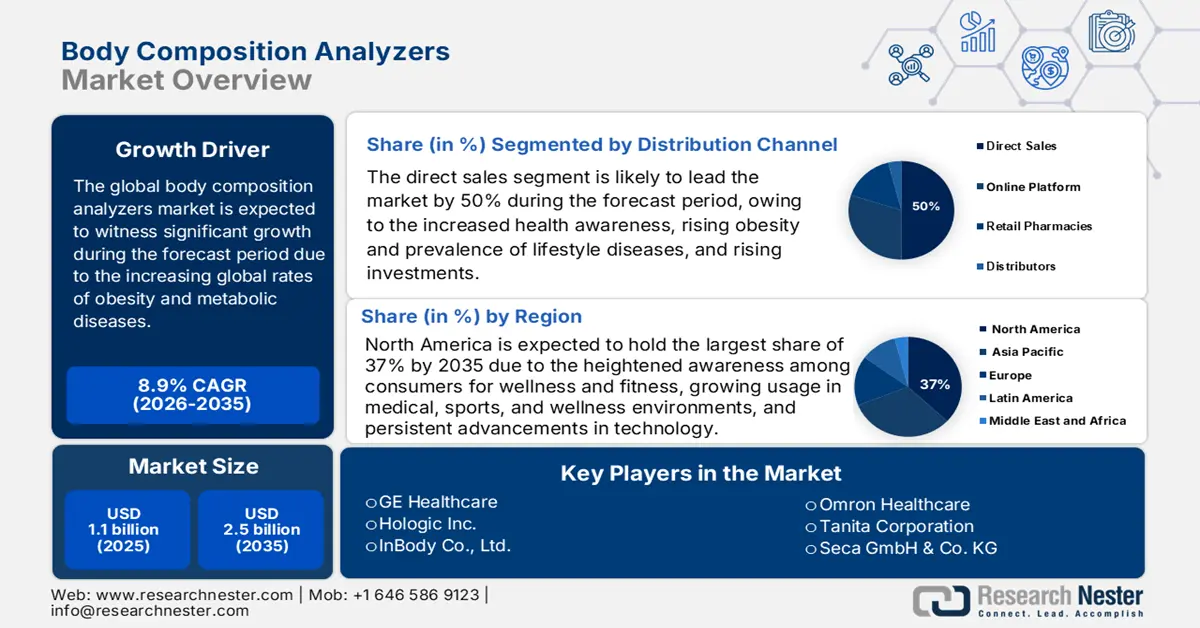
Body Composition Analyzers Market size is valued at USD 1.1 billion in 2025 and is projected to reach USD 2.5 billion by the end of 2035, rising at a CAGR of 8.9% during the forecast period, i.e., 2026‑2035. In 2026, the industry size of body composition analyzers is estimated at USD 1.2 billion.
The market is growing due to increasing global rates of obesity and metabolic diseases in both clinical and wellness environments. Consistent user engagement at diagnostic centers and fitness facilities reflects a desire for personalized health evaluations. As per a study by the CDC in September 2024, most U.S. adults have at least one chronic illness, with obesity in adults being 40.3%, which accounts for a huge amount of total healthcare expenses, emphasizing the importance of continuous monitoring devices, such as bioimpedance, for reducing emergency visits and hospital stays. Besides, R&D investments are supported by government healthcare budgets and policies encouraging local manufacturing of medical devices and APIs.
For the body composition analyzers industry, the 3DO scanner shows strong accuracy and reliability across diverse populations. Moreover, the July 2023 NLM report demonstrated that fat-free mass and fat mass measurement by the 3DO scanner closely agreed with the standard DXA method, with concordance scores as high as 0.9 and 0.9, respectively. The device performs well in terms of body sizes, gender, and ethnicity, thereby qualifying as an instrument acceptable for application to a large population base. According to a report by the NLM in September 2024, with 51 hospitals and 1,000 clinics across seven states. Besides, providence Health is a major brand in the western US. Reusable gowns offer the dual benefits of reduced medical waste and carbon emissions, along with cost savings, improved comfort, and reduced supply chain dependencies. The helps identify the major component suppliers and final markets, whereas the supply and consumer price indexes generally follow the coarse trend shown by medical device prices monitored by industry groups.