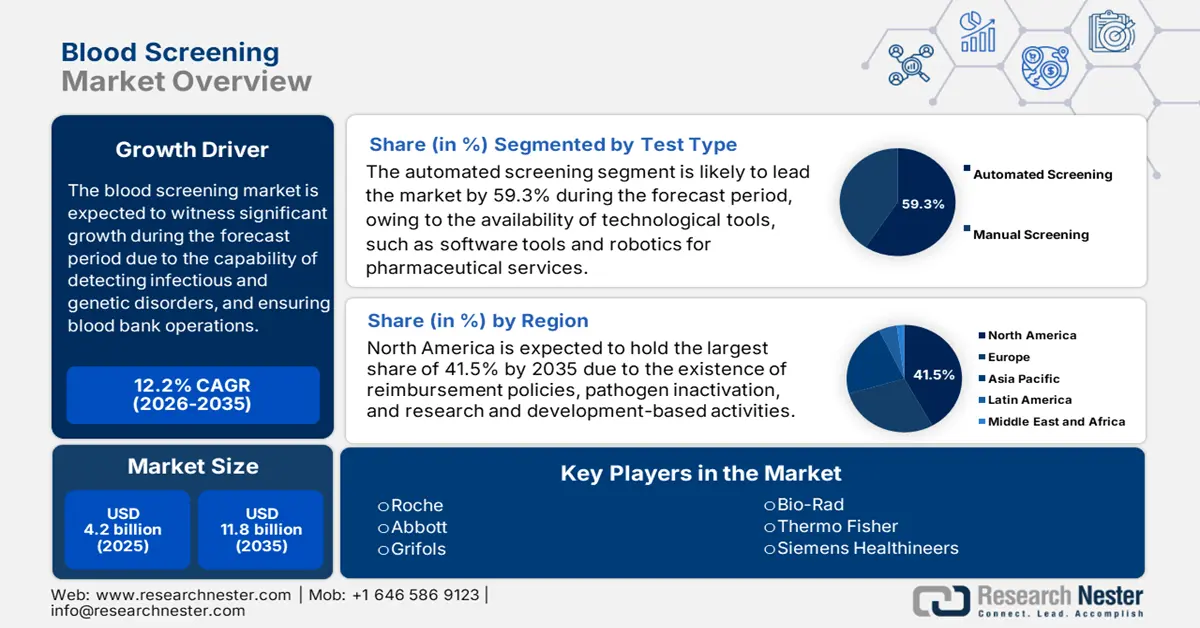
Blood Screening Market Outlook:
Blood Screening Market size was USD 4.2 billion in 2025 and is predicted to reach USD 11.8 billion by the end of 2035, increasing at a CAGR of 12.2% during the forecast period, i.e., 2026-2035. In 2026, the industry size of blood screening is assessed at USD 4.7 billion.
The international market readily encompasses services, products, and technologies to effectively detect genetic disorders, infectious diseases, such as Zika, hepatitis B/C, and HIV, and other contaminants. In addition, the market has also ensured compliance, transfusion safety, and suitable blood bank operations. According to an article published by the CDC in May 2024, parents with any disease have the ability to pass 50% of the gene-based disease to their children. Besides, if both parents are affected by diseases, then there is a 25% chance that their children will be affected. Therefore, blood screening allows early diagnosis to ensure timely management and interventions, thus suitable for the overall market’s growth.
Moreover, a surge in blood transfusion volumes, strict government policies, and technological innovation are also driving the market’s growth across different nations. As per an article published by NLM in June 2023, blood product transfusion takes place through intravenous tubing with filters, usually comprising 170 to 260 microns. The purpose is to successfully combat debris from being administered. Besides, blood components can be provided through different central venous access devices by considering certain sizes. This includes 20 to 22 gauge for routine and 16 to 18 gauge for rapid transfusions among adults, along with 22 to 25 gauge for pediatrics, thereby denoting a positive outlook for the market.