Bismaleimide Monomer Market Outlook:
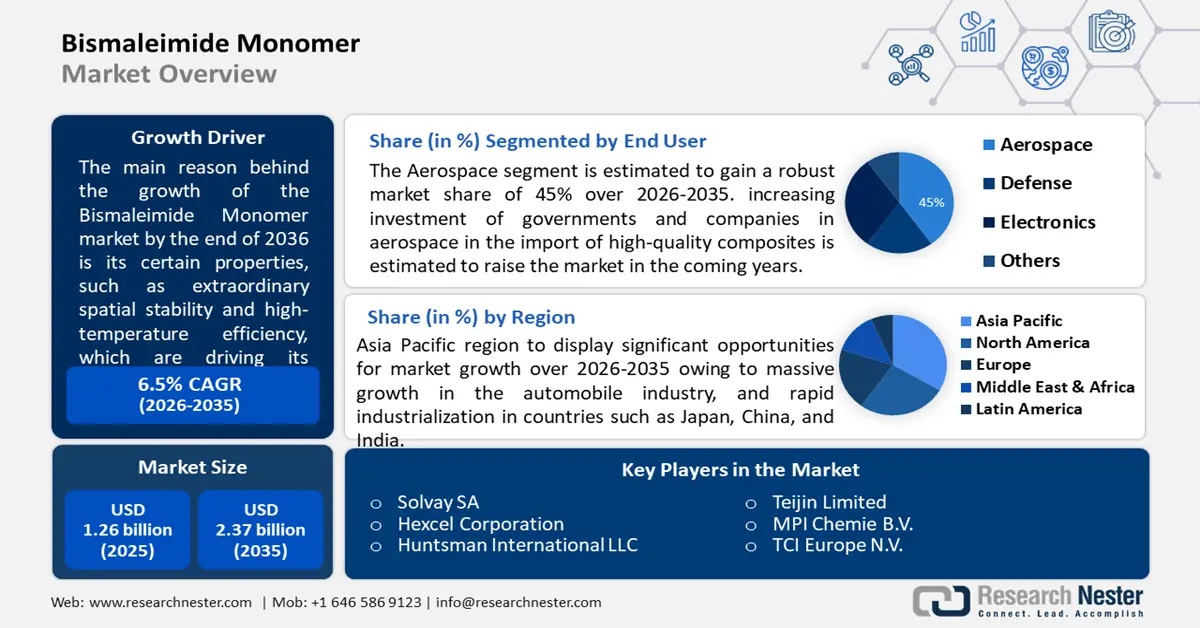
Bismaleimide Monomer Market size was over USD 1.26 Billion in 2025 and is projected to reach USD 2.37 Billion by 2035, growing at around 6.5% CAGR during the forecast period i.e., between 2026-2035. In the year 2026, the industry size of bismaleimide monomer is evaluated at USD 1.33 Billion.
The growth of the market is primarily attributed to its certain properties, such as extraordinary spatial stability and high-temperature efficiency, which are driving its demand, particularly in the booming aerospace, automotive, and electrical & electronic industries. For instance, since mid-2020, the global electronics industry demonstrated positive growth. As part of this evolution, electronics exports in several major APAC electronics manufacturing hubs continued to grow strongly till the mid of 2022. South Korean ICT exports increased by 19% year on year to USD 124 billion in the first 6 months of 2022, making up 36% of total South Korean exports, whereas India's total electronics exports have boosted by 44% year over year to USD 12 billion since the previous financial year 2021–22.
Bismaleimides are addition-type polyimides that are employed in high-performance structural composites that need high temperature and toughness. Monomers are generally created by combining maleic anhydride and aromatic diamine, and the resulting bismaleamic acid is cyclo-dehydrated to form a bismaleimide resin. The maleimide double bond is highly reactive and can undertake a chain reaction. Bismaleimides have a higher service temperature than epoxies. Insulating materials have been becoming more popular in the growing aviation, computer, and construction industries. As per the World Bank, worldwide industrial growth (including the construction industry) reached up to 28.3% in 2021.