Bioresorbable Coronary Scaffolds Market - Regional Analysis
North America Market Insights
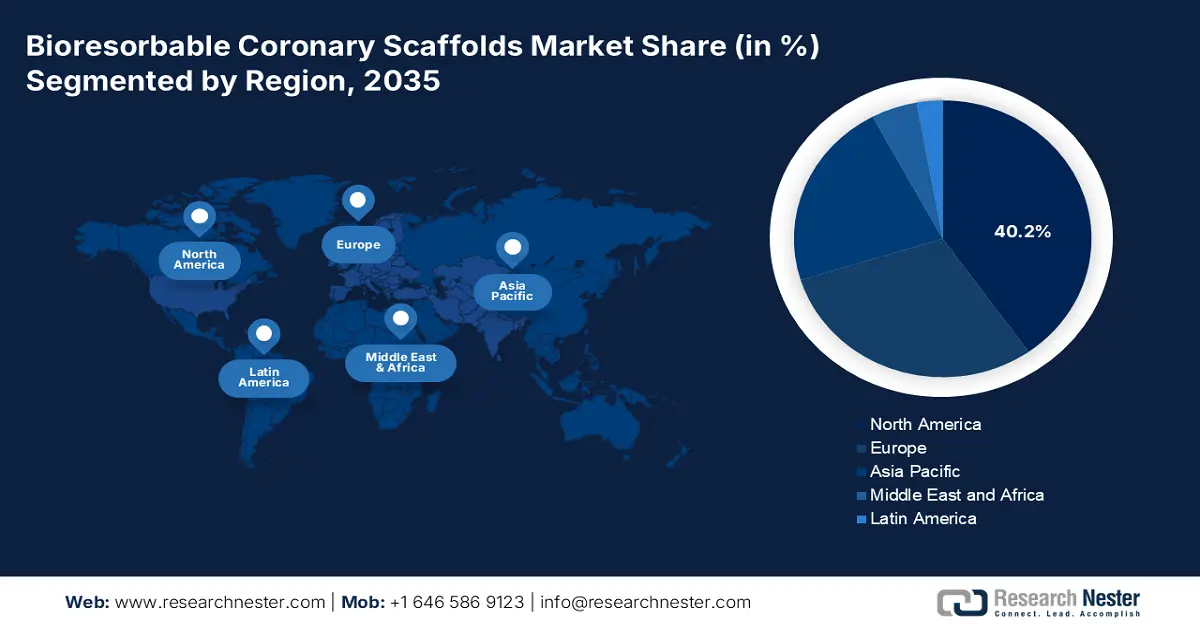
North America is predicted to show dominance over the market by garnering the highest revenue share of 40.2% over the analyzed period. The major drivers behind its forefront position are continuously magnifying patient volume and advancing the healthcare system across mature economies, including the U.S. and Canada. In this regard, the CDC data in October 2024 reported that the heart-related disease cost USD 417.9 billion in 2021, and 371,506 people in 2022 have died due to coronary heart disease. Besides, the ongoing integrations of next-gen technology in CVD interventions, with strong financial support from insurers empower the region's global significance as a lucrative landscape in this field.
The U.S. is augmenting leadership in the regional bioresorbable coronary scaffolds market with efforts to strengthen nationwide public access to advanced care. Recent expansions in Medicare coverage and provincial Federal funding are also making notable contributions to this cohort. The NLM article in November 2024 states that over five years, patients treated at COAP-participating hospitals incurred USD 3,861 less in downstream costs (95% CI: USD 1,794–USD 5,741), primarily due to reduced healthcare utilization during quarters when patients remained alive. Moreover, despite the persistent gap in accessibility, the country's efforts to improve such disparity are establishing a strong foundation for this sector.
The Canada market is defined by a single-payer system in which provincial health authorities decide on coverage based on health technology assessment (HTA). The main trend is the centralized evaluation process carried out by the Canadian Agency for Drugs and Technologies in Health (CADTH), providing provinces with reimbursement recommendations. Access to the market depends on demonstrating not only Health Canada regulatory approval, but also cost-effectiveness and clinical merit relative to permanent drug-eluting stents. This leads to a planned and evidence-based adoption strategy. Federal and provincial health expenditure, as monitored by the Canadian Institute for Health Information (CIHI), is concentrated on cost-effective interventions.
Cardiovascular death rate: crude versus age-standardized
|
Year |
Crude per 100,000 |
Age Standardization per 100,000 |
|
2020 |
275.7 |
133.0 |
|
2021 |
279.8 |
134.2 |
|
2022 |
276.6 |
129.5 |
Source: Our World in Data 2022
APAC Market Insights
The Asia Pacific bioresorbable coronary scaffolds market is estimated to propagate with the highest CAGR in the world by 2035. Its progressive pace of growth is highly fueled by the aging population, increased CVD occurrence & mortality, and government initiatives. For instance, the NLM study in August 2025 has stated that the prevalence of cardiovascular disease is set to rise by 90% from 2025. Similarly, the Ministry of Health, Labour and Welfare (MHLW) projected the proportion of older citizens, is expected to have a high prevalence of disease. This demography further pushes individual governments to reinforce advanced technologies and universal solutions in the cardiac care industry, securing a sustainable consumer base for both domestic and foreign pioneers in this sector.
China is embarking on its leadership in the APAC bioresorbable coronary scaffolds market with its exceptional domestic medical instrument manufacturing and raw material supplying abilities. With an aim to offer comprehensive pricing, the country is highly focused on enhancing the affordability of available products in this field. For instance, the NLM study in November 2023 depicts that the care cost for CVD ranges from 6,103 CNY to 98,637. Additionally, the country's expansion in this field is bolstered by government-mandated procurement programs that increase its ability to reach greater levels.
India is also dominating the region with the increasing prevalence of CVD making it with a significant growth potential. As per the NLM report in November 2024, the prevalence of cardiovascular disease in India is approximately 272 per 100,000 people. The Indian Council of Medical Research (ICMR) highlighted cardiovascular diseases as a major cause of mortality within the nation and motivated the government to improve cardiac care facilities and access, although cost is a major hindrance. This growing disease burden is expected to accelerate demand for advanced interventions such as bioresorbable coronary scaffolds in tertiary and specialty cardiac centers across India.
Europe Market Insights
Europe's market is propelled by the strong regulatory control by the European Medicines Agency and the diverse reimbursement environments across the member states. The market driver leading the market is the increasing incidence of coronary artery disease, with an increasing population of aging people requiring advanced interventional products. As per the WHO report in May 2024, nearly 42.5% of adults die due to CVDs, indicating 10,000 deaths every day. The main trend in the leading role of health technology assessment organizations, such as Germany's G-BA and France's HAS, critically assess on clinical benefit and cost-effectiveness prior to allowing market access and setting price.
Germany is expected to have the largest revenue share in Europe due to its EU-largest population and well-funded, fast healthcare reimbursement system. The Federal Ministry of Health manages a system under which mandatory benefit assessments are performed by the Federal Joint Committee (G-BA). A favorable G-BA result is the major determinant for success in the market since it negotiates prices directly with manufacturers. Germany's robust medtech sector and high rate of PCI procedures per capita further confirm its leadership, backed by strong healthcare spending and willingness to embrace new technologies that prove patient benefit.
France will continue as a leading market, defined by its centralized assessment process through the French National Authority for Health (HAS). The rising incidence of cardiovascular disease and the increasing use of advanced scaffold technologies are driving the market. As per the World Heart Federation report in 2025, nearly 152,728 deaths occurred in 2021. This growth aligns with the country’s value-based healthcare and rigorous reimbursement criteria via the French National Authority for Health. Further, the continuous R&D and positive clinical results highlight the long-term cost-effectiveness and patient benefits of bioresorbable scaffolds support market expansion.