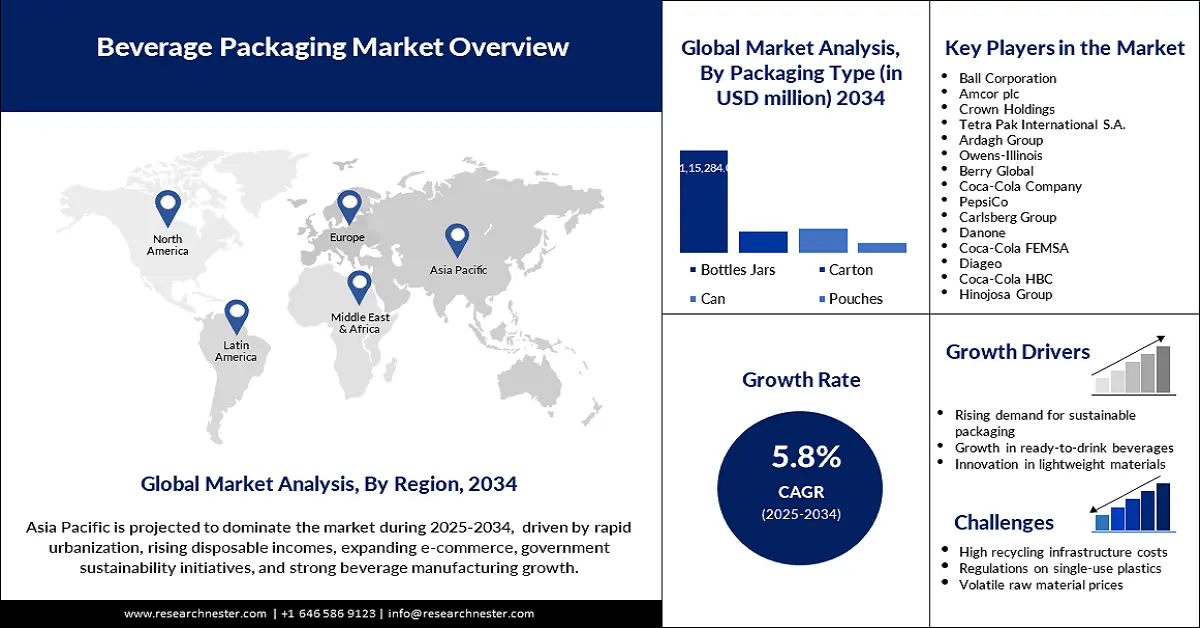
Beverage Packaging Market Outlook:
Beverage Packaging Market size was valued at USD 93.9 billion in 2024 and is projected to reach a valuation of USD 165.3 billion by the end of 2034, rising at a CAGR of 5.8% during the forecast period, i.e., 2025-2034. In 2025, the industry size of beverage packaging is estimated at USD 99.4 billion.
The beverage packaging market is undergoing considerable expansion as brands and manufacturers invest in sustainability, innovation, and visual differentiation. For instance, Kellanova reduced plastic use in packaging on Cheez-It Snap'd and Club Crisps in December 2023, removing 124,000 pounds of plastic and 548,000 pounds of cardboard annually. This action aligns with a broader industry trend towards sustainability and efficiency in packaging. Packaging redesigns are also gaining popularity at the same time, as Impossible Foods launched powerful red packaging in March 2024 to stand out and acquire new customers beyond the plant-based sector. Smart labeling and oxygen scavengers are also employed by firms to enhance shelf life and encourage traceability. Governments are also introducing stricter controls, such as India's July 2024 Extended Producer Responsibility guidance, which demands greater rPET adoption and more ambitious recycling targets of drink companies.
One of the major opportunities in the market is to adopt new, lighter, and recyclable materials. In May 2024, Diageo piloted paper bottles with Baileys Irish Cream, introducing 2,000 small bottles that weigh five times less than glass and aim to reduce carbon emissions. Brands like Nestlé and Paper Boat have introduced recyclable packaging for premium beverages and flexible pouches, with consideration to shifting consumer views towards sustainability. Regulatory efforts are also contributing to the trend, with California mandating a minimum level of 15% post-consumer recycled content in beverage bottles from January 2024, up to 50% by 2030. These developments reflect a shift towards circular economy models and packages that balance convenience, safety, and sustainability.