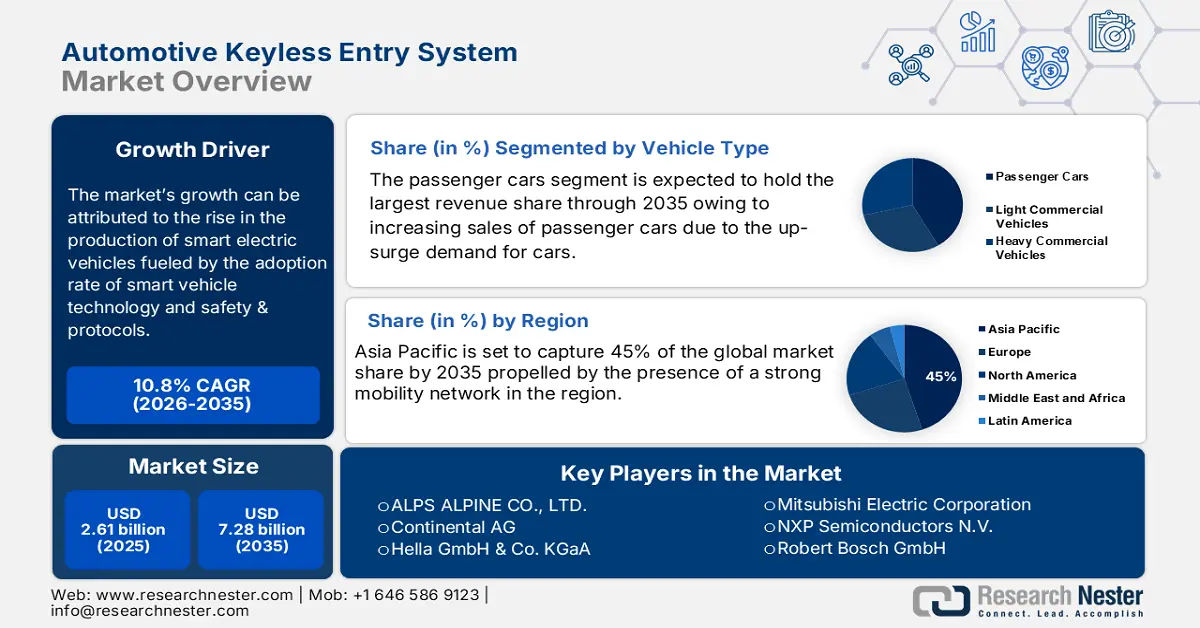
Automotive Keyless Entry System Market Outlook:
Automotive Keyless Entry System Market size was over USD 2.61 billion in 2025 and is projected to reach USD 7.28 billion by 2035, witnessing around 10.8% CAGR during the forecast period i.e., between 2026-2035. In the year 2026, the industry size of automotive keyless entry system is evaluated at USD 2.86 billion.
The growth of the market can be attributed to the up-surged production of smart electric vehicles, backed by the higher adoption rate of smart vehicle technology and safety & protocols. The automotive keyless entry system is a basic need in the upcoming models of cars when automobiles are getting smarter Y-O-Y. For instance, in 2021, approximately 6 million units of electric vehicles (EVs) were sold out across the globe and it was further projected that in every 200 cars on the road, 1 of them is the smart electric vehicle.
An automotive keyless entry system is used to remotely lock, unlock, and start a car’s engine without using a mechanical key, using radio frequency (RF) signals. Nowadays, most keyless entry systems use a transmitter fob to generate the lock and unlock signals. Modern keyless entry systems use a key fob with two or more buttons to control the locks, trunk, or windows, sending a radio frequency signal to a receiver unit within the car, usually from a range of about 15 to 45 feet, when one of the buttons is pushed. With the increasing advancements in technology as well as rising demand for vehicles, the demand for keyless entry systems is on the rise among automobile users, which in turn, is expected to create massive revenue generation opportunities for the key players operating in the global automotive keyless entry system market during the forecast period. For instance, as per the data released in 2022 by the Federation of Automobile Dealers Associations (FADA), there was an increase in total vehicle retail, 204%, and 278% in passenger vehicles (PV) and commercial vehicles (CV) respectively in India.