Artificial Intelligence in Healthcare Market Regional Analysis:
APAC Market Insights
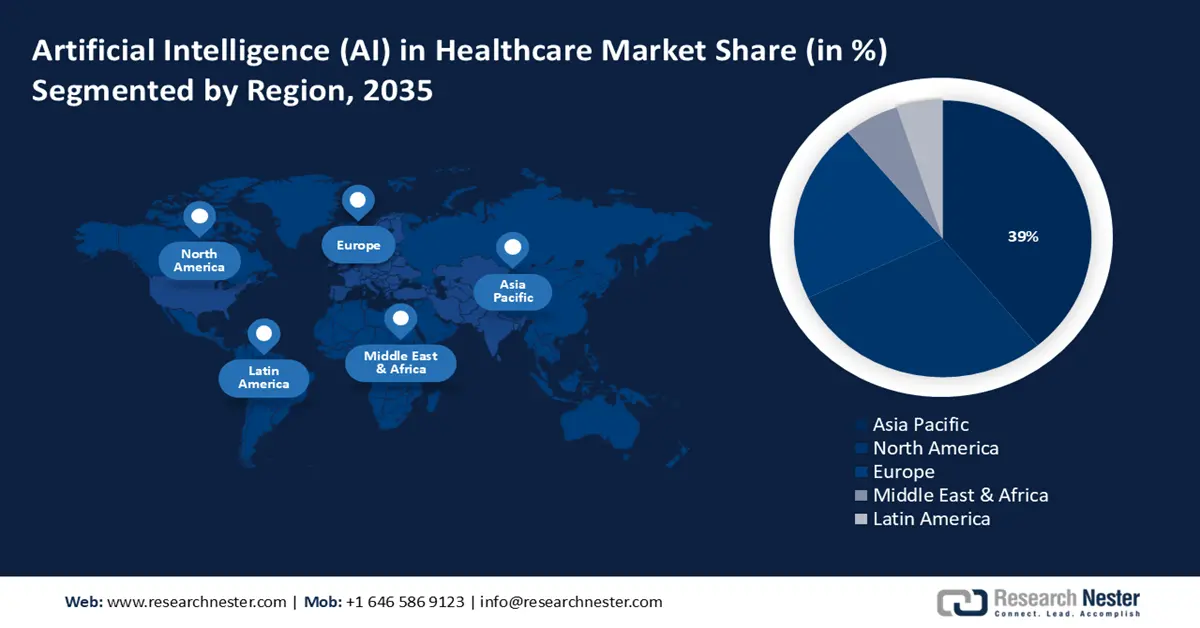
Asia Pacific is predicted to dominate the AI in healthcare market with a share of 39% throughout the analyzed timeframe. The region has become an emerging landscape for global leaders due to several growth factors, such as the rapidly aging population, large pharmaceutical industry, and government initiatives. The efforts from research-oriented medical institutions are also propelling expansion in this sector. For instance, in September 2024, Nanyang Technological University, Singapore and the National Healthcare Group (NHG) collaboratively constructed a center of excellence to establish innovative AI technologies and their practical applications in medicine.
India is propagating the market with broader scope of application and increasing economic contribution. The country is meticulously engaging resources to retain its progression in pharmacology, medical device production, and infrastructural upgradation. This is influencing associated organizations to integrate advanced technologies for enhanced outcomes, fueling adoption in this sector. This is testified by the IBEF report, which estimates the financial output of AI in healthcare to range between USD 25.0 billion and USD 30.0 billion by 2025.
North America Market Insights
North America is also claiming a significant share in the artificial intelligence (AI) in healthcare market by the end of 2035. The region is home to several MedTech pioneers, such as NVIDIA Corporation, Google LLC, Salesforce, and others, which indicates its significance in global revenue generation. The enlarging geriatric population, medical expenditure, and telemedicine industry in this region are embarking on increased AI implementation in various medical disciplines. On this note, Research Nester concluded North America to be the dominating landscape in the virtual healthcare delivery industry by 2035, with the largest share of 46.0%. Another robust survey of 800 respondents revealed an 86.0% penetration of AI in medical organizations across the U.S.: Medscape & HIMSS AI Adoption by Health Systems Report 2024.
The U.S. is leveraging its regional proprietorship with a surge in personal caregiving for older citizens, where an NLM article projected the 85-and-older and 65-and-older population to surpass 19.0 million and 75.0 million, respectively, by 2050. On the other hand, in 2024, the number of assisted living communities in this country crossed 30,600: American Health Care Association. This highlights the need for workforce cultivation to cope with the demand for dedicated caregivers and monitoring systems. The market is helping the nation to solidify a strong network of service-providing channels, fostering profitable business opportunities.