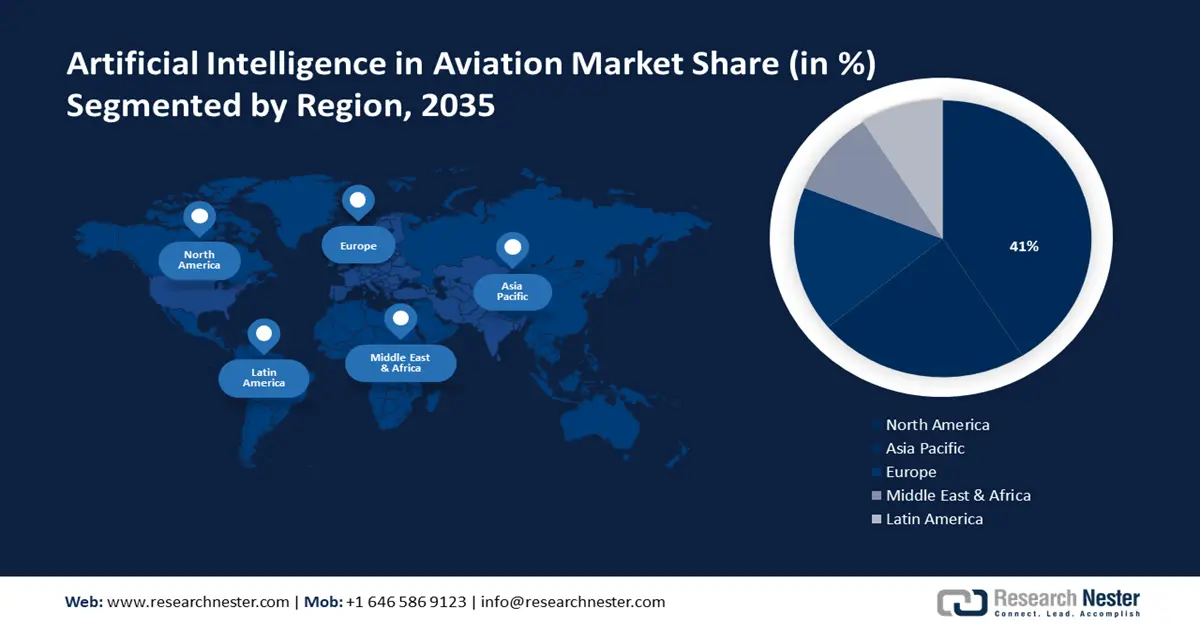
Artificial Intelligence in Aviation Market Regional Analysis:
North American Market Insights
North America industry is poised to dominate majority revenue share of 41% by 2035. The landscape's substantial growth in the region is expected credited to the surge in industrialization, along with advanced technological infrastructure, which has a strong emphasis on innovation.
According to the United Nations Industrial Development Organization, in industrial sectors, there was an increase of about 2.3%, which includes mining, electricity, manufacturing, and many more.
Owing to the presence of air transport infrastructure in the United States, aircraft cabin interiors, and many more that are well-established is slated to act as a growth driver for this landscape. According to the International Air Transport Association, there is an increase of about 28% in annual traffic in 2023 as compared to 2022.
The increase in the number of air travelers in Cananda along with the surge in air travel is credited to be a growing factor for the growth of this industry. According to the International Air Transport Association, Canada is predicted to grow by 51% by 2028.
APAC Market Insights
The Asia Pacific region will also encounter a huge influence on the AI in aviation market expansion during the forecast period and will account for the second position attributed to the increasing investments in the development of infrastructures in airlines for impacting tourism in this region. According to ASEAN, Southeast Asian airlines will require more than 2000 airliners in the coming 20 years.
Owing to the increasing congestion at Beijing Airport, China, Alibaba Holding Limited has announced an AI-based solution to remove this problem.
There has been an increase in artificial intelligence which will increase the market demand of artificial intelligence in aviation sector in Japan. Japan's government is investing more than USD 3 billion to spread the AI industry and increase research activities in private and institutional enterprises.